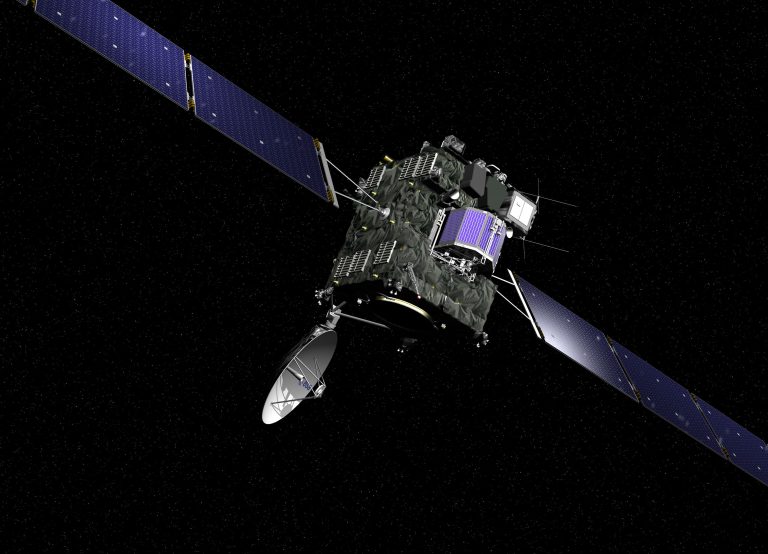
Rosetta

Credit: ESA

Rosetta

The Rosetta mission is a historic space mission by the European Space Agency (ESA), designed to study the origin and evolution of comets. Originally, the mission was scheduled to rendezvous with comet 46P/Wirtanen, but following the postponement of the initial launch in January 2003, a new target was designated: comet 67P/Churyumov-Gerasimenko.

Rosetta made history by becoming the first spacecraft to orbit a comet and deploy a lander (Philae) on its surface.

The role of IAS

The Institut d'Astrophysique Spatiale (IAS) played a major role in the Rosetta mission:

On the Philae lander

  • Responsible for the panoramic imaging and infrared microscopy systems (CIVA experiment);

    • CIVA (Comet Infrared and Visible Analyser) enabled the acquisition of the first in situ images of a cometary nucleus;

On the Rosetta orbiter

  • Participation in the COSIMA mass spectrometer (COmetary Secondary Ion Mass Analyser);

  • Contribution to the VIRTIS spectral imager (Visible and Infrared Thermal Imaging Spectrometer).

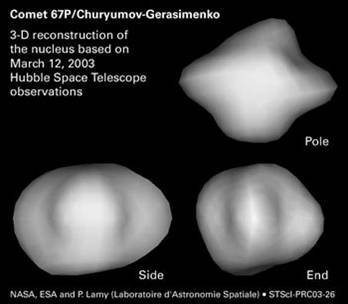
3D model of the nucleus of 67P/Churyumov-Gerasimenko, Rosetta's new target. (Based on HST images, NASA/ESA/P. Lamy).

Archived

  • January 2003: Postponement of the initial launch (original target: comet 46P/Wirtanen);

  • February 2004: Launch of the Rosetta spacecraft from Kourou (French Guiana);

  • 2005 – 2014: Interplanetary cruise (gravitational assists around Earth and Mars);

  • August 2014: Rendezvous with comet 67P/Churyumov-Gerasimenko;

  • November 2014: Landing of Philae on the cometary nucleus (first-ever landing on a comet);

  • 2014 – 2015: Study of the comet from its awakening to perihelion (August 2015);

  • September 2016: End of mission (controlled touchdown of Rosetta on the comet).

  • 2004 – 2014: The Journey

    • Flybys of Earth (2005, 2007, 2009) and Mars (2007) for gravitational assists;

    • Flybys of asteroids Šteins (2008) and Lutetia (2010);

    • Hibernation of the spacecraft between 2011 and 2014 to conserve power.

  • 2014: Arrival at destination

    • August 2014: Rosetta enters orbit around 67P/Churyumov-Gerasimenko;

    • November 2014: Philae lands on the comet (landing site: Agilkia);

    • First in-situ images of the cometary nucleus (thanks to CIVA, developed by IAS).

  • 2015: Peak activity

    • August 2015: Comet passes its perihelion (point closest to the Sun);

    • Study of gas and dust jets emitted by the comet;

    • Data analysis from the COSIMA and VIRTIS instruments.

  • 2016: The end of the mission

    • September 2016: Rosetta concludes its mission by landing on the comet for close-up observations.

Philae (lander), CIVA, COSIMA, VIRTIS

Leave a comment

Your email address will not be published. Required fields are marked with *

Scroll to top