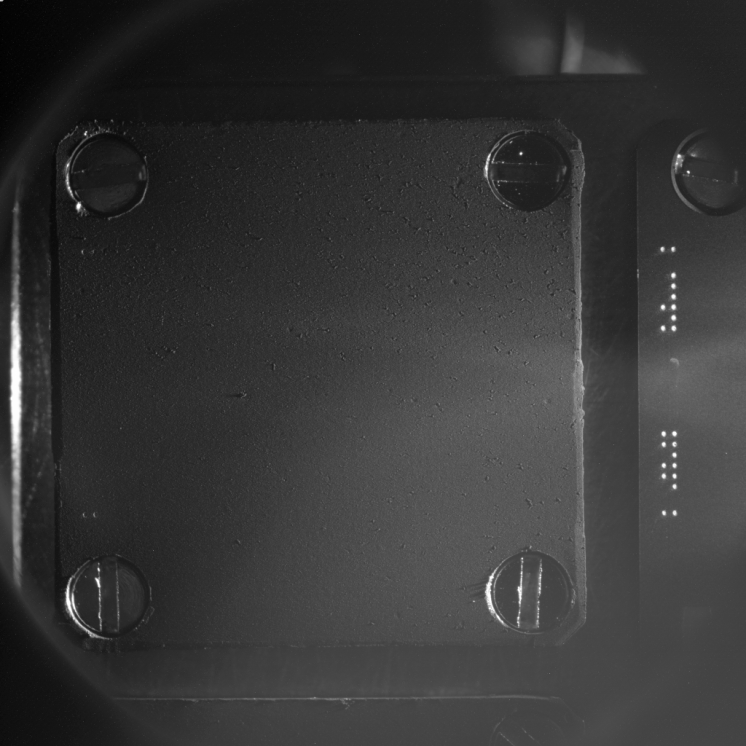
Image of an initial target captured by the COSISCOPE camera before exposure to cometary dust in late July 2014. The light is coming from the right at a low angle, and the image resolution is 14 µm per pixel. The collection target (10 x 10 mm, left and center) consists of a sheet of gold covered with a thin layer of gold nanoparticles (“metallic black”). As this image shows, the target is almost entirely devoid of optical signatures prior to exposure, which should make it relatively easy to identify the collected cometary grains.

Credits: ESA/Rosetta/MPS on behalf of the COSIMA team/MPS/CSNSM/UNIBW/TUORLA/IWF/IAS/ESA/BUW/MPE/LPC2E/LCM/FMI/UTU/LISA/UOFC/vH&S

The first collection of cometary grains has begun for the COSIMA mass spectrometer aboard the Rosetta spacecraft

The COSIMA instrument aboard the Rosetta spacecraft will obtain the first high-resolution mass spectra of grains collected in the immediate vicinity of a comet. COSIMA’s camera, COSISCOPE—developed by the Institute of Space Astrophysics—will make it possible to identify and characterize the collected cometary grains.

The COSIMA instrument is under the responsibility of the Max Planck Institute for Solar System Research (Göttingen, Germany). Dust densities beyond 3 astronomical units (450 million km, the current distance between the Sun and Comet 67P/Churyumov-Gerasimenko) are low, and the first three targets (each 10 mm x 10 mm) have been exposed for one month since August 10. Identifying the cometary grains collected by the targets is a crucial step.
To do this, COSIMA takes images of the targets before and after exposure using a camera, COSISCOPE, built by the Institute of Space Astrophysics. Two LEDs illuminate the targets at a grazing angle from two opposite directions to identify small grains protruding from the smooth, porous layer of “metallic black” that covers the first exposed targets (see figure). The COSIMA science team will select the regions to be placed under the ion gun to obtain mass spectra of cometary grains based on the images obtained by COSISCOPE after exposure toward the comet.

Contacts

  • Yves Langevin, Solar System and Planetary Systems Physics Team
  • Pascal Eng

For more information:

Link to the corresponding post on the European Space Agency blog: Cosima Reaches for Dust

Scroll up