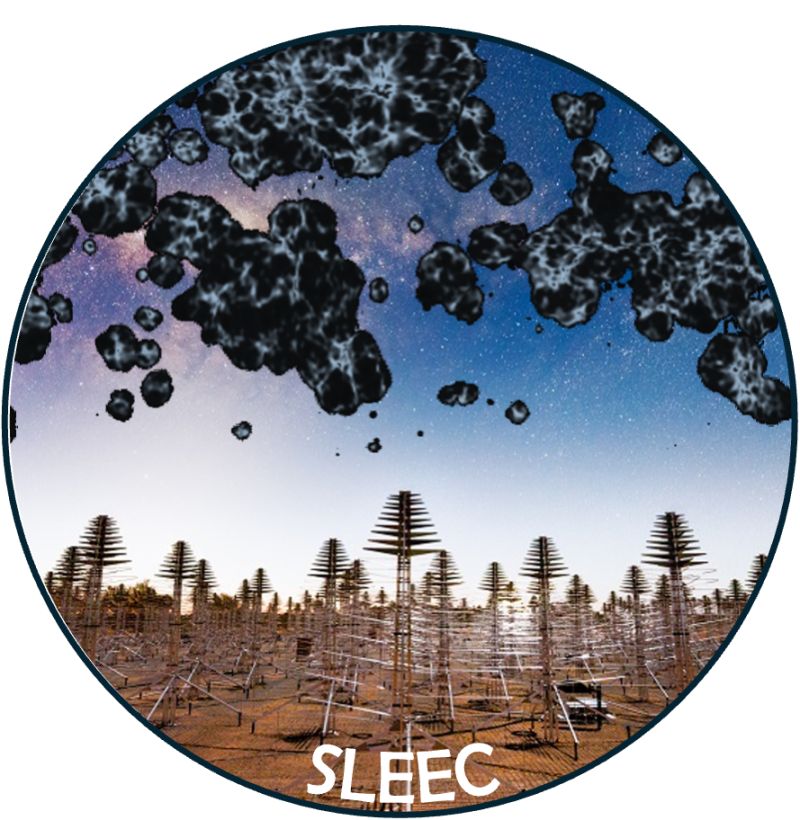
The SLEEC project’s methodology is based on self-supervised learning, a family of AI techniques that learn to represent complex data without requiring manual labeling. In particular, the project relies on diffusion models, architectures that have demonstrated their power in capturing high-dimensional data distributions. The first research track will use “diffusion autoencoders” to construct compact representations of the three-dimensional 21-cm signal, seeking to minimize information loss while reducing sensitivity to astrophysical modeling uncertainties. The second research track will employ similar architectures to directly reconstruct the underlying physical fields (density, temperature) from the observed signal, an approach that is still emerging in the field. These methods will be coupled with Bayesian inference, notably through simulation-based inference, to produce robust constraints on the cosmological and astrophysical parameters of the reionization era. The project aims to validate these approaches using realistic simulations of the 21-cm signal, in anticipation of SKA data. Ultimately, combining these two research tracks could lay the groundwork for a foundational model dedicated to 21-cm cosmology—a reusable tool that can be applied to various future analyses.