
Astrochemistry and Origins
Overview
The Astrochemistry and Origins team is primarily an experimental group that combines laboratory analyses and simulations with interpretation, modeling, and observations to study solid extraterrestrial matter originating from small bodies in the Solar System, as well as the surfaces of icy bodies (trans-Neptunian objects).
The team's work is characterized by combining laboratory experiments and measurements with observational data from various space instruments to aid in the interpretation of the latter.
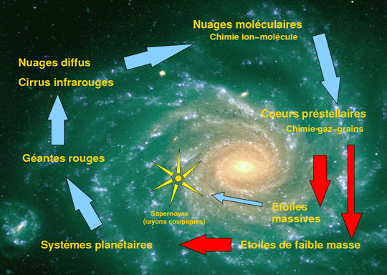
"Analyzing extraterrestrial matter (meteorites, cometary grains, asteroids, interstellar dust) to understand its evolution and its role in the origin of the Solar System and life."
Zahia Djouadi, Head of the A&O Team
Three main types of experiments are conducted by the members of the A&O team:
- Physicochemical characterization measurements of various types of samples.
- Experimental simulations aimed at reproducing an astrophysical process or environment in the laboratory and studying its physical and/or chemical effects on various types of solid matter.
- Experiments to produce analogues of extraterrestrial matter (ices, minerals, organic materials).
The team's physicochemical characterization methods rely primarily on spectroscopy, microscopy, and imaging techniques used to analyze various extraterrestrial samples: meteorites, interplanetary dust (commonly referred to as IDPs for Interplanetary Dust Particles) collected in the stratosphere, and cometary and asteroidal grains collected by space probes and returned to Earth.
To produce and/or analyze a wide range of samples of astrophysical interest, the A&O team has made the strategic choice to develop spectroscopic and physicochemical analyses on instruments located at IAS and to rely heavily on interdisciplinary, national, and international collaborations to expand its analytical capabilities through national platforms, large particle accelerators, and synchrotrons (the team has a long-standing partnership with the SMIS beamline at the SOLEIL synchrotron, thereby benefiting from guaranteed access to the beamline instruments and also developing collaborations with other beamlines).
The spectroscopic data of interest obtained in the laboratory by the A&O team regularly feed into the DAYSY (Database for AstrochemistrY and SpectroscopY) database, which is part of the SSHADE (Solid Spectroscopy Hosting Architecture of Databases and Expertise) architecture, labeled by Europlanet (headed by B. Schmitt, IPAG, OSUG).
This database ensures the archiving, traceability, and, above all, public access to a significant portion of the experimental data produced by the team.
The Team
- Alice Aléon-Toppani, Senior Lecturer
- Kana Amano, Postdoctoral Researcher
- Donia Baklouti, Senior Lecturer
- Rosario Brunetto, CNRS Researcher
- Sasha Cryan, PhD Student
- Zélia Dionnet, Assistant Astronomer
- Zahia Djouadi, Senior Lecturer (Team Leader)
- Cateline Lantz, Assistant Astronomer
- Laura Nardelli, PhD Student
Scientific Themes
The scientific objectives of the A&O team are aligned with observational instruments and Solar System exploration missions. Team members from diverse backgrounds (astrophysics, physics, chemistry, and geology) employ various analytical methods, enabling the most thorough study possible of extraterrestrial solids. The analysis of diverse extraterrestrial samples and work on synthetic laboratory analogues, combined with in-situ observations (Rosetta, Hayabusa2, and OSIRIS-REx missions), effectively constrain the evolutionary links between interstellar, cometary/asteroidal, and interplanetary materials.
Analysis of Primitive Cosmo-Materials
Primitive bodies—which have evolved very little, if at all, since the dawn of our Solar System nearly 4.6 billion years ago and from which laboratory cosmo-materials are derived—exhibit a complex assembly and significant physicochemical heterogeneities down to the micrometric and nanometric scales. Historically, the team has been heavily involved from an early stage in the analysis of primitive extraterrestrial samples, tiny interplanetary particles known as IDPs (Interplanetary Dust Particles), and meteorite samples. It has made particular use of infrared microspectroscopy (the only observable property that can be directly linked to data measured by ground-based and space telescopes, as well as space probes) and Raman microspectroscopy (for studying the aromatic organic component). Consequently, the team participated in the preliminary analysis groups for cometary samples returned in 2006 by NASA's Stardust mission and was selected in 2018 to participate in the preliminary analyses of asteroidal samples returned in late 2020 by JAXA's Hayabusa2 mission.
In recent years, the A&O team has developed various analytical protocols specifically optimized for these precious, fragile, and rare materials, following an analytical chain from the least destructive to the most destructive techniques in order to extract maximum information from its analyses across different scales. The flagship analytical technique used is infrared spectroscopy (microspectroscopy, hyperspectral imaging, and tomography), which is completely non-destructive. To complement the physicochemical information provided by infrared and Raman measurements, a suite of techniques stemming from the latest technological advances and collaborations (at both local and national levels) has been progressively integrated to achieve the most comprehensive characterization possible of the analyzed samples. These notably include Transmission Electron Microscopy (TEM) and Scanning Electron Microscopy (SEM), synchrotron X-ray fluorescence (NANOSCOPIUM beamline at SOLEIL), X-ray tomography (PSICHÉ and ANATOMIX beamlines at SOLEIL), and Time-of-Flight Secondary Ion Mass Spectrometry (TOF-SIMS, via the PLACAMAT platform in Bordeaux, alongside collaborations with Andromède (IJCLab) and LAEC (Lebanon)).
Together, these techniques enable the A&O team to study both the physical properties (porosity, mineral assembly, fracturing) and chemical properties (composition of mineral and organic phases and their colocalizations) of the analyzed samples to better constrain the pre- and post-accretionary processes experienced on their parent bodies.
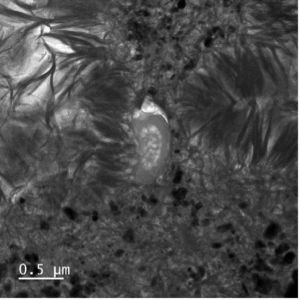
Transmission electron microscopy provides a fascinating glimpse into the nanoscopic intricacies of extraterrestrial matter, bearing witness to the complex history of asteroids. Here, a grain from the carbonaceous asteroid Ryugu, collected by the Hayabusa2 mission, reveals a nodule of organic matter surrounded by coarse-grained phyllosilicates and a fine clay matrix rich in sulfide crystals.
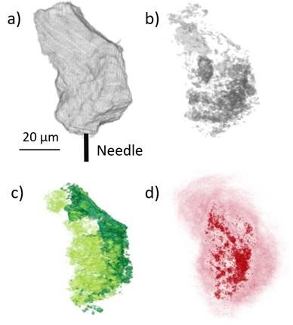
3D distributions of various components on a grain of the Ryugu asteroid analyzed via X-ray and IR tomography: (a) Total matter, (b) View of its porosity, (c) Different mineral types, and (d) Distribution of aliphatic CH organics.
Irradiation Experiments on Extraterrestrial Materials and Their Analogs
A significant portion of the A&O team’s work focuses on studying the effects of irradiation on various types of solid surfaces. This research encompasses, on the one hand, the study of the physicochemical evolution of irradiated ice mixtures and the formation of complex molecular and macromolecular organic matter; and, on the other hand, the study of the evolution and alteration of planetary surfaces and those of small bodies (asteroids, trans-Neptunian objects) under the influence of irradiation by the solar wind and cosmic radiation. To this end, the team has developed the INGMAR (Irradiation of Ice and Meteorites Analyzed by Reflectance) in collaboration with the IJCLab.
INGMAR consists of a vacuum chamber connected to the SIDONIE (IJCLab) and to visible and infrared spectroscopy lines, enabling in situ monitoring of how the sample spectra evolve during irradiation. Depending on the thickness of the prepared samples, measurements can be taken either in transmission (0.4–25 µm) or in reflection (0.4–5 µm). A cryostat allows the temperature of the samples placed at its end to be varied from 12 to 300 K. A gas mixing line is connected to the vacuum chamber and allows various ice mixtures to be deposited on the cryostat’s cold finger. Various ions are available; their energies and fluences can be selected according to the astrophysical process to be simulated or studied.
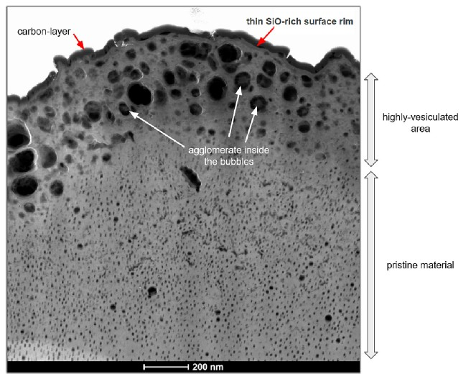
High-resolution electron microscope image of a serpentine rock irradiated with Ar+. A region with numerous vesicles is located above the untreated (unirradiated) region. The upper layer consists of a thin rim rich in SiO.
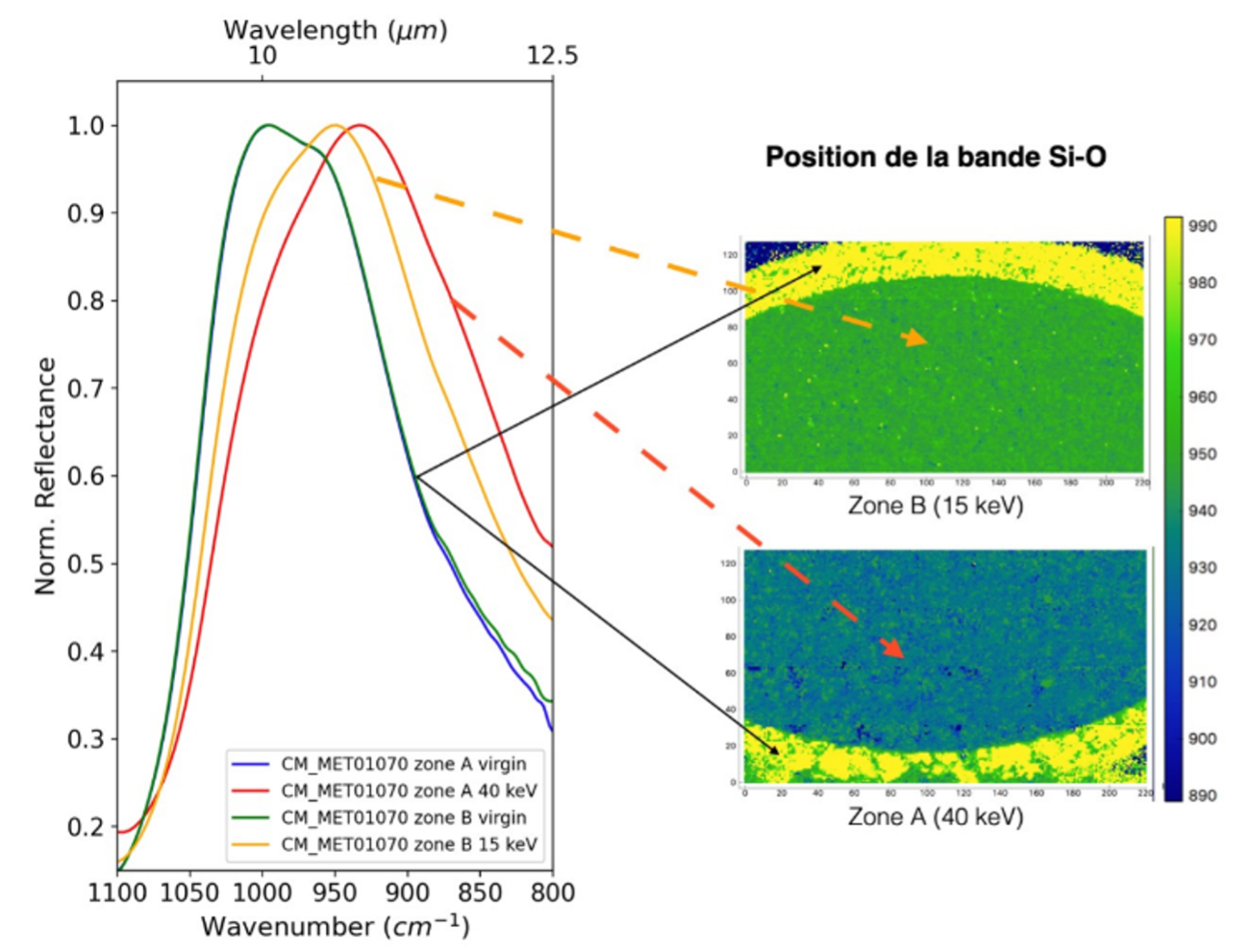
Left: MIR spectra obtained from a sample of the CM MET01070 meteorite before (blue and green) and after irradiation with He+ ions at different energies (orange and red).
Right: Images showing the position of the main peak around 10 µm (shown on the left), where clear differences are visible between the two irradiation energies (at the center of the sample in both thumbnails) and the edge of the sample, which was shielded during irradiation. The greater the irradiation, the more the spectrum is altered. This is a new marker of spatial alteration identified by our team that we are using in observations of small bodies.
Observations of Small Bodies by the SS
The team’s expertise in the analysis of extraterrestrial material—particularly through mass spectrometry—was utilized to characterize cometary dust collected and subsequently analyzed using TOF-SIMS by the onboard COSIMA instrument (and its COSISCOPE microscope; principal investigator: Yves Langevin, IAS). This enabled us to reveal the particularly high carbon content of the dust from Comet 67P/Churyumov-Gerasimenko, and we continue to work on this exceptional set of spectrometric data to refine our understanding of the chemical composition and physical structure of this primordial material.
In addition, drawing on its laboratory expertise in IR spectroscopy, the team is called upon by space projects to help analyze data from in-flight missions (remote observations). This was notably the case for the Hayabusa2/JAXA and OSIRIS-REx/NASA sample-return missions, where the team was involved in analyzing data from the NIRS3 (Near Infrared Spectrometer), OVIRS (OSIRIS-REx Visible and Infrared Spectrometer), and OTES (OSIRIS-REx Thermal Emission Spectrometer) to search for spectroscopic evidence of space weathering (changes in spectral slope, band shifts, etc.).
In addition, the team is exploring the outer reaches of the solar system using the James Webb (JWST) space telescope, which opens a new window onto trans-Neptunian objects—icy bodies that bear witness to planetary formation. We are co-investigators on several major projects, including a large international program (DiSCo), to observe and analyze these distant objects using the NIRSpec. Our unique laboratory expertise allows us to identify the molecules present on their surfaces and decipher their spectra in order to reconstruct their composition and history. Our work has revealed three major families of trans-Neptunian objects, each with distinct chemical compositions, shedding new light on the formation of the solar system. These results also serve as a reference for the study of other icy bodies, such as Centaurs and Neptune Trojans. The team leads the analysis of spectra and the development of scenarios regarding the origin and evolution of these objects, and regularly welcomes students working at the interface between space observations and laboratory experiments.
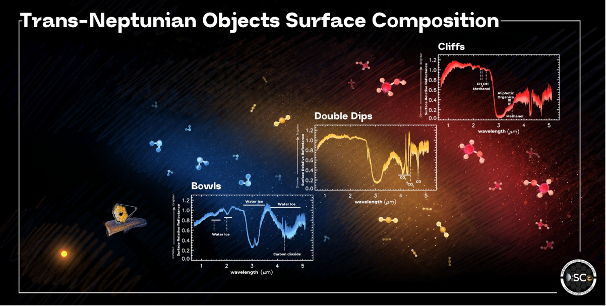
Artistic representation of the distribution of trans-Neptunian objects in the planetesimal disk, with representative spectra superimposed for each compositional group, highlighting the dominant molecules on their surfaces. Credit: Graphic illustration by William D. González Sierra for the Florida Space Institute, University of Central Florida.
Technical Resources
The resources (both dedicated and shared) available to the team include the following equipment and their associated infrastructure, particularly in terms of vacuum chambers, cryogenic systems, and radiation sources.
Experiments and setups located in the IAS buildings:
- An ISO 7-class cleanroom equipped with an ISO 5-class laminar flow system. This room includes:
– A motorized micromanipulator (Quick pro Microsupport) for preparing samples ranging in size from ~10 µm to a few millimeters.
– A macroscope (Leica) and a microscope (Nikon).
– Fiber-optic UV-Vis-NIR spectrometers. - A transmission-type Fourier transform infrared spectrometer (MIR) (VERTEX 70) to which the following can be connected:
– A high-temperature, high-pressure environmental cell. [300, 1000 K] and up to 69 bar (see Pronext). - A gas supply line from a cylinder for mixtures (buffer volume) feeding the Pronext cell.
- A Fourier-transform infrared spectrometer (INVENIO-R).
- A high-vacuum cathodic sputtering evaporator (for the synthesis of thin films of silicates or other materials).
- A vacuum tube furnace capable of annealing at temperatures up to 1,200 °C.
- A device for producing organic films of various compositions using microwave-induced plasma.
- A high-performance liquid chromatography (HPLC) system (Dionex) coupled with a diode-array UV-visible spectrophotometer.
- Microwave hydrogen discharge lamps (VUV source).
Shared experiences and initiatives:
- The INGMAR facility, in collaboration with IJCLab (located in Building 108, connected to the SIDONIE accelerator, IJCLab), includes:
– A vacuum chamber.
– A cryostat.
– A UV-Visible-Near-Infrared fiber-optic spectrometer and an FTIR spectrometer. - An infrared hyperspectral imager (Cary 670/620) with its internal light source (Globar) installed at the SMIS beamline at the SOLEIL synchrotron.
- A bolometer—cooled with liquid helium—on an FTIR spectrometer (SOLEIL SMIS line).
- Scanning electron microscopy (installed at the GEOPS laboratory) – FEG-ESEM equipped with a Dual EDS / µ-XRF coupling system.
- Transmission electron microscopy (JEOL/EDS/STEM 200 keV TEM), equipment installed at CentraleSupélec.