
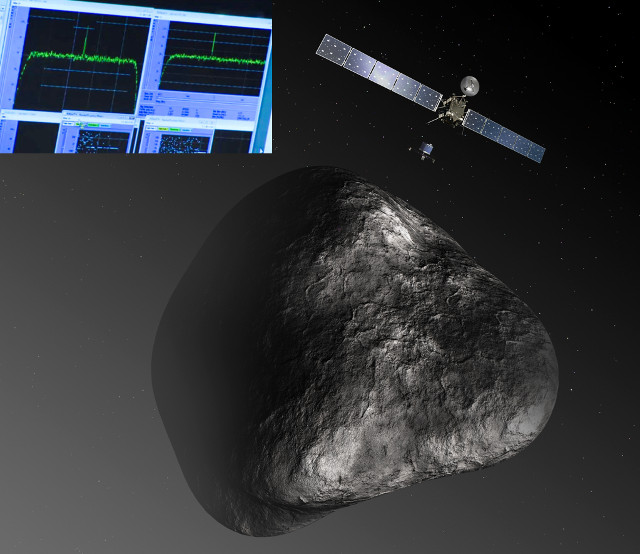
On its interplanetary journey to encounter Comet Churyumov-Gerasimenko, the Rosetta spacecraft has just emerged from hibernation—a state into which ESA had placed it in June 2011 because its heliocentric distance was too great (> 4.5 AU) to remain operational. The wake-up was scheduled for Monday, January 20, at 10:00 UT. After carrying out a cycle of automatic operations lasting several hours—including warming up and configuring the system—Rosetta transmitted the long-awaited signal, which was received at ESOC (Darmstadt) at 7:18 p.m. Now that this crucial milestone has been successfully achieved, all subsystems—and subsequently the instruments—will be tested in the coming weeks. Three braking maneuvers will gradually bring the spacecraft into an orbit close to that of the comet’s nucleus, which it will then accompany starting in June 2014.Once the comet’s nucleus is located, Rosetta’s distance from the nucleus will decrease from several million to several hundred kilometers (August 2014) and then to tens of kilometers (September 2014), to allow for increasingly precise analyses of the comet’s surface and coma. It is on this basis that the landing site for “Philae” (the name given to the lander) will be selected. The release and descent will take place in November 2014. The heliocentric distance will then be close to 3 AU: Philae will conduct its first in situ analyses before activity reaches a high level. The main spacecraft (the Orbiter) will continue its analyses until perihelion (August 2015)—the point of maximum activity—and then during the spacecraft’s retreat from the comet, until the end of 2015.
The IAS is heavily involved in the Rosetta mission, both scientifically and in terms of instrumentation and operations. On the Orbiter, we participated in the development of two instruments: COSIMA, a time-of-flight mass spectrometer designed to analyze the isotopic and molecular composition of grains (mineral and organic) ejected from the nucleus, and VIRTIS, a hyperspectral imager operating in the visible and near-infrared spectrum, designed to characterize the composition of the surface and the coma in terms of their main constituents (ices, minerals, molecules). For Philae, the IAS developed the CIVA imaging system, which will produce a stereoscopic panorama of the landing site, as well as microscopic, visible, and infrared images of samples collected from beneath the surface. In addition, the IAS (J-P. Bibring) shares overall scientific responsibility for Philae with the Max Planck Institute for Solar System Research (Lindau-Göttingen).