
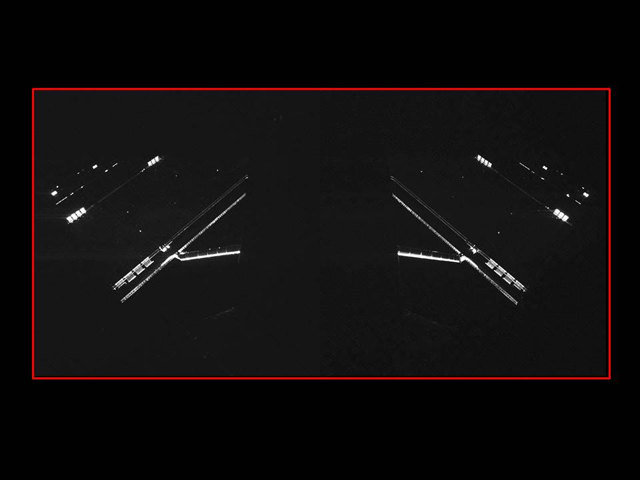
Images of the backside of the ROSETTA probe’s solar panels, taken by CIVA during the night of April 14–15 from the Philae lander. Philae is scheduled to deploy in November 2014; the CIVA cameras will then capture a complete panorama of the comet’s nucleus. Currently located between Mars and Jupiter, ROSETTA receives 16 times less sunlight than Earth.
Successful wake-up for the CIVA cameras on ROSETTA’s Philae lander
After 10 years of interplanetary travel, Rosetta is approaching its target, the nucleus of Comet Churyumov-Gerasimenko, where Philae will land in November. The CIVA cameras, which will capture a stereoscopic panorama of the comet’s surface once Philae has landed, have just been successfully powered up after several years of hibernation, more than 600 million km from the Sun.
The CIVA (Comet Nucleus Infrared and Visible Analyzer) instrument, which consists primarily of a set of seven panoramic cameras—including a pair of stereoscopic cameras—is under the responsibility of the Institute of Space Astrophysics (principal investigator: Jean-Pierre Bibring).
Contacts
- Jean-Pierre Bibring, Professor at Paris-Saclay University, Solar System and Planetary Systems Physics Group (lander, ÇIVA)
- Pascal Eng