
Introduction to the IAS
A laboratory run by the CNRS and Paris-Saclay University
The Institute of Space Astrophysics (UMR 8617) is a joint research unit of the CNRS and Paris-Saclay University. It has a staff of 131 in Orsay, in the Essonne department, and is part of Paris-Saclay University’s Observatory of Universe Sciences (OSUPS).
Founded in 1989, the IAS is a laboratory with more than 30 years of experience in exploring the universe.
The management team consists of: Frédéric Auchère, the director; Rosario Brunetto and Bruno Maffei, the deputy directors; Anne Philippon, the technical director; and Yara Hodroj, the secretary general.
A laboratory in the heart of the Saclay Plateau
The IAS benefits from a rich scientific and industrial environment, spanning the campus’s academic laboratories and the space industry. It serves two inseparable objectives:
- conduct cutting-edge research on the universe, from the Sun to cosmology;
- design, test, and operate instruments for space missions, and provide the national community with testing capabilities and data.
Science at the IAS
The research covers a broad spectrum of space science: the Sun, the planets of the solar system and exoplanets, extraterrestrial and interstellar matter, galaxies, and cosmology. It is organized into five thematic areas:
- Solar and Stellar Physics: Studies the internal structure and evolution of the Sun and stars, as well as the formation and dynamics of their
atmospheres, with a focus on the key role of the magnetic
field (SoHO, STEREO, CoRoT). - Physics of the Solar System and Planetary Systems: Characterizes the composition of planetary surfaces and atmospheres
to understand their physicochemical
and climatic evolution (Mars Express, Cassini-Huygens, Rosetta, Mercury, and Mars). - Astrochemistry and Origins: Laboratory research in experimental astrochemistry on extraterrestrial and interstellar solid matter and its evolution, in conjunction with astronomical observations.
- Astrophysics of Interstellar Matter: Exploring the physicochemistry of interstellar gas and dust
, their composition and evolution
, and their role in the formation of stars and protoplanetary disks
. - Cosmology: Analyzes the early fluctuations of the Universe (Planck) and its large-scale structure by combining
observations and modeling, including experiments to detect dark matter using massive bolometers.
A strong technical component
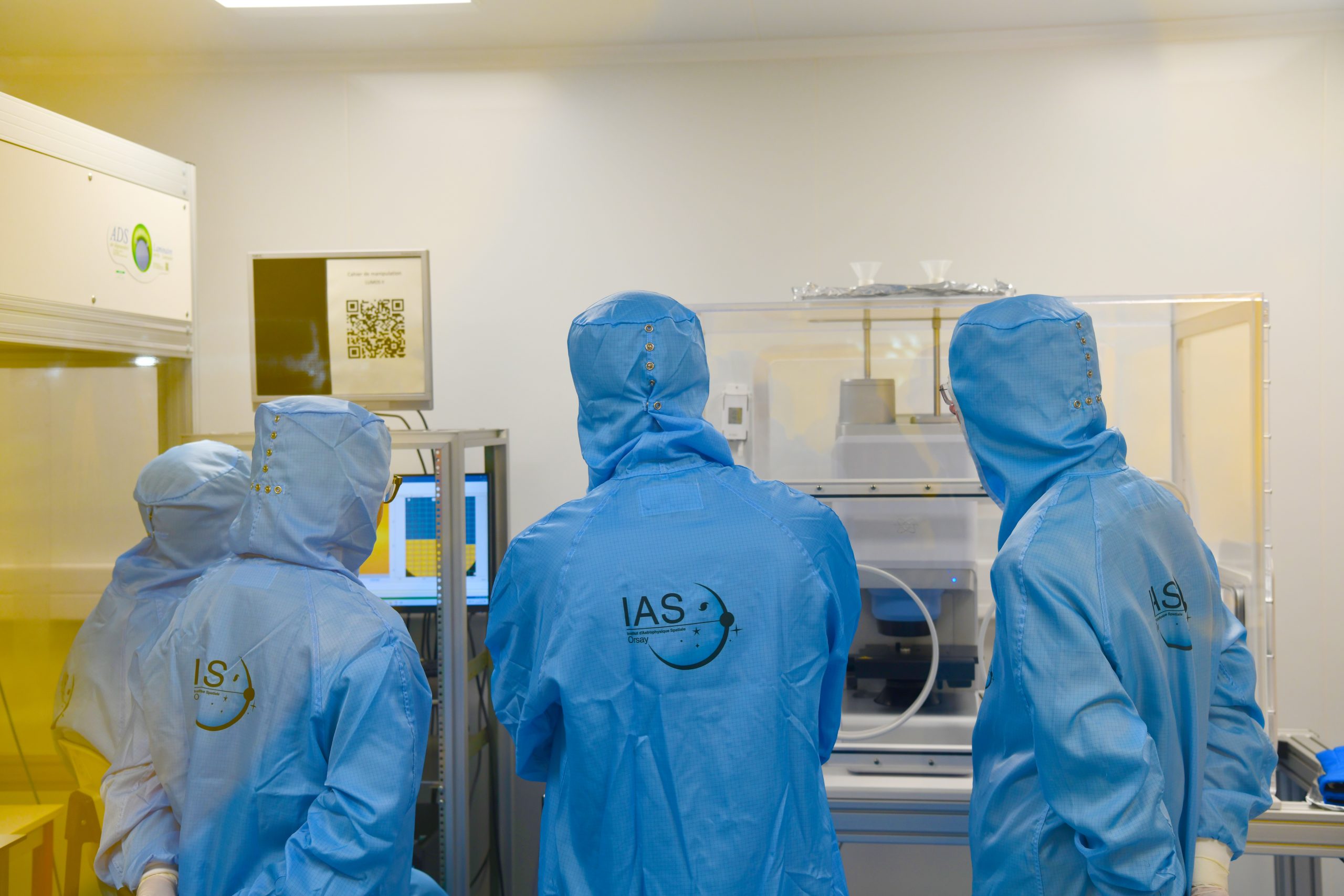
The IAS is a recognized leader in space instrumentation, with a major R&D program. Its scientific and technical teams design instruments for space missions, test them, characterize their performance, and then analyze the data they collect. Multiple projects can be carried out simultaneously, thanks to the combined expertise in electronics, computer science, instrumentation, mechanical engineering, thermal engineering, cryogenics, and optics.
Platforms That Serve the Community
The Space Instrument Calibration Station. This national facility, located in a controlled-clean environment, houses space simulators for instrument calibration and space environment testing capabilities. The IAS is also collaborating with the CEA on a space simulator project at the SOLEIL synchrotron.
IDOC, the Space Data and Operations Center. It manages certain operations for SoHO and Mars Express, and provides data analysis, archiving, and access to data from missions to which the laboratory has contributed, for the national and international communities.
Space Missions
The IAS has made major contributions to ESA mission instruments (SoHO, Mars Express, Cassini-Huygens, Rosetta) and participates in NASA missions such as STEREO. It has also taken part in the CoRoT (CNES) and Planck (ESA) missions, for which it served as prime contractor for the main instrument.
Education and Training
The IAS is heavily involved in teaching physics at the bachelor’s and master’s levels, participates in three doctoral programs, and contributes to the “Tools and Systems for Astronomy and Space” master’s program at Paris-Saclay University. Each year, it hosts several dozen interns, ranging from students at technical colleges to engineering schools.
Partners
CNES, ESA, NASA, and JAXA, as well as companies such as Thales Alenia Space, Air Liquide, and Airbus.
Contact
Institute of Space Astrophysics (UMR 8617), CNRS / Paris-Saclay University
, Building 121, 91400 Orsay, France