Rosetta

Credit: ESA

Rosetta

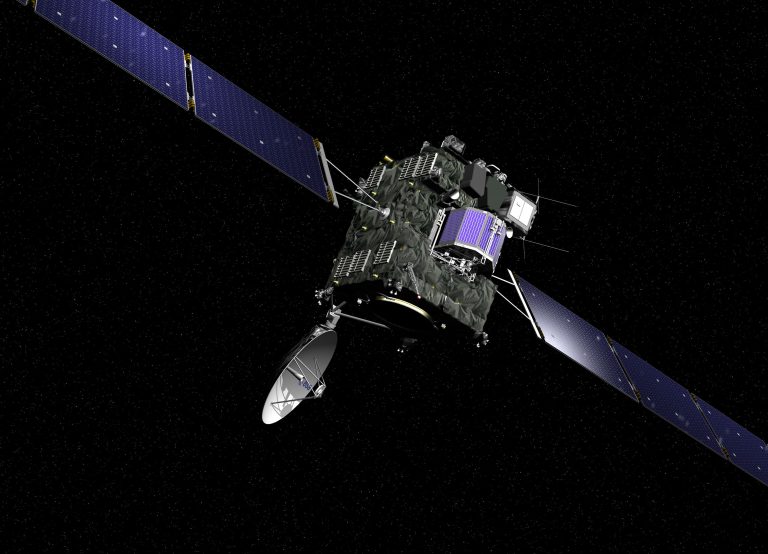
The Rosetta mission is a historic space mission bythe European Space Agency (ESA), designed to study the origin and evolution of comets. Originally, the mission was supposed to encounter Comet 46P/Wirtanen, but after the initial launch in January 2003 was postponed, a new target was selected: Comet 67P/Churyumov-Gerasimenko.

Rosetta made history by becoming the first spacecraft to enter orbit around a comet and deploy a lander (Philae) onto it.

The Role of the IAS

The Institute of Space Astrophysics (IAS) played a major role in the Rosetta mission:

On the Philae lander

  • Manager of Panoramic Imaging and Infrared Microscopy Systems (CIVA experiment);

    • CIVA (Comet Infrared and Visible Analyzer) captured the first in-situ images of a comet nucleus;

On the Rosetta orbiter

  • Participation in the COSIMA (COmetary Secondary Ion Mass Analyzer) mass spectrometer;

  • Contribution to the VIRTIS (Visible and Infrared Thermal Imaging Spectrometer) spectral imager.

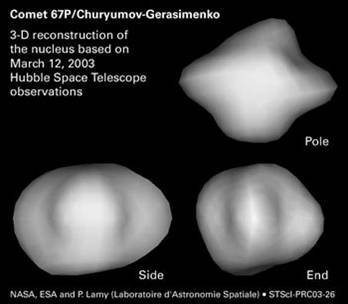
3D model of the nucleus of 67P/Churyumov-Gerasimenko, Rosetta's new target. (Based on HST images, NASA/ESA/P. Lamy).

Archived

  • January 2003: Postponement of the initial launch (original target: Comet 46P/Wirtanen);

  • February 2004: Launch of the Rosetta spacecraft from Kourou (French Guiana);

  • 2005–2014: Interplanetary journey (gravity assists around Earth and Mars);

  • August 2014: Encounter with Comet 67P/Churyumov-Gerasimenko;

  • November 2014: Philae lands on the comet's nucleus (the first landing on a comet);

  • 2014–2015: Study of the comet from its reawakening through perihelion (August 2015);

  • September 2016: End of the mission (Rosetta's controlled landing on the comet).

  • 2004–2014: The Journey

    • Flybys of Earth (2005, 2007, 2009) and Mars (2007) for gravitational assists;

    • Overview of the asteroids Šteins (2008) and Lutétia (2010);

    • The probe went into hibernation between 2011 and 2014 to conserve energy.

  • 2014: Arrival at the Destination

    • August 2014: Rosetta enters orbit around 67P/Churyumov-Gerasimenko;

    • November 2014: Philae lands on the comet (landing site: Agilkia);

    • First in-situ images of the comet's nucleus (thanks to CIVA, developed by the IAS).

  • 2015: Peak Activity

    • August 2015: The comet passed through perihelion (the point closest to the Sun);

    • Study of the gas and dust jets emitted by the comet;

    • Analysis of data from the COSIMA and VIRTIS instruments.

  • 2016: The End of the Mission

    • September 2016: Rosetta concludes its mission by landing on the comet to conduct close-up observations.

Philae (lander), CIVA, COSIMA, VIRTIS

Leave a comment

Your email address will not be published. Required fields are marked with *

Scroll up