
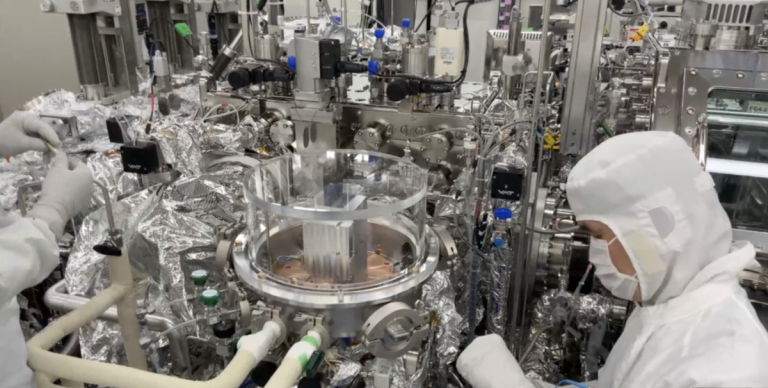
The MicrOmega instrument (in its nitrogen-purged enclosure) at the ISAS Curation Facility in Sagamihara, Japan.
MicrOmega – Hayabusa2 – OSIRIS-REx
Carbonaceous asteroids are precious remnants of the Solar System’s formation 4.5 billion years ago. They have, in part, preserved the processes that governed its early evolution and likely contributed significantly to the supply of minerals and chemical compounds that may have been crucial to the evolution of Earth and the terrestrial planets.
The return of samples from the asteroid Ryugu by JAXA’s Hayabusa2 mission and from the asteroid Bennu by NASA’s OSIRIS-REx mission offers, for the first time, the opportunity to analyze their composition in a laboratory without any terrestrial contamination—unlike meteorites.
The Hayabusa2 spacecraft reached the asteroid Ryugu in June 2018. After several months of observation (particularly using the NIRS3 IR spectrometer, for which several team members are Co-PIs), the spacecraft successfully collected two sets of samples from the asteroid’s surface. One of these was carried out near an artificial crater to gain access to materials that were originally beneath the surface. Thanks to these operations, approximately 5.4 g of samples (far more than the targeted 100 mg) were collected and returned to Earth in early December 2020.
These unique samples are now stored at JAXA’s Extraterrestrial Sample Curation Center (ESCuC) in Sagamihara, Japan, in a dedicated facility (“Curation Facility”). A preliminary analysis phase of these samples—which are kept in a controlled atmosphere inside ultra-clean chambers—has thus begun using four instruments: a quartz balance, a visible-light microscope equipped with color filters, a point-source FTIR spectrometer, and a MicrOmega-type near-IR hyperspectral microscope designed and developed at the Institute of Space Astrophysics with support from CNES. This instrument, similar to the model installed on ESA’s ExoMars rover, enables the characterization and mapping of the mineralogical and molecular (organic) composition of the samples, ranging from a few centimeters down to a scale of a few tens of microns. These analyses, which are completely non-destructive and non-invasive, provide an initial characterization of the mineralogical and molecular composition of the Ryugu material, offering a comprehensive view of the collection that falls midway between remote sensing (cm–km) and smaller-scale analyses (sub-micron). Critically, the analyses performed by MicrOmega at ESCuC are conducted without removing the samples from their storage containers. Thus, at the time of their characterization by MicrOmega, the samples have never been exposed to the Earth’s environment and have therefore not undergone any alteration—a crucial factor for this type of material.
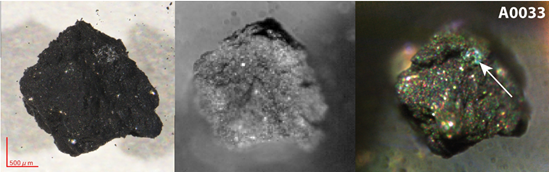
Illustration: Image of grain A0033 under a visible-light microscope (left, https://darts.isas.jaxa.jp/app/curation/ryugu/) and under a MicrOmega at 2.50 µm (center). RGB MicrOmega image (right) showing the presence of a blue-green carbonate inclusion, indicated by an arrow (adapted from Loizeau et al. 2023).
Meanwhile, the samples from the OSIRIS-REx mission, collected from the B-type asteroid Bennu, arrived on Earth in September 2023 and have since been stored at the Johnson Space Center in Houston (USA). Approximately 120 g of samples were collected. Thanks to an agreement between NASA and JAXA, a portion of the samples from Ryugu and Bennu were exchanged between the two agencies. Since August 2024, a portion of the Bennu samples (weighing 0.6 g) has been stored in a facility at ISAS in Sagamihara, Japan. Following an agreement between CNES and JAXA, the MicrOmega instrument was moved to this new facility to enable analysis of the OSIRIS-REx samples, paving the way for a comparison—using the same techniques and under the same conditions—of the samples collected from Ryugu and Bennu.
Since late 2020, analyses using the MicrOmega instrument have continued. They initially focused on samples from Ryugu and now also include characterizations of samples from Bennu. These analyses have led to numerous publications as well as the development of grain catalogs accessible to the scientific community via AOs (for Ryugu: https://darts.isas.jaxa.jp/app/curation/ryugu/; for Bennu: https://darts.isas.jaxa.jp/app/curation/bennu/).
Status
In operation
Partners (academic / industrial)

Funding Sources

Key Dates (tentative)
2018–203x
Key Steps
- Start of analysis of the Hayabusa2 samples: 2020
- Start of work on the OSIRIS-REx samples: 2024
Space Instruments
MicrOmega
Contacts
Scientific Advisors
- Cédric Pilorget, Associate Professor at Paris-Saclay University and researcher at the IAS, Solar System and Planetary Systems Physics Group
Technical Advisors
- Vincent Hamm, Research Engineer, Optics Department
Further Reading
ISAS Catalog:
https://darts.isas.jaxa.jp/app/curation/ryugu/
https://darts.isas.jaxa.jp/app/curation/bennu/
News:
Successful Launch of Hayabusa 2: MicrOmega Is in Space!
Hayabusa 2 has just completed its rendezvous with its target asteroid!
The “MicrOmega-Curation Facility” Successfully Delivered to ISAS
Samples from the asteroid Ryugu analyzed by the IAS
In terms of instrumentation, MicrOmega is an ultra-miniaturized hyperspectral microscope operating in the 0.99–3.65 µm spectral range, incorporating all the necessary instrumental functions: monochromatic illumination of samples within a 5 × 5mm² field of view, at a resolution of 256 × 250 pixels; a dispersive system consisting of a white-light lamp coupled to a very high-performance bimodal (dual-transducer) AOTF; and image focusing onto a detector that is actively cooled by a dedicated cryogenic system. The complete instrument, including electronic circuit boards, weighs 2.0 kg.
Major Published Articles
Pilorget, C., et al. “First compositional analysis of Ryugu samples by the MicrOmega hyperspectral microscope.” *Nature Astronomy*, 2021, Vol. 6, pp. 221–225. DOI: 10.1038/s41550-021-01549-z
Loizeau, D., et al. “Constraints on the Early Evolution of the Solar System from a MicrOmega Analysis of Ryugu Carbonates.” *Nature Astronomy*, 2023, Vol. 7, pp. 391–397. DOI: 10.1038/s41550-022-01870-1
Le Pivert-Jolivet, T., et al. “Space weathering record and pristine state of Ryugu samples from MicrOmega spectral analysis.” *Nature Astronomy*, 2023, Vol. 7, pp. 1445–1453. DOI: 10.1038/s41550-023-02092-9
Pilorget, C., et al. Phosphorus-rich grains in Ryugu samples with significant biochemical potential. *Nature Astronomy*, 2024, Volume 8, pp. 1529–1535. DOI: 10.1038/s41550-024-02366-w
Pilorget, C., et al. “IR Analyses of Samples from Bennu and Ryugu and the Potential Source of the Ingredients of Terrestrial Planets.” *Nature Communications*, 2025, 16, 9532, DOI: 10.1038/s41467-025-65438-z
Jiang, T., et al. Ammonium-bearing phyllosilicate grains detected in Ryugu and Bennu samples via infrared spectroscopy. Nature Communications, 2026, Volume 17, Issue 1, id.5078. DOI: 10.1038/s41467-026-72866-y