
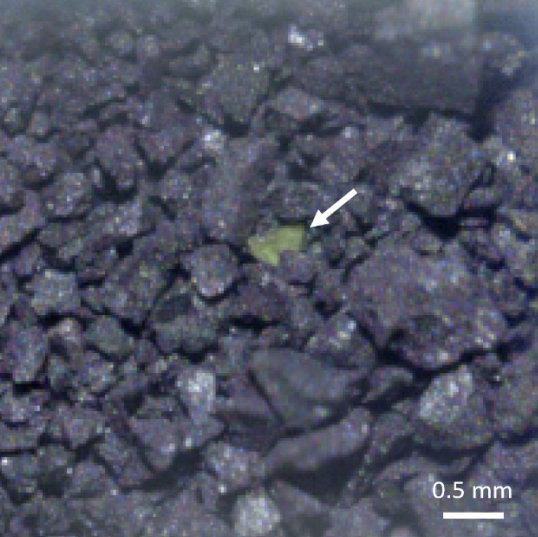
Ryugu samples yield their first secrets
Initial analyses of samples retrieved from the primitive asteroid Ryugu, to which the IAS-developed MicrOmega instrument contributed, have provided an initial characterization of the physicochemical properties of the grains.
In December 2020, JAXA's Hayabusa2 mission brought back to Earth more than 5 grams of samples collected from two sites on the carbonaceous asteroid Ryugu, a first in space exploration! These objects potentially contain material that bears witness to the conditions and processes of the primordial formation and evolution of the Solar System. Furthermore, the samples collected on Ryugu's surface were preserved from any contact with the terrestrial environment until their storage in the ultra-clean ISAS/JAXA curation facility in Sagamihara, Japan. Consequently, they constitute an unrivaled collection in our laboratories.
A comprehensive characterization of these samples is currently underway directly within this facility. These analyses enable a preliminary determination of the physical and compositional characteristics of the grains using a high-precision balance, an optical microscope, a near-IR point spectrometer, and—for the first time ever—a near-IR hyperspectral microscope, thanks to the MicrOmega instrument developed by IAS in Orsay, which remotely participates in the acquisitions themselves. These initial analyses, conducted in a completely non-invasive, non-destructive manner without any contact, treatment, or preparation under a controlled dry nitrogen atmosphere, are essential and unique because they are performed on all samples and characterize them down to microscopic scales. They also bridge the gap between remote observations made by the spacecraft and finer laboratory characterizations performed on grains extracted from the collection.
MicrOmega, qui couple l’imagerie à petite échelle (quelques dizaines de microns) à la spectroscopie, dans un domaine de longueurs d’onde permettant d’identifier dans chacun des pixels de l’image les constituants principaux, minéraux et organiques en particulier, a permis des avancées majeures. Les résultats ont montré que les échantillons collectés étaient bien représentatifs de Ryugu, et qu’à échelle macroscopique, ils sont constitués d’une matrice hydratée très sombre (réflectance < 3%) dans laquelle sont piégés des composés organiques. Aux échelles submillimétriques en revanche, des inclusions de composition distinctes ont été identifiées, dont des grains de carbonate, pour certains enrichis en fer, avec des tailles jusqu’à plusieurs centaines de micromètres. Les analyses ont également révélé la présence de composés azotés, ainsi que d’autres phases provenant d’altération aqueuse.
Two papers published in Nature Astronomy outline these initial results (Yada et al. 2021 and Pilorget et al. 2021).
The initial characterizations of the samples collected on Ryugu within the Curation Facility thus highlight the richness of this collection, which has preserved a portion of the primordial compounds. Based on their characterization within the Curation Facility, selected grains were extracted and distributed to international "Analytical Teams". IAS is also involved in these analyses, particularly through IR characterizations performed at the Soleil synchrotron. Finally, characterization work continues within the Curation Facility with the objective of establishing a catalog of grains accessible to the broader scientific community through an open call for proposals to be launched before the summer of 2022.
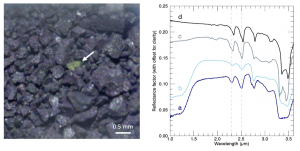
Figure 1: Average spectrum (100 pixels) of a carbonate grain detected with MicrOmega (a), compared with three laboratory reference spectra (siderite (b), dolomite (c) and calcite (d)), and RGB image showing this grain, indicated by an arrow (R: 2.5 µm, G: 2.7 µm, B: 3.4 µm).
Contacts
Scientific and Technical Contacts
- Cédric Pilorget, Associate Professor at Université Paris-Saclay, Équipe Physique du système solaire et des systèmes planétaires
- Jean-Pierre Bibring, Professor at Université Paris-Saclay, Solar System and Planetary Systems Physics Team
- Rosario Brunetto, Research Scientist, Astrochemistry & Origins Team