
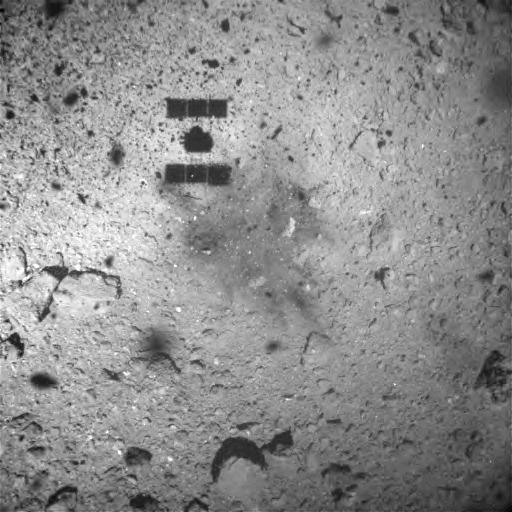
This phase of the Hayabusa2 mission, executed on February 22, 2019, was the most perilous, requiring a precision touchdown of the entire spacecraft onto a highly rugged terrain covered in boulders of all sizes. It demonstrates the extraordinary operational mastery of the ISAS/JAXA teams. A second sample collection may take place in a few months, prior to the asteroid's departure scheduled for late this year and its return to Earth a year later. Consequently, our laboratories are expected to receive samples in 2021 for the very first time, harvested directly from one of the oldest objects in the solar system—rich in organic compounds that may have played a pivotal role in the evolution toward life on Earth.
Upon their return to the ISAS curation facility in Sagamihara/Tokyo, the samples will undergo characterization before being distributed to selected scientific teams. At the request of our ISAS partners, the IAS will deliver a MicrOmega instrument to enable non-destructive, grain-by-grain microscopic infrared characterization of these samples, encompassing both their mineralogical composition and their content of hydrated and carbonaceous phases.
With this mission, Japan brilliantly inaugurates a new phase in the space exploration of the solar system, combining remote sensing, in situ characterization, and sample return. Upcoming missions include NASA's OSIRIS-REx, targeting a sample collection from the carbonaceous asteroid Bennu; China's Chang'e 5 and 6 missions, featuring automated lunar sample returns; the MMX mission (launch planned for 2024) by ISAS/JAXA, with cooperation from CNES and the IAS; and the Mars Sample Return (MSR) mission slated for the end of the decade. Leveraging its expertise in both payload development and the terrestrial analysis of extraterrestrial samples, the IAS is a prospective partner for all these endeavors.