
Analysis of Ryugu asteroid samples by MicrOmega reveals new insights into the early evolution of the Solar System
A new study based on data from the MicrOmega instrument—which is currently participating in the analysis of samples from the Ryugu asteroid returned by JAXA's Hayabusa2 mission—has characterized and mapped various carbonate mineral types within the samples, shedding valuable light on the early days of the Solar System.
A copy of the MicrOmega instrument, designed and developed at the IAS, is currently installed in Japan at JAXA's Curation Facility (ISAS, Sagamihara). MicrOmega is a near-infrared hyperspectral microscope used to map minerals and organic molecules at the scale of a few tens of micrometers on the surface of samples. It was originally developed as an instrument for the Mars rover of ESA's ExoMars mission. The instrument has been operational since December 2020 to analyze all samples returned from Ryugu before any removal from their protected environment.
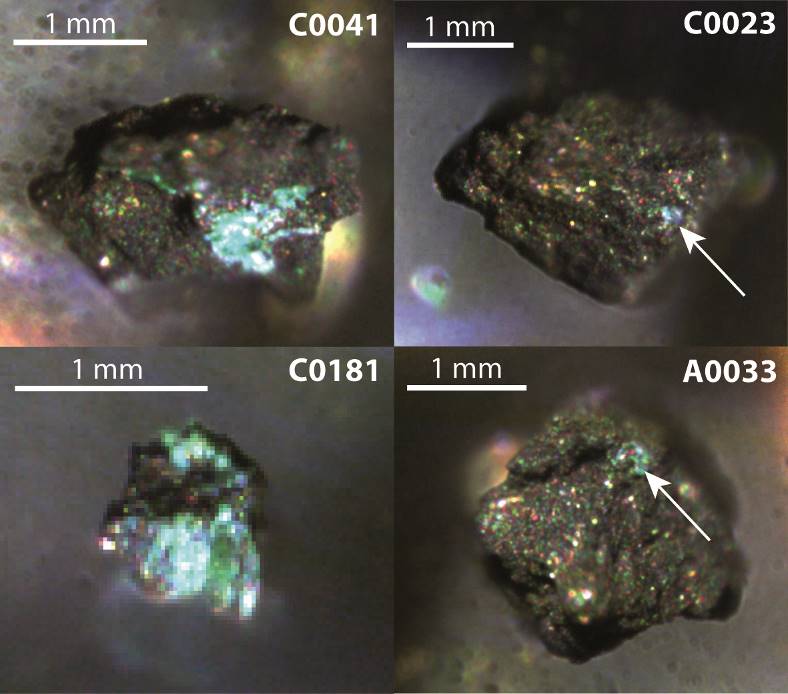
Analysis of observations obtained on bulk samples, followed by several hundred extracted millimeter-sized grains, enabled the detection of several hundred carbonate-rich areas ranging from 50 µm to nearly 1 mm in width. These detections appear either as small grains entirely rich in carbonates or as carbonate inclusions within millimeter-sized grains. Two distinct carbonate populations can be identified: most of the smaller detections are rich in calcium and magnesium (dolomite), whereas the larger detections are rich in iron and magnesium (breunnerite). For some of the larger inclusions, flat and elongated structures are visible on the grain surfaces, suggesting formation between grains or along fractures.
These carbonates formed during the first few million years following the formation of the Solar System, and the observation of two distinct populations suggests two different formation processes or episodes, potentially linked to different carbon sources.
Similarities with carbonates detected in CI chondrite meteorites also suggest that the properties observed in Ryugu samples may be generic features of material formed beyond the main asteroid belt.
Four Ryugu grains with carbonate inclusions, shown here in blue/green (false-color composites of infrared images taken by MicrOmega). (Loizeau et al. 2023)
Contacts
Damien Loizeau, Postdoctoral Researcher, Solar System and Planetary Systems Physics Team