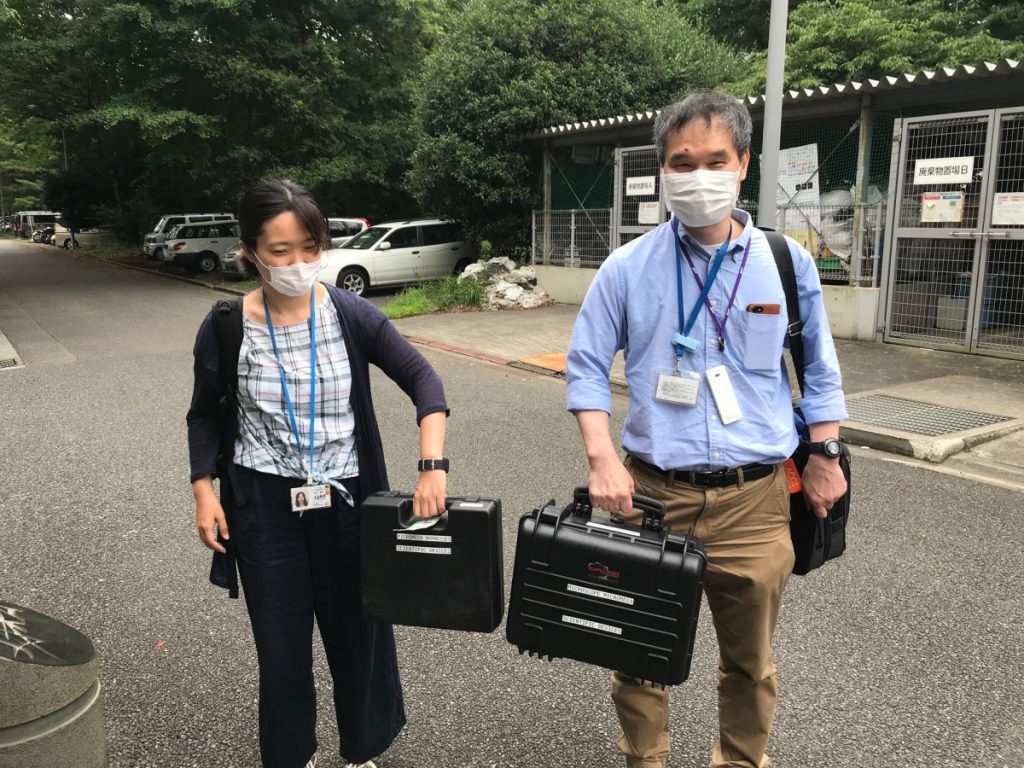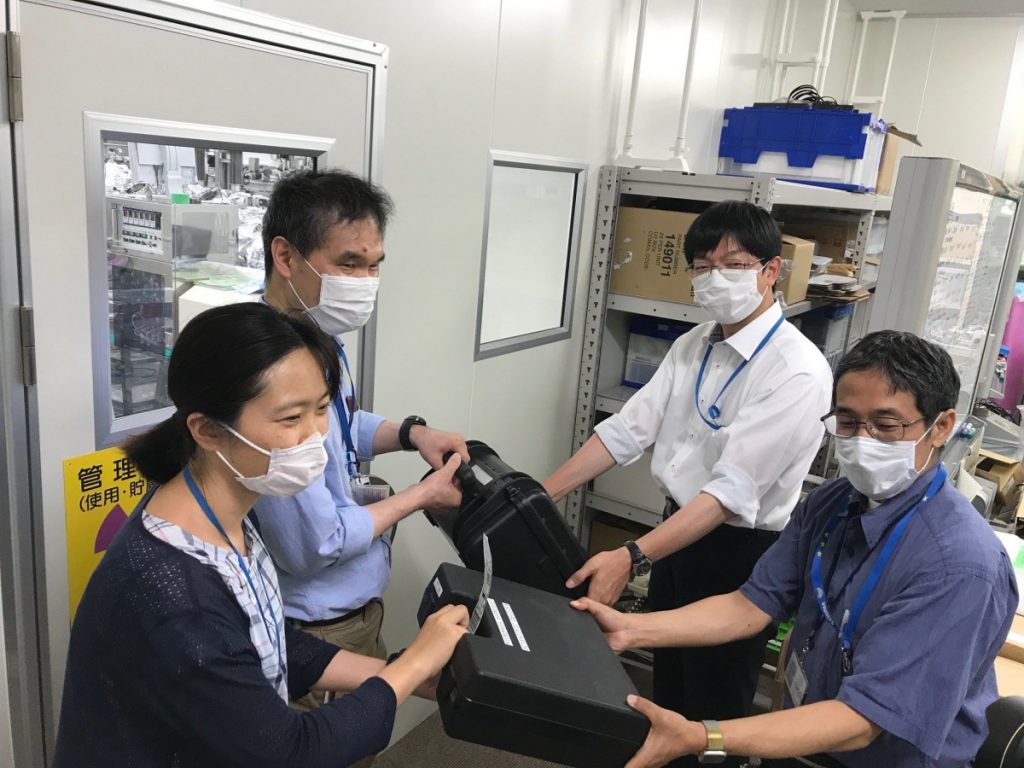
Despite health restrictions that drastically limited technical activities at the IAS and entry into Japan, the IAS team succeeded in integrating, testing, and perfectly calibrating the MicrOmega instrument, and in delivering it to the Hayabusa2 mission’s “curation facility” at the Institute of Space and Astronautical Science (ISAS), on Friday, July 3, 2020. MicrOmega’s performance has proven to be excellent.
Hayabusa2, a mission of the Japanese space agency JAXA, is the first to have studied a presumed carbonaceous asteroid, Ryugu, while remaining at distances of less than 20 km for nearly 18 months. Observations using imaging and infrared spectroscopy suggest that this very dark object is very slightly hydrated and may have undergone partial surface dehydration due to solar heating.
Two sample collections took place: one of surface material and the other of deep material exposed on the surface by the impact of a projectile ejected from the probe. Hayabusa 2 departed Ryugu last December and is continuing its return journey to Earth, where the capsule containing the collected samples is scheduled to land in December 2020. The samples will then be transferred to ISAS, the JAXA space laboratory in charge of this mission, for characterization before being distributed to other international laboratories for further analysis.
Beyond potentially validating hypotheses about Ryugu’s history, this characterization will pursue another objective: because they originate from a very primordial object—likely rich in carbon-based compounds present in the protoplanetary disk that gave rise to the solar system—some of these samples may preserve properties that played a key role in the evolution of life on Earth. Their analysis would thus complement the analyses conducted on material from Comet Churyumov-Gerasimenko by the Rosetta/Philae mission.
This marks the first time an infrared hyperspectral microscope has been selected to perform, within the reception, storage, and distribution laboratory (“curation facility”), to characterize extraterrestrial samples collected in space: because it has the ability to non-destructively identify the mineral and molecular composition—particularly the carbonaceous and hydrated phases—of their constituent grains, MicrOmega was selected by JAXA for this characterization of the Ryugu samples collected by Hayabusa2.
MicrOmega, which is part of the development of infrared hyperspectral imagers that has been underway at the IAS for several decades, has benefited from the expertise of numerous colleagues across all departments of the laboratory: its selection by our partners at JAXA is a testament to their excellence and commitment.