Miri – JWST

The James Webb Space Telescope (JWST) is the largest space telescope ever launched, developed by NASA, ESA, and the Canadian Space Agency (CSA). As the successor to the Hubble Space Telescope, it observes the Universe in the infrared spectrum to revolutionize our understanding of star formation, distant galaxies, exoplanets, and interstellar matter. It was launched on December 25, 2021, from Kourou aboard an Ariane 5 rocket. Following a 6-month deployment and calibration phase, the JWST commenced scientific observations in July 2022. Its exceptional performance, particularly in angular resolution and sensitivity, enables the exploration of previously inaccessible phenomena, such as the composition of protoplanetary disks, photon-dominated regions (PDRs), and the evolution of trans-Neptunian objects.

The role of IAS

IAS is a member of the European consortium for the MIRI (Mid-InfraRed Instrument), contributing to the optical testing of the imager and the measurement of its point spread function. The laboratory is also responsible for the processing and dissemination of MIRI imager data within the French MIRI expertise center.
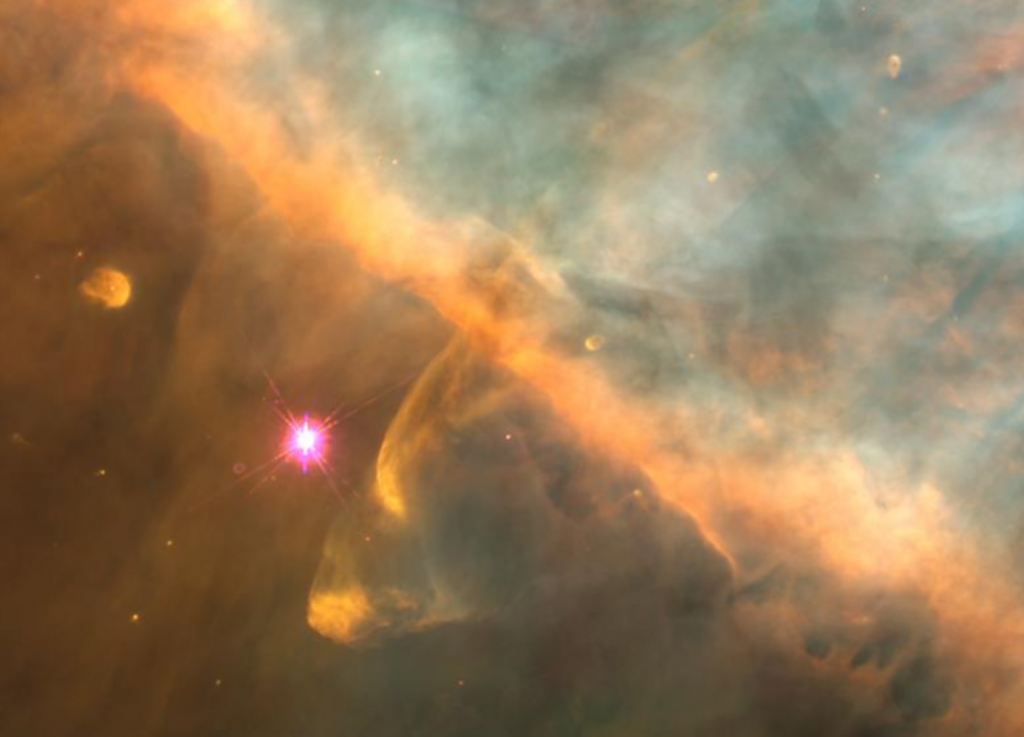
IAS also co-led one of the first 13 JWST Early Release Science Programs, the PDRs4All program, dedicated to the study of photon-dominated regions and interfaces between dense clouds and ionized regions. Its teams are involved in several scientific topics, notably:

  • Analysis of photon-dominated regions and the radiative impact of massive stars
  • Grain growth and protoplanetary disk dynamics
  • Chemical composition of trans-Neptunian objects and galaxy protoclusters
  • Detection of key molecules such as the methyl cation (CH₃⁺), CO₂, and H₂O₂ across various astrophysical environments.

MIRI is the mid-infrared instrument for the James Webb Space Telescope, providing imaging, coronagraphy, and integral field spectroscopy across the 5–28 micron wavelength range. MIRI is one of four instruments built for the Webb telescope. It was developed as a joint partnership between Europe and the United States, with key partners including the ESA, a consortium of nationally funded European institutes, NASA's Jet Propulsion Laboratory (JPL), and the Goddard Space Flight Center (GSFC).

Operational

  • 2018: Selection of the initial observation programs (Early Release Science Programs)
  • December 25, 2021: Launch
  • July 2022: Commencement of scientific observations
  • July 2022: Release of the initial data and images
  • 2023–2024: Major discoveries (molecular detections, protoplanetary disk analysis, TNO studies)
  • 2025: Continuation of scientific observations and analyses
  • Design and optical testing of the MIRI imager
  • Participation in the MIRI consortium and the French expertise center
  • Co-leadership of the Early Release Science program PDRs4All
  • Processing and dissemination of MIRI data
  • Detection of novel molecules (CH₃⁺, CO₂, H₂O₂) in diverse environments
  • Study of protoplanetary disks and trans-Neptunian objects
Scroll to top