
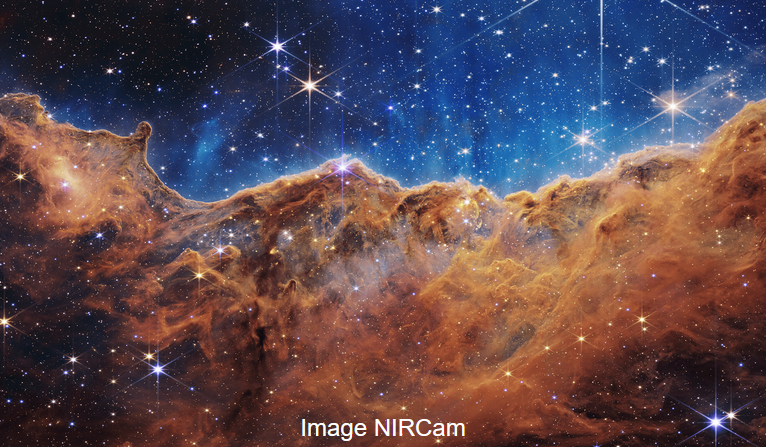
The first data were presented on Tuesday, July 12. They confirm the exceptional performance of the JWST and its four scientific instruments (NIRSPec, NIRISS, NIRCam, MIRI), particularly their angular resolution and sensitivity, which are often better than predicted.
Never before has the sky been observed with this level of detail and depth. These exceptional results are the culmination of nearly three decades of collaborative development between NASA, ESA, and CSA, drawing on collective experience gained in particular during the deployment and operation of previous major space observatories (IRAS, COBE, HST, ISO, Spitzer, WISE, Planck, Herschel, etc.).
The IAS is a member of the European consortium for the MIRI mid-infrared instrument. The laboratory was involved in the optical testing of the MIRI imager—which yielded the only ground-based measurement of the optical impulse response—is responsible for processing and disseminating the imager’s data within the French MIRI center of expertise, and established the INCLASS joint laboratory for the fusion of imaging and spectroscopic data. Its scientific teams are involved in several upcoming observation programs focusing on photodominated regions, the radiative impact of massive stars, grain growth, dynamics in protoplanetary disks, the composition of trans-Neptunian objects, and protogalaxy clusters.