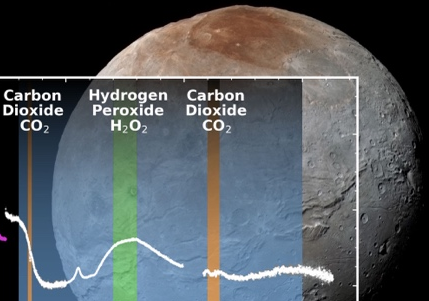
Unlike other large objects in the Kuiper Belt, such as dwarf planets, Charon’s surface is not covered in volatile ices like methane, making its overall composition more accessible to remote analysis. The discoveries made possible by the JWST pave the way for an in-depth study of the processes that shape the surfaces of these icy objects. For example, the presence of hydrogen peroxide (H₂O₂) indicates that Charon’s surface, which is rich in water ice, undergoes changes caused by the Sun’s ultraviolet light and energetic particles from the solar wind and cosmic rays. As for carbon dioxide (CO₂), the leading interpretation is that the CO₂ in the upper layer originates from the interior and was exposed at the surface during crater formation. We know that carbon dioxide is present in the regions of the protoplanetary disk from which the Plutonian system formed. This information provides valuable insight into the chemical and physical evolution of icy objects in the outermost regions of the solar system.