
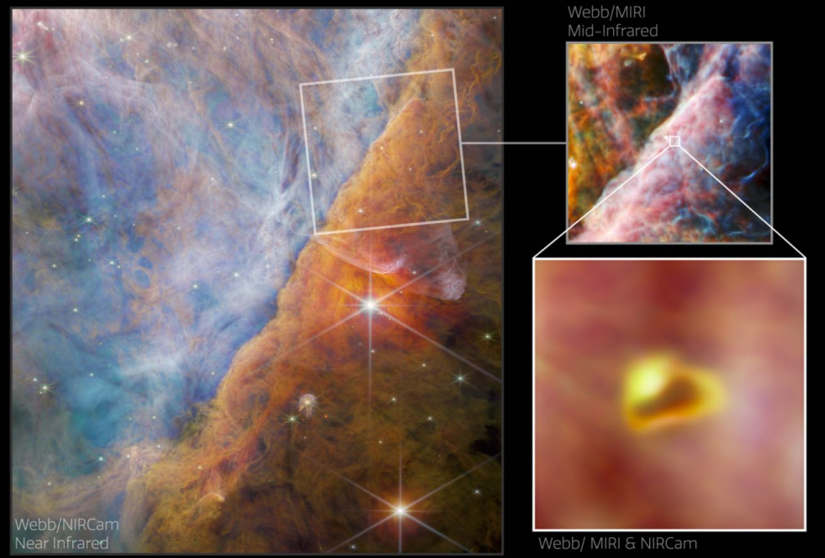
A new species detected by the JWST space telescope
An international research team including researchers from IRAP, ISMO, and IAS (CNRS and Université Paris-Saclay), as well as LERMA and IPAG, used data collected by JWST (James Webb Space Telescope, NASA/ESA/CSA) to detect the methyl cation (CH₃⁺) for the first time. This detection was made in the protoplanetary disk surrounding a young star in the Orion molecular cloud region, approximately 1,300 light-years from Earth. It is the result of a successful collaboration between astrophysicists, astrochemists, and spectroscopists, with an essential contribution from laboratory spectroscopists.
The methyl cation is a relatively simple carbon-bearing molecule with a unique property: it reacts relatively inefficiently with the most abundant molecule in our universe (molecular hydrogen), but it readily reacts with other molecules, enabling the formation of much more complex carbon-based molecules. Carbon chemistry is of particular interest to astronomers, as all known life forms are carbon-based. The vital role of CH₃⁺ in interstellar carbon chemistry has been predicted since the 1970s, but the unique capabilities of JWST have finally made it possible to observe it—in a region of space that could potentially form host planets capable of supporting life.
This research is part of the "PDRs4All" project, one of the 13 JWST Early Release Science programs led by three co-PIs, including Olivier Berné from IRAP (Toulouse), Emilie Habart from Université Paris Saclay, and Els Peeters from the University of Western Ontario (Canada). These observations are designed to showcase JWST's observational capabilities and enable the astronomical community to learn how to make the most of its instruments. The data reduction for JWST/MIRI-MRS—the instrument that enabled the detection of the CH₃⁺ molecule—was carried out at the French MIRI expertise center, with support from CNES and the ANR-labcom INCLASS between IAS and the company ACRI-ST.
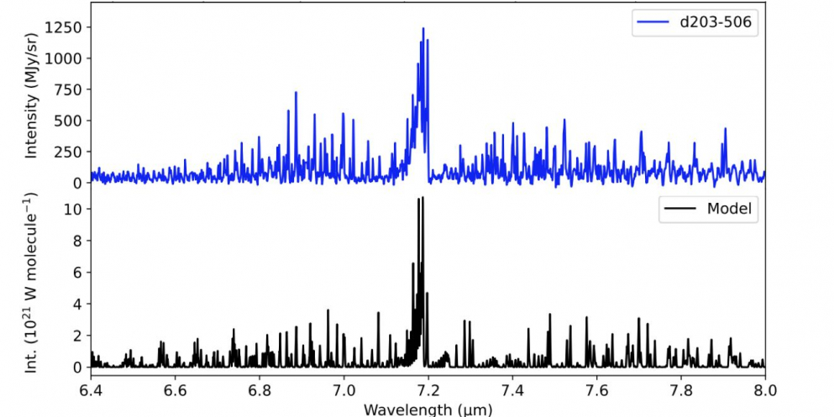
Comparison between the JWST spectrum of the protoplanetary disk d203-506 and the modeled CH₃⁺ spectrum.
Contacts
Émilie Habart, Associate Professor, Head of the AMIS Team