
JWST Reveals the Composition of a Protoplanetary Disk
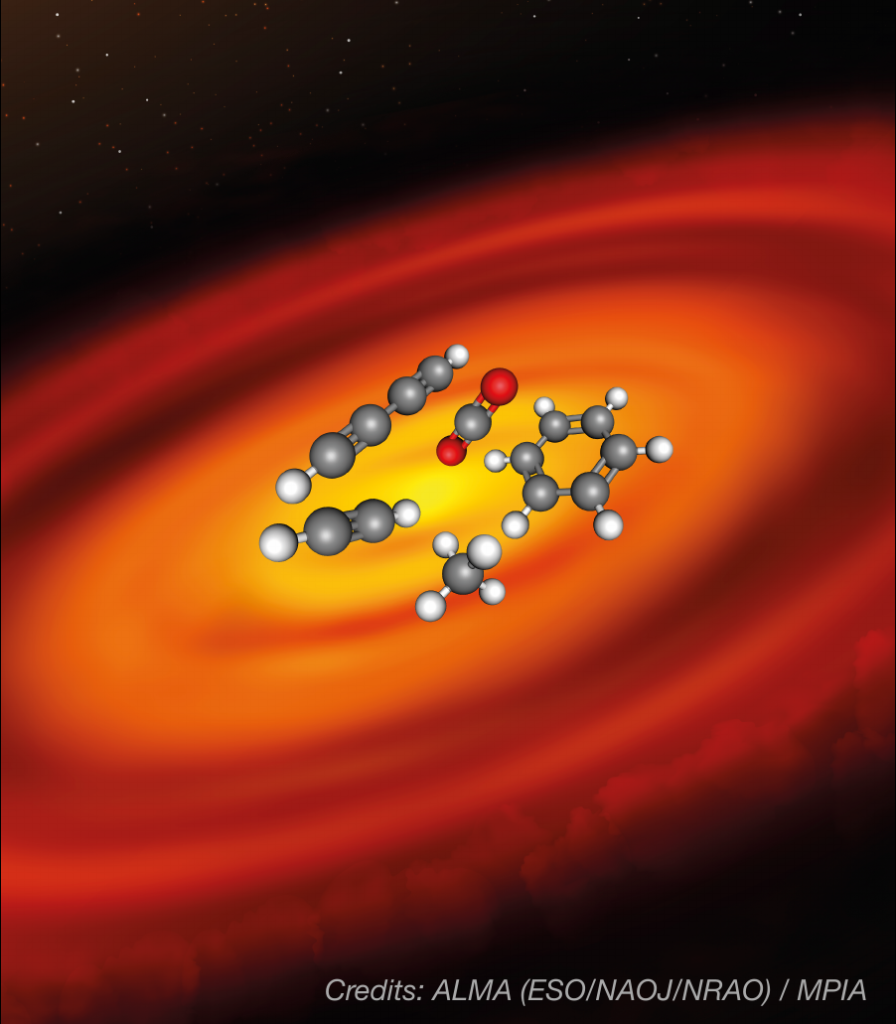
An international research team involving the IAS has just revealed the chemical composition of a disk of matter rotating around a young star where new planets are forming. The results of this study, led by Benoît Tabone, a CNRS researcher at the IAS, were obtained as part of the guaranteed time program of the MIRI instrument, developed by a consortium of laboratories in Europe and the United States.
The unique feature of this disk is that it orbits a very low-mass star—5 to 10 times less massive than our Sun—a type of star known to host an abundance of potentially habitable rocky planets, as evidenced by the famous Trappist-1 exoplanet system. Surprisingly, this disk is extremely rich in gas-phase hydrocarbons, with two molecules from this family detected for the first time in such a disk: benzene ($ ext{C}_6 ext{H}_6$) and diacetylene ($ ext{C}_4 ext{H}_2$). Conversely, oxygen-rich molecules such as carbon dioxide ($ ext{CO}_2$) and water ($ ext{H}_2 ext{O}$) are present in very low abundances. This surprising chemical composition is likely due to the destruction of carbon grains within the disk, which releases carbon into the gas phase. This implies that the rocky planets formed in this disk are carbon-poor, much like our Earth.
This study sheds new light on the emergence of habitable planets and provides an initial glimpse into the capabilities of the JWST in this field.
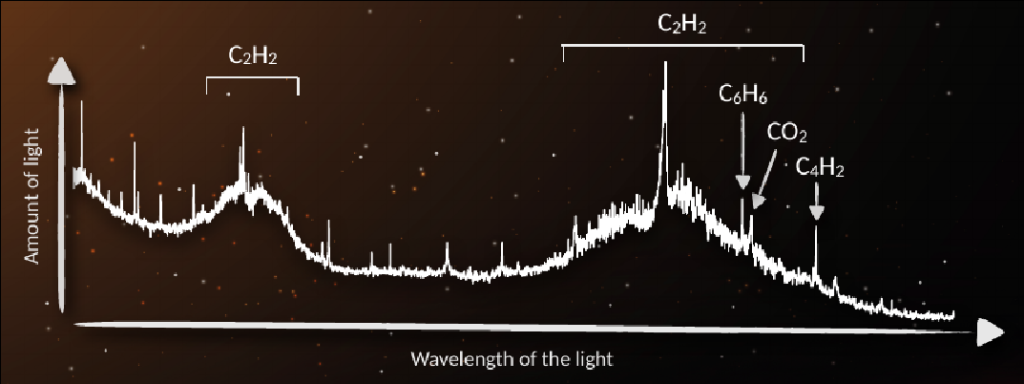
The MIRI spectrum of the star J160532. The emission lines of benzene ($ ext{C}_6 ext{H}_6$), diacetylene ($ ext{C}_4 ext{H}_2$), and carbon dioxide ($ ext{CO}_2$) appear as narrow peaks in the spectrum. Acetylene is so abundant that it produces two broad humps in the spectrum, demonstrating the dominance of hydrocarbons in the disk. Water emission, commonly observed in other disks, is weak or absent. © Benoît Tabone/MINDS consortium/NASA/ESA
Contacts
Benoît Tabone, Researcher, Interstellar Matter Astrophysics Team
References
- Link: CNRS press release
- Scientific article: A rich hydrocarbon chemistry and high C to O ratio in the inner disk around a very low-mass star. Tabone et al. Nature Astronomy, 2023. DOI:10.1038/s41550-023-01965-3