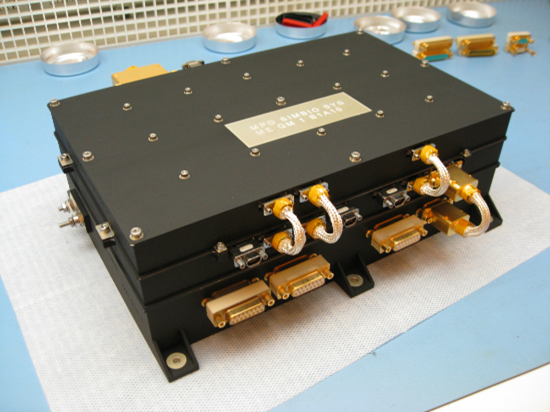
The electronic module of the SIMBIO-SYS instrument suite, developed by the IAS

SIMBIO-SYS

The BepiColombo mission was launched on October 19, 2018, to observe the planet Mercury starting in 2026. This ambitious mission aims to study every aspect of the planet closest to the Sun, from its interior to its surface and out to the outermost layers of its atmosphere.

The Role of the IAS

To achieve these ambitious goals, the BepiColombo mission consists of two probes that will enter orbit around the planet Mercury:

  • Mercury’s magnetosphere will be studied by the MMO (Mercury Magnetospheric Orbiter) spacecraft. Developed by the Japan Aerospace Exploration Agency (JAXA), it will be placed in a highly elliptical orbit, allowing it to explore the outer layers of Mercury’s atmosphere and magnetic field across a wide range of altitudes (from 400 km to more than 10,000 km).
  • The planet’s surface and interior will be analyzed by the MPO (Mercury Planetary Orbiter) probe, designed by the European Space Agency (ESA). This second orbiter will fly only close to the surface, at altitudes between 400 and 1,500 km. MPO carries 11 instruments, including the SIMBIO-SYS instrument suite—a set of imagers dedicated to studying Mercury’s surface—which the IAS helped design.

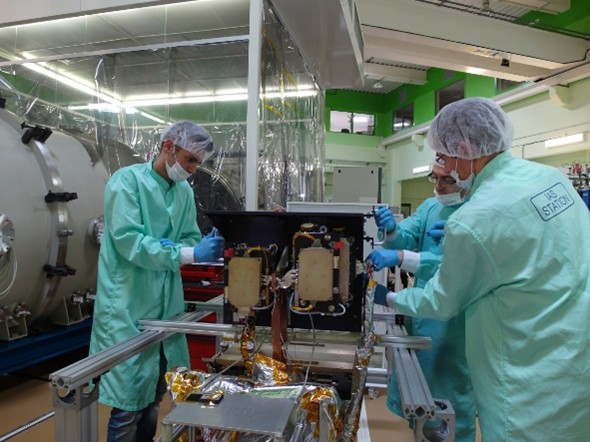
The SIMBIO-SYS instrument was designed by a Franco-Italian consortium under Italian scientific leadership (PI: Gabriele Cremonese). The IAS was responsible for developing the high-throughput instrument management electronics module and the onboard software (with Yves Langevin serving as co-PI), as well as for the optical and radiometric calibration of the integrated assembly, under the supervision of François Poulet. The IAS’s contributions to in-flight operations and subsequently during the orbital phase around Mercury will be coordinated by Mathieu Vincendon (scientific activities) and Vincent Carlier (technical activities related to responsibility for the management module).

Assets

  • Instrument calibration: April 2015 at the IAS calibration station.
  • Scheduled launch: January 2017 aboard the Ariane V rocket.
  • Launch: January 2024.
  • End of mission: January 2026.

Release Date: October 19, 2018

Contacts

Advisors (scientific and technical)

  • Yves Langevin, Research Director, Solar System and Planetary Systems Physics Group
  • François Poulet, Astronomer, Solar System and Planetary Systems Physics Team
  • Mathieu Vincendon, Associate Professor at Paris-Saclay University and Team Leader, Solar System and Planetary Systems Physics Team

The SYMBIO-SYS instrument

The SIMBIO-SYS instrument suite will make it possible to map various properties of the planet’s surface (geological units, rock composition, topography, etc.). It consists of three instruments:

  • The primary objective of the HRIC (High Spatial Resolution Imaging Channel) imager is to characterize the geology of Mercury’s surface at high spatial resolution (up to 5 meters on the surface).
  • The STC (STereo Channel) stereoscopic imager will enable mapping with a resolution 10 times lower (50 m per pixel), but covering the entire planet and providing a three-dimensional view.
  • The VIHI (Visible Infrared Hyperspectral Imager) will capture images of the planet across more than 250 different wavelengths. This spectroscopic data will enable it to identify the composition of the observed surfaces.

In the spring of 2015, the IAS conducted a cross-calibration of the three channels of the SIMBIO-SYS instrument suite.

Scroll up