
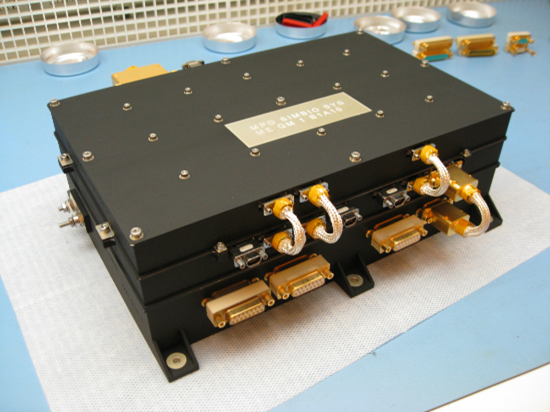
SIMBIO-SYS (Spectrometer and Imagers for MPO BepiColombo-Integrated Observatory SYStem) is the primary instrument on the BepiColombo Mercury Planetary Orbiter (MPO), which will be used to study the planet Mercury. Comprising a high-resolution camera (HRIC), a stereoscopic camera (STC), and a visible and near-infrared hyperspectral imager (VIHI), this suite of instruments is expected to profoundly change our understanding of the composition and geomorphology of Mercury’s surface.
The instrument acceptance test went well, and an initial functional electrical check was successfully completed. Activities to integrate and align the instrument with the IAS calibration system are underway, with installation in the test chamber scheduled for the coming days, followed by the start of scientific measurements.
Preparing for calibration required the development of a specialized test setup involving all IAS disciplines (electronics, computer science, mechanics, optics, and thermal engineering) with support from the calibration station staff. The experimental calibration setup consists primarily of the Jupiter chamber containing the instruments, an optical bench housing the calibration sources and optical components that simulate Mercury’s observation conditions, mechanical interfaces for positioning the experiment inside the chamber, thermal interfaces designed to investigate the operating temperatures of the various parts of the experiments, and computer interfaces that ensure communication with the experiment and control of the calibration setup based on the tests to be performed.