
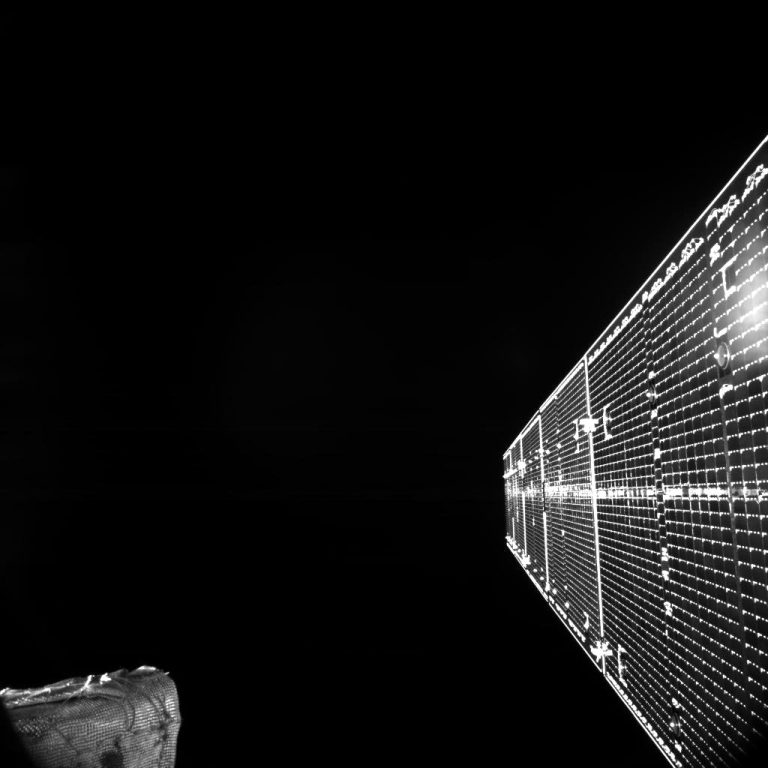
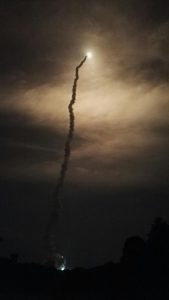
It was on a pitch-black, humid night in French Guiana that the 16 instruments aboard the BepiColombo mission were launched by the Ariane 5 rocket on October 19 at 10:45 p.m. Seventy-six minutes after launch, the solar panels deployed successfully. BepiColombo, with a launch mass exceeding 4 metric tons, is by far the heaviest spacecraft to use ion propulsion for its trajectory changes, with the goal of entering orbit around Mercury in December 2025. The nominal duration of the scientific mission will be one year. The IAS actively participated in the preparation of the SIMBIO-SYS instrument suite by supplying the main electronics—under the leadership of our late colleague Pascal Eng—and by calibrating the integrated instrument.
SIMBIO-SYS comprises three major instruments—a high-resolution camera, a stereoscopic camera, and a visible and near-infrared hyperspectral imager—which will provide more than 50% of the data from the European orbiter (Mercury Planetary Orbiter). The next step for the IAS will be to participate in the NECP (“Near Earth Commissioning Phase”) operations in early December. The IAS congratulates Arianespace, ESA, and CNES on this successful launch.
BepiColombo is on its way to Mercury! (Credit: IAS/Chloë Guallar)
Launch of BepiColombo (Credit: IAS/Mathieu Vincendon)
Contacts at the IAS: Mathieu Vincendon