
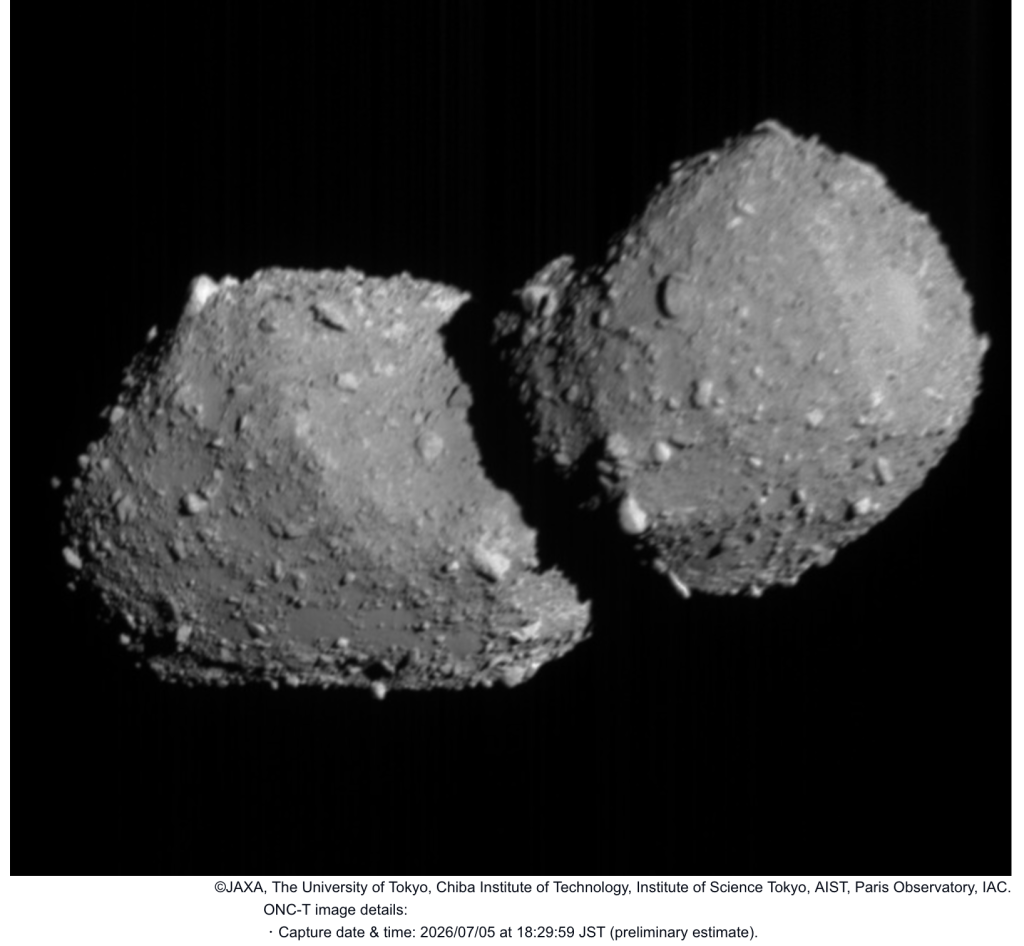
The Astrochemistry & Origins team and its INGMAR experiment show that the solar wind could produce signs of hydration on Torifune!
The flyby of Torifune (an S-type asteroid) took place successfully on July 5. The possibility of detecting hydrated compounds via a 3-micrometer absorption band on this anhydrous object was raised, as has been observed on the Moon by several space missions since 2009.
One possible cause of this hydration signature—which is surprising in objects that do not contain endogenous hydrated material—is the formation of hydroxyl (OH) groups through the implantation of hydrogen ions from the solar wind (a phenomenon known as space weathering) that react with oxygen atoms on the silicate-rich surface (SiO₂ groups).
This spectral signature has since been suggested for other water-free objects, such as certain asteroids. However, the vast majority of these observations have been made from Earth, and an absorption band caused by atmospheric water prevents us from obtaining details about this spectral signature around 3 µm (position, depth).
The NIRS3 spectrometer aboard the Hayabusa2/JAXA mission was specifically designed to observe this spectral region and has successfully detected the band associated with hydrated minerals (phyllosilicates) on Ryugu. The observation of Torifune would represent the first direct measurement of this spectral region on an S-type asteroid.
To determine whether this hydrogen implantation process can occur on S-type asteroids, the Astrochemistry & Origins team—in collaboration with K. Kitazato, the principal investigator (PI) of NIRS3—conducted an H+ ion irradiation experiment on ordinary chondrites similar to Torifune. This irradiation campaign was conducted in the INGMAR vacuum chamber (which allows for in situ infrared spectroscopy measurements) connected to the SIDONIE ion implanter (IJCLab).
A band at 2.8–3 µm was thus detected in a position and at a depth similar to those suggested for other asteroids. The detection of the 3 µm band on water-free objects would have significant implications for the mechanisms of water formation and distribution throughout the Solar System.
The team has thus demonstrated for the first time that signs of hydration (hydroxyl groups, OH) can form on the surface of S-type asteroids as a result of solar wind bombardment. We are now eagerly awaiting the NIRS3 results obtained during the flyby of Torifune to verify this hypothesis!
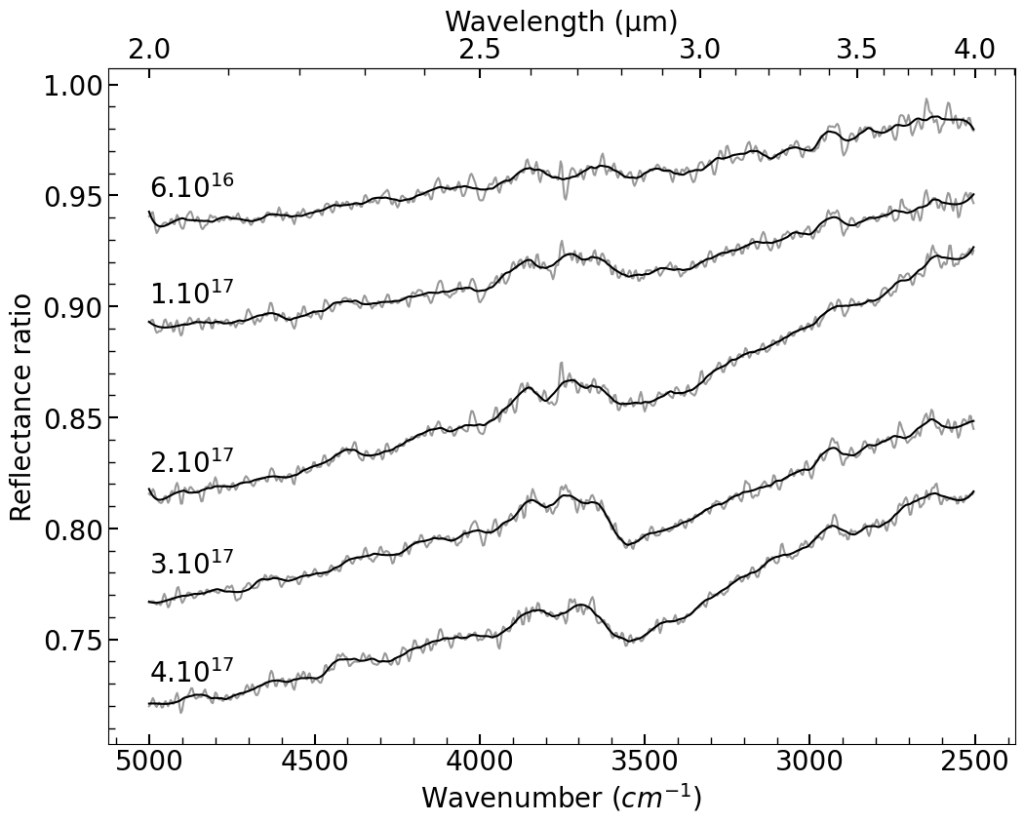
This figure shows the ratios (spectra after each irradiation step divided by the pre-irradiation spectrum) in the near-infrared region and illustrates the formation and growth of a band around 2.8–3 μm resulting from the implantation of H+ ions into the Sahara 98222 meteorite (an L6-type ordinary chondrite, with Torifune as its best analog).
Contacts
-
Cateline Lantz, Assistant Astronomer at Paris-Saclay University, Solar System and Planetary Systems Physics Group, Astrochemistry Group
-
Rosario Brunetto, research fellow at the IAS, Astrochemistry Team
References
- Link to the online publication:
Lantz et al., H+ irradiation of ordinary chondrites supporting observations ofTorifune by Hayabusa2#, A&A Letters, 2026