
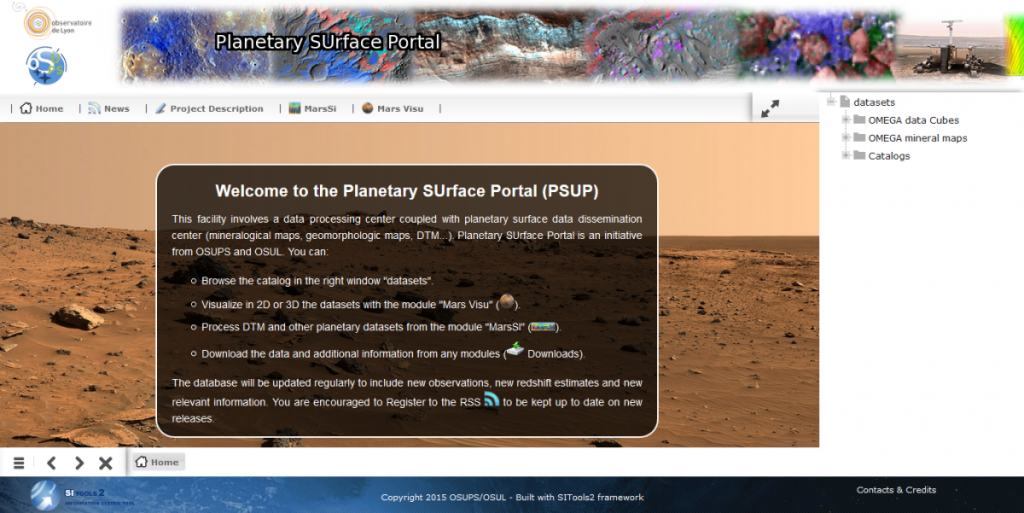
PSUP, a gateway to Mars
The PSUP (Pôle des SUrfaces Planétaires) service consists of a Martian surface data processing center coupled with a high-value-added data dissemination and visualization center.
The PSUP (Pôle des SUrfaces Planétaires) service consists of a Martian surface data processing center coupled with a high-value-added data dissemination and visualization center.
The International Astronomical Union (IAU) has approved the naming of asteroid (20747) Tanialepivert in honor of Tania Le Pivert-Jolivet, a former PhD student at the Institute of Space Astrophysics (IAS) and currently a postdoctoral researcher at the Astrophysics Institute of the Canary Islands (IAC), for her contributions to the study of primitive asteroids.
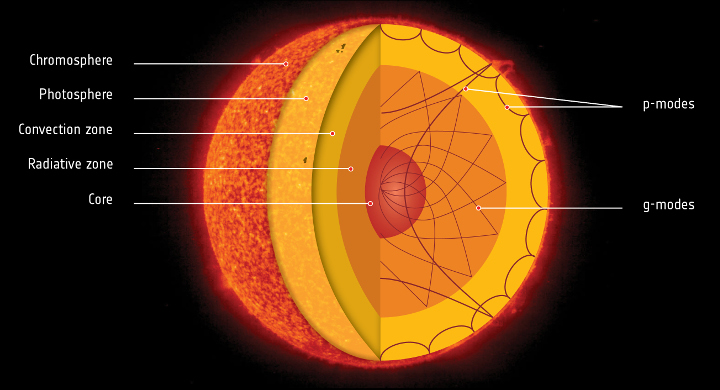
Data from the GOLF instrument on board the SOHO spacecraft (ESA and NASA) have enabled the first detection of gravity modes, seismic waves that carry the physical properties of the deepest solar layers.
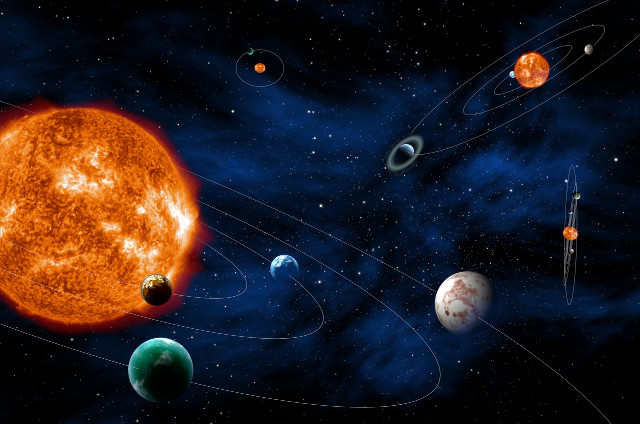
The PLATO (PLAnetary Transits and Oscillations of stars) space observatory, designed to study planetary transits and stellar oscillations, was selected on February 19 by the ESA Science Programme Committee as part of its Cosmic Vision program.
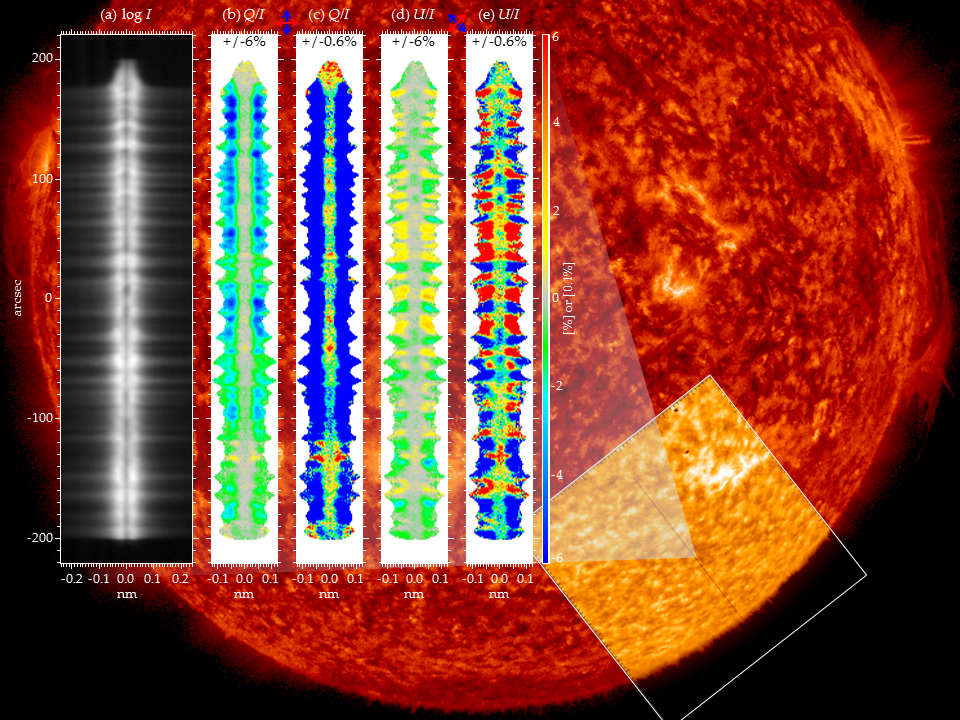
Using data from the CLASP sounding rocket spectropolarimeter, researchers have for the first time observed a direct signature of the magnetic field in the chromosphere, a region of the Sun's upper atmosphere.
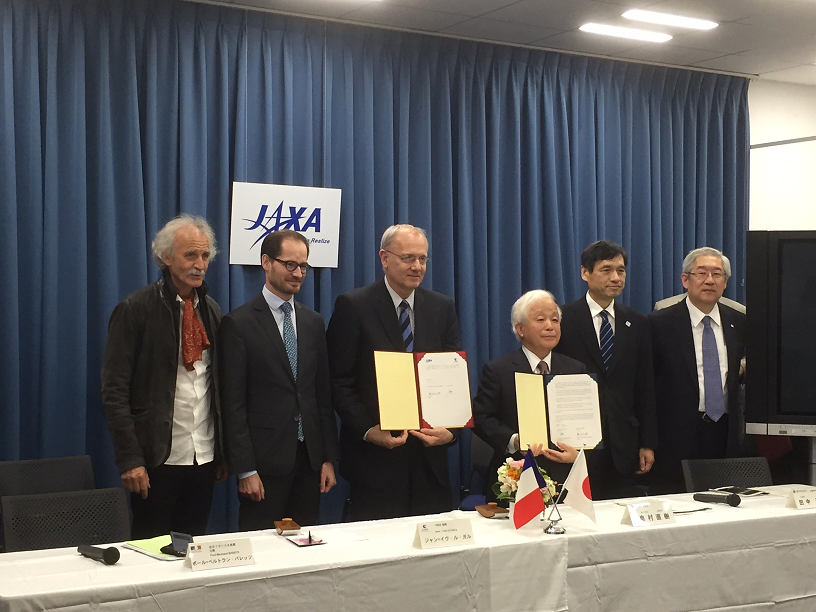
On Monday, April 10, 2017, at the headquarters of JAXA (the Japanese space agency) in Tokyo, CNES President J.-Y. Le Gall and N. Okumura, his counterpart at JAXA, signed a scientific and technical cooperation agreement for the implementation of the MMX mission to explore Phobos and Deimos, the two moons of Mars.
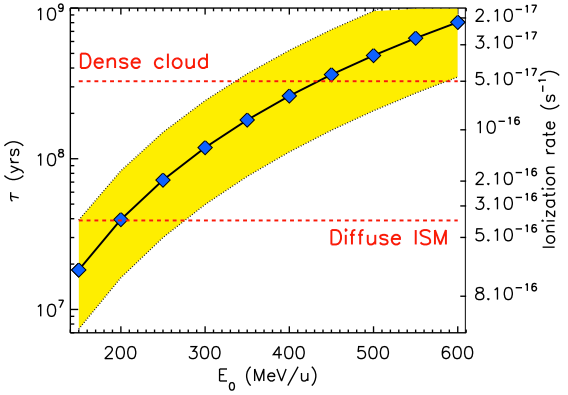
A multidisciplinary team involving researchers from IAS, IPNO, ISMO, and CSNSM in Orsay, alongside GSI in Darmstadt (Germany), has characterized in the laboratory the effects of heavy cosmic rays on the structural modification and sputtering of small carbonaceous species released when simulated and accelerated cosmic rays from the GSI accelerator impact a carbonaceous interstellar dust grain analogue.

Nabila Aghanim, CNRS Research Director at the Institut d’Astrophysique Spatiale in Orsay, has just been awarded the CNRS Silver Medal, a distinction that "each year honors researchers for the originality, quality, and significance of their work, recognized at both national and international levels, thereby contributing to the prestige of the CNRS and the excellence of French research."
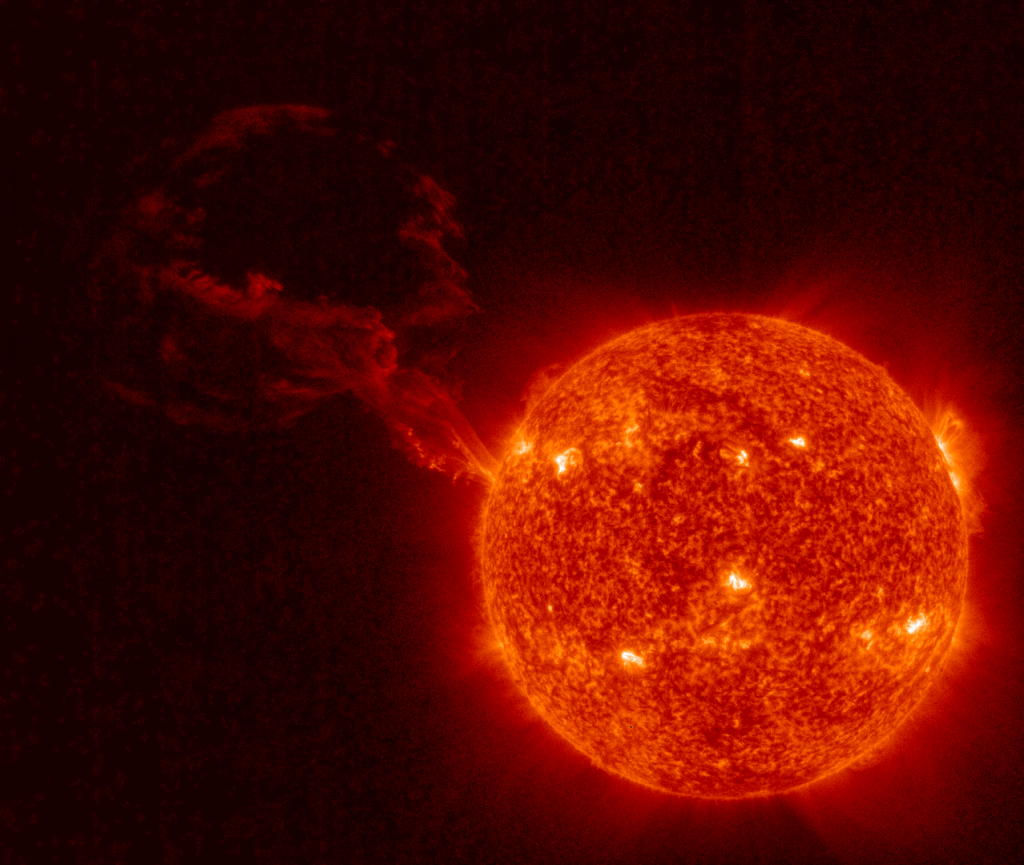
The Sun is currently in a quiet phase of its activity cycle; the next solar maximum is expected in roughly five years, but a severe solar storm can occur at any time, not necessarily at the peak of the solar cycle.
Led by Nabila Aghanim, the ByoPiC project (funded by the ERC under an Advanced Grant) aims primarily to address one of the major questions in physical cosmology: where is half of the ordinary matter—baryons—hidden within the cosmic web in the late universe?