An experimental simulation of the ejection of carbon-bearing species from interstellar grains exposed to cosmic radiation

A multidisciplinary team involving researchers from the IAS, IPNO, ISMO, and CSNSM in Orsay and from GSI in Darmstadt (Germany) has characterized in the laboratory the effects of heavy cosmic rays on the structural changes and sputtering of small carbon-based species released when cosmic rays—simulated and accelerated at the GSI accelerator—impact a carbon-based interstellar dust grain analog. Measurements taken during such simulations provide insight into the processes induced by radiation observed in space and their relative importance. The goal of these studies is to provide data on the evolution of interstellar matter, to understand its evolution, and to provide constraints for modelers of astrophysical environments.
Interstellar dust grains are immersed in a radiative environment comprising high-energy ultraviolet radiation and cosmic rays (high-energy particles), which influence their physicochemical composition. As a result of the induced ionizing interactions, carbonaceous dust particles present in the interstellar medium release fragments that have a direct impact on the evolution of gas-phase chemistry.
 
The exposure of carbonaceous interstellar dust to cosmic rays is simulated in the laboratory by irradiating films of interstellar analogs of hydrogenated amorphous carbon with high-energy ions. New species formed and released into the gas phase are being investigated.
 
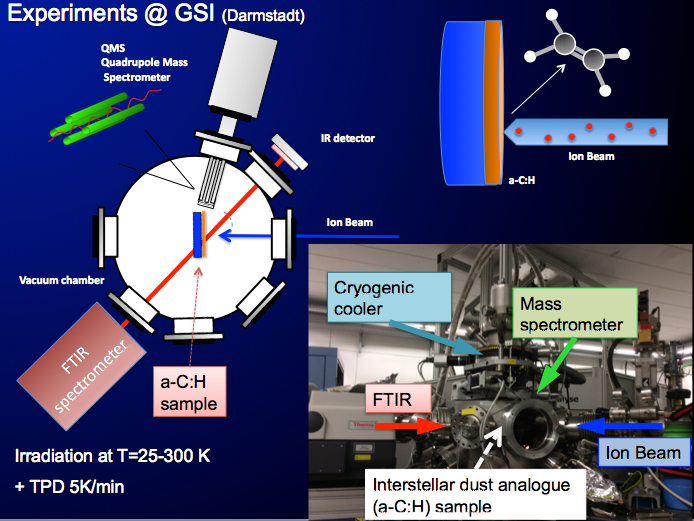
During these experimental simulations, thin films of hydrogenated amorphous carbon (known as aC:H)—astrophysical analogs of the dust that givesrise to a spectroscopic signature typically observed at 3.4 μm in the diffuse interstellar medium of galaxies—were irradiated with gold ions (950 MeV), xenon (630 MeV), and carbon (43 MeV) ions at the GSI UNILAC accelerator (see Fig. 1 for a view of the experimental setup). The evolution of the dust analogs was monitored in situ as a function of fluence (total number of incident ions per unit area) at 40, 100, and 300 K, since interstellar dust can be very cold.

Fig. 1: View of the experimental setup used to study the irradiation of interstellar dust analogs at GSI. The M branch is equipped with a Fourier-transform infrared (FTIR) spectrometer, a mass spectrometer (QMS), and a cryogenic sample chamber under high vacuum, which is coupled to GSI’s UNILAC accelerator, which delivers beams of fast heavy ions.
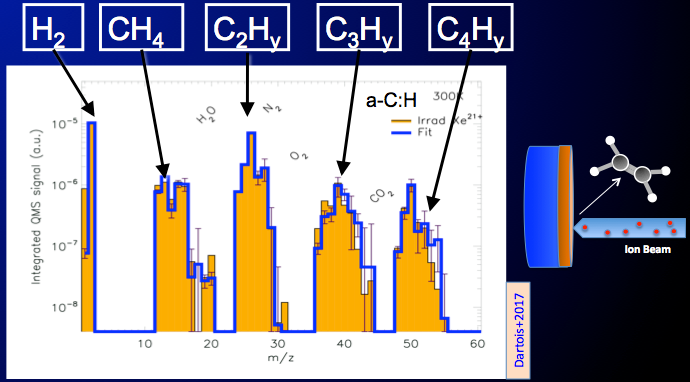
Les effets sur la phase solide sont étudiés par spectroscopie infrarouge complétée par l’enregistrement simultané des spectres de masse des espèces libérées dans la phase gazeuse. Les espèces spécifiques produites et libérées sous le faisceau ionique sont analysées. Le principal produit de radiolyse est l’hydrogène moléculaire H2, participant à la déshydrogénation du grain carboné (a-C:H) dans un contexte astrophysique. Ces irradiations montrent également que la production de nombreux petits hydrocarbures (CxHy; x = {1, 4}) est efficace avec des ions lourds rapides (voir Fig. 2), et augmente au cours de la production de H2 avec l’énergie déposée.
 
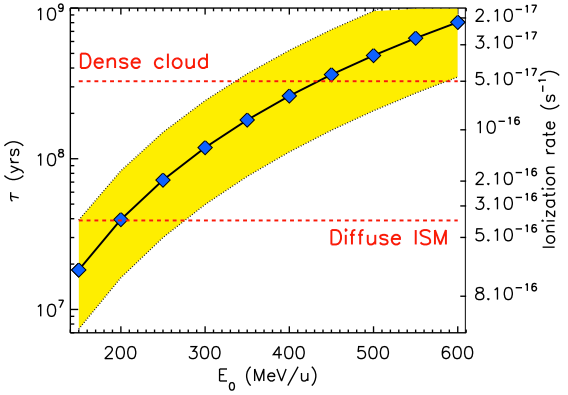
The cross sections derived from experiments on interactions with fast heavy ions were incorporated into an astrophysical model, showing that the effect of cosmic-ray irradiation is significant in intermediate-to-dense regions where the high-energy component of cosmic rays penetrates much deeper than external ultraviolet radiation, and reaches equilibrium at depth with the secondary ultraviolet field produced by the interaction of cosmic rays with H2 (see Figure 3).
 
The production of these carbon-bearing species through this so-called “downward” process (grain destruction) will contribute to the erosion of a-C:H dust grains. The extent of this process will depend on the initial hydrogen content of the interstellar dust grains. If the hydrogen content is high—either intrinsically or due to hydrogenation through interaction with ambient hydrogen gas—the production of small volatile carbon species is efficient and leads to the complete destruction (“volatilization”) of the grains, while the released species enrich the gas-phase chemistry. This efficiency is expected to decrease if the hydrogen content becomes much lower and the grains eventually evolve into a polyaromatic structure. The species released during experiments simulating cosmic-ray ions on less hydrogenated, more polyaromatic interstellar analogs will be studied in upcoming dedicated experiments.
Fig. 2: Signal from the integrated mass spectrometer over the irradiation time for an interstellar analog a-C:H sample irradiated with the ion 132Xe21+ (orange bars) at 300 K. The best-fit model of the sum of the species contributing to the signal is shown in blue. The boxes above mark the regions corresponding to the different groups of measured carbon-bearing gaseous species, and the positions where residual contaminant gases from the vacuum chamber could contribute are indicated.
Fig. 3: Characteristic time for the destruction of carbon-hydrogen bonds in an interstellar grain due to galactic cosmic ray irradiation, as a function of various assumptions regarding the spectrum of low-energy ions in these cosmic rays (using a parameter E0). The shaded area indicates the measurement uncertainty relative to the measured cross sections. The corresponding calculated ionization rate is shown on the opposite axis. The observed interstellar ionization rates for dense clouds and the average values for diffuse clouds are shown as dotted lines.

Contacts

Advisors (scientific and technical)

References

E. Dartois, M. Chabot, T. Pino, K. Béroff, M. Godard, D. Severin, M. Bender, and C. Trautmann. (2017). Swift heavy-ion irradiation of interstellar dust analogues: Small carbonaceous species released by cosmic rays. Astron. Astrophys., 599, A130, DOI: 10.1051/0004-6361/201629646
Note: The results were obtained using the M-branch experimental facility at the GSI Helmholtzzentrum für Schwerionenforschung in Darmstadt, Germany. Interstellar grain analogs were produced using the SICAL-P experiment at the IAS in Orsay. This work was supported by IPNO, INSU, INP, CNRS, and the University of Paris-Sud, with additional financial support from the national PCMI program.
Scroll up