
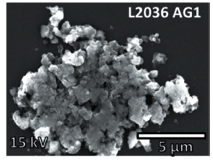
Is anhydrous interplanetary dust derived from icy asteroids?
Analysis of IDPs using infrared microspectroscopy offers two major advantages. In addition to being non-destructive (it does not alter the physicochemical properties of the analyzed samples), it allows for the comparison of laboratory results with astronomical observations made in the same wavelength ranges.
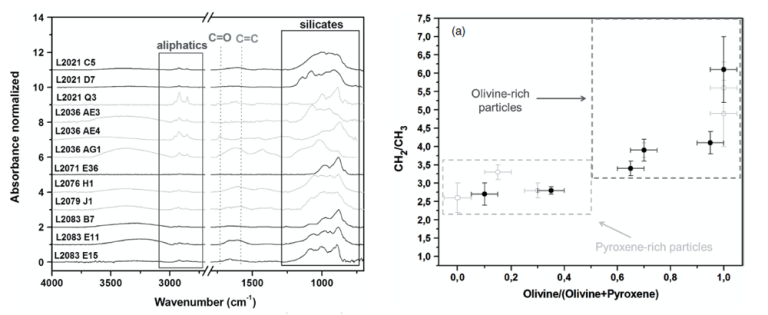
In our study of anhydrous IDPs (Merouane et al. ApJ 2014), we were able to quantify and determine the mineral composition of a dozen dust samples. Two classes with different mineralogies were observed: one rich in olivine and the other rich in pyroxene. Joint analysis of the dust’s organic component allowed us to highlight a close link between the mineral composition of the IDPs and the lengths of the associated aliphatic chains. This study, combining IR and Raman analyses, thus allowed us to conclude that silicates may play a catalytic role in the formation and elongation of aliphatic chains in the protoplanetary nebula. However, the precise origin (asteroidal or cometary) of these dust particles was not elucidated in this initial study.
A collaboration led by P. Vernazza of the LAM (Vernazza et al. 2015, ApJ) subsequently enabled a comparative study of the IR spectra of IDPs obtained at the IAS with those of various primitive asteroids (types B, C, P, and D), as well as with those of comets such as Halley and Hale-Bopp. All of these objects are characterized by very low albedos and are rich in carbon and organic matter. They also contain silicates and, in some cases, an icy component.
This study shows a remarkable correspondence between the spectra of anhydrous, pyroxene-rich IDPs and those of BCG-type asteroids, which account for ~53% by mass of the main belt. P- and D-type asteroids (accounting for ~13% by mass of the main belt), on the other hand, are better represented by anhydrous IDPs composed of a mixture of olivines and pyroxenes, just like the spectra of Halley’s Comet and Comet Hale-Bopp (H-B).
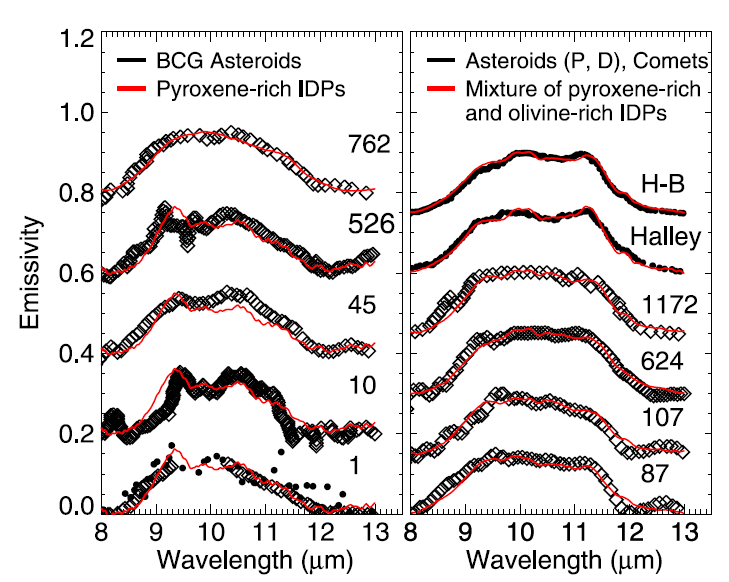
This figure, taken from [2], shows on the left a comparison of the 10 µm band of pyroxene-rich IDPs with those of various BCG-type asteroids (low albedo, rich in carbon and organic matter as well as silicates). On the right, the 10 µm bands of two comets and four P- and D-type asteroids require a mixture of olivine and pyroxene for the best fit.
This study also shows that only anhydrous interplanetary dust has spectral properties consistent with those of ice-rich asteroids. This finding calls into question the status of meteorites as the reference standard for understanding the asteroid belt, in favor of interplanetary dust. While meteorites provide samples of the surface composition of most rocky, metallic, and hydrated asteroids—which constitute the largest proportion—the icy asteroids are not represented by the various meteorites currently held in laboratories. Figure 4 below illustrates the correlations between various small bodies in the solar system (asteroids and comets) and meteorites and IDPs.
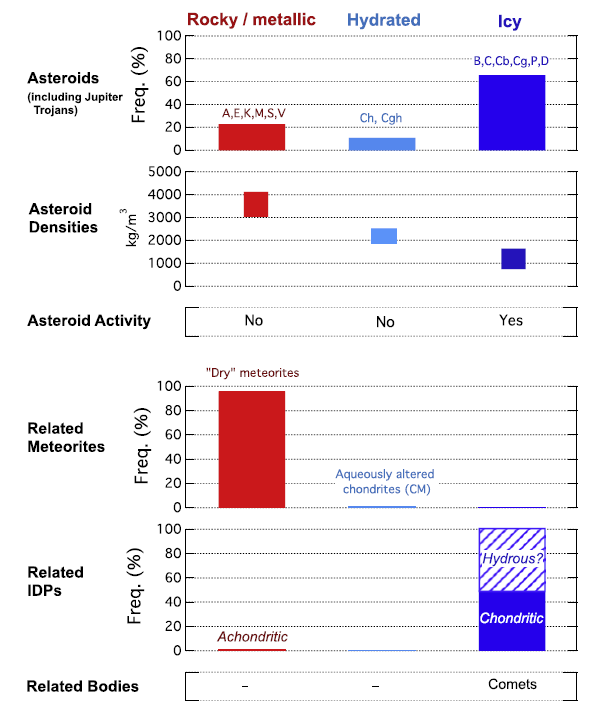
Taken from [2], this histogram shows the correspondence between various small bodies in the solar system and the samples available in laboratories. “Dry” meteorites (those that have not undergone aqueous alteration) are thought to be good representatives of the surface composition of rocky and metallic asteroids. IDPs, on the other hand, are associated with icy asteroids, some of which may exhibit activity similar to that of comets.
Contacts
Advisors (scientific and technical)
- Zahia Djouadi, Associate Professor, Astrochemistry & Origins Team
- Sihane Merouane, MPS
- Louis d’Hendecourt, IAS
- Pierre Vernazza, LAM
- Rosario Brunetto, Research Fellow, Astrochemistry & Origins Team