
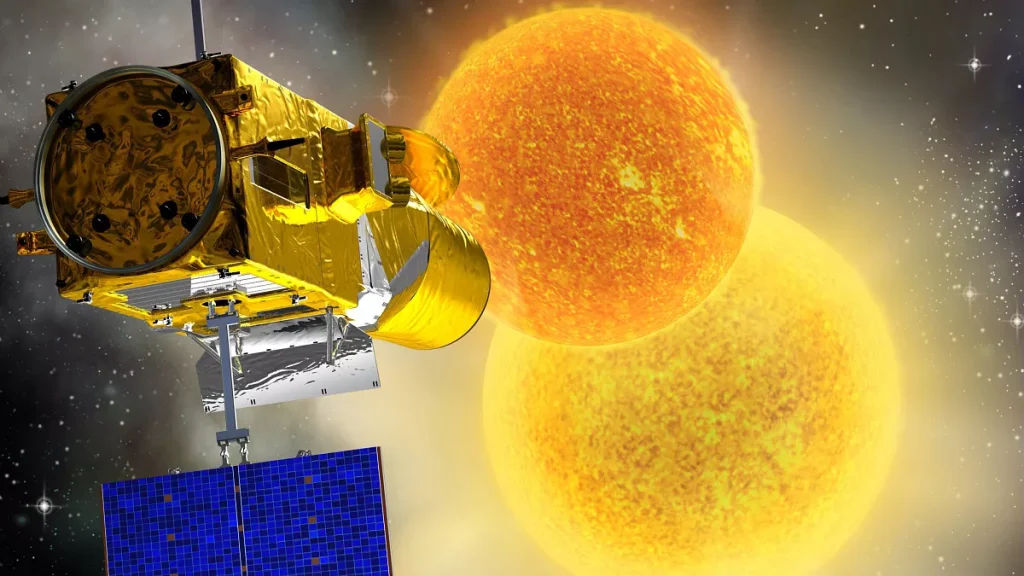
Artist's rendering of the CoRoT space telescope © CNES/ESA/ill./DUCROS David, 2006
CoRoT
CoRoT (Convection, Rotation, Planetary Transits) is a mission led primarily by CNES for the seismic observation of stars and the search for exoplanets. It was launched in late 2006 from Baikonur into a low polar Earth orbit for a duration of 3 years. It ultimately operated until 2013, and its scientific operations continue.
The Role of the IAS
The IAS is directly involved in this mission at various levels:
– Design and construction of an optical subsystem (imaging prism for the exoplanet channel)
– EOptical studies
– EInstrument calibration
– Participation in operations and data processing to achieve photometric accuracy objectives
– Data archiving and distribution
Data access: http://idoc-corot.ias.u-psud.fr/
Status
Archived
Partners (academic / industrial)
Funding Sources
Key Dates (tentative)
Key Steps
Launch: 1995
Launch: 2006
Ceased operations: 2013
Data analysis is still in progress
Contacts
Advisors (scientific and technical)
- Marc Ollivier, Astronomer, Solar System and Planetary Systems Physics Team
- Frédéric Baudin, Solar and Stellar Physics Team
For more information:
The COROT mission (Stellar Convection, Rotation, and Planetary Transits) is primarily a CNES mission (classified as a “small mission”) with two main objectives: asteroseismology and the detection of exoplanets.
Asteroseismology is the technique of studying the interiors of stars by observing their vibration modes, just as a seismograph on the Earth’s surface provides information about our planet’s internal structure. In the case of COROT, this involves studying a star’s vibration modes by observing the slight variations in luminosity (on the order of a few thousandths of a percent) that these modes induce over time. This method is currently the only way to “directly” observe the interiors of stars and should thus provide a better understanding of the internal structure and evolution of stars.
Another objective of COROT is to detect extrasolar planets (planets orbiting other stars) using the “transit” method. This involves detecting the presence of a planet as it passes in front of its star, causing a micro-eclipse. The change in brightness is then directly determined by the ratio of the planet’s apparent surface area to that of the star—approximately 0.01% for an Earth-sized planet orbiting a Sun-like star. In addition to giant extrasolar planets (“hot Jupiters” or “warm Jupiters”—giant planets orbiting close to their star), COROT should therefore detect terrestrial planets orbiting stars other than our Sun.
To achieve these two main objectives (and other secondary objectives), COROT uses a 27-cm-diameter telescope equipped with a CCD camera at its focal point, whose field of view is divided equally between asteroseismology and exoplanetology. The precision required for this type of observation can only be achieved from space, which offers a stable environment free from atmospheric turbulence.
In total, about 100 stars will be studied using “seismic” methods, and more than 50,000 will be examined to detect any planetary companions.