
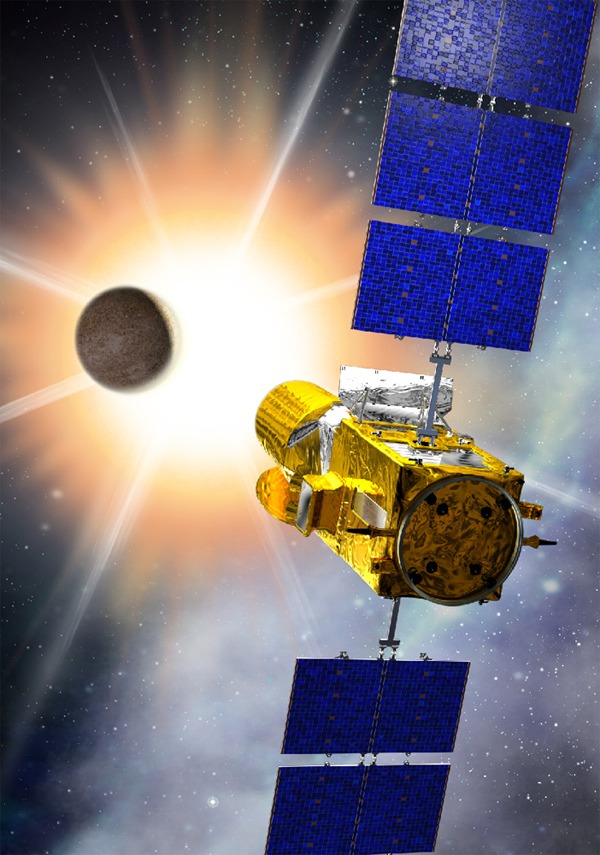
After a mission twice as long as initially planned, CNES's CoRoT satellite—capable of observing stellar oscillations and hunting for exoplanets—is being retired. Launched on December 26, 2006, CoRoT was built by CNES under the scientific responsibility of the Paris Observatory and LAM. IAS participated in its development and data exploitation, and hosts the CoRoT data center. As a pioneering satellite dedicated to the study of stars and the search for extrasolar planets, it demonstrated the effectiveness of its methodology right from launch: ultra-precise measurements (to one ten-thousandth) of stellar light intensity over extended periods (several months) in a nearly continuous manner. This yielded a wealth of unprecedented results, which is far from over since a significant portion of the data remains to be analyzed. In the field of exoplanets, CoRoT opened up the exploration of small planets with the discovery of the first confirmed rocky exoplanet orbiting a solar-type star, thereby proving the advantages of space-based observations. To date, it has revealed 32 planets with around a hundred others awaiting confirmation. Through its complementary ground-based observation program, CoRoT transitioned exoplanet science from the era of detection to the era of characterization and detailed studies.
CoRoT and its ground-based follow-up also pioneered a new path: the joint study of stars and their planetary systems, along with their interactions, such as tidal effects in stars, the impact of stellar radiation on planetary structure, and more.
CoRoT equally revolutionized stellar physics by measuring the frequencies and amplitudes of stellar oscillations with unprecedented precision. These oscillation frequencies, much like musical instruments, provide a unique diagnostic regarding the structure, interior workings, and age of stars. Notably, CoRoT discovered solar-like oscillations in significantly different stars, including more massive or older ones. The goal here is to better understand the internal mechanics of stars, the cosmic factories that forge all the ingredients for planets and life.
While CoRoT's legacy is substantial, it has numerous successors. At ESA, the Cheops mission—selected in 2012 for a 2017 launch—along with the EChO and Plato missions, competing for a 2024 launch, build upon CoRoT's experience. On the ground, numerous exoplanet detection campaigns are currently active. Across the Atlantic, NASA's Kepler satellite (now also retired) followed CoRoT starting in 2009, and the TESS mission has recently been selected. In 2012, despite Kepler's successes, the majority of data downloads from the CoRoT archive originated from the United States.