
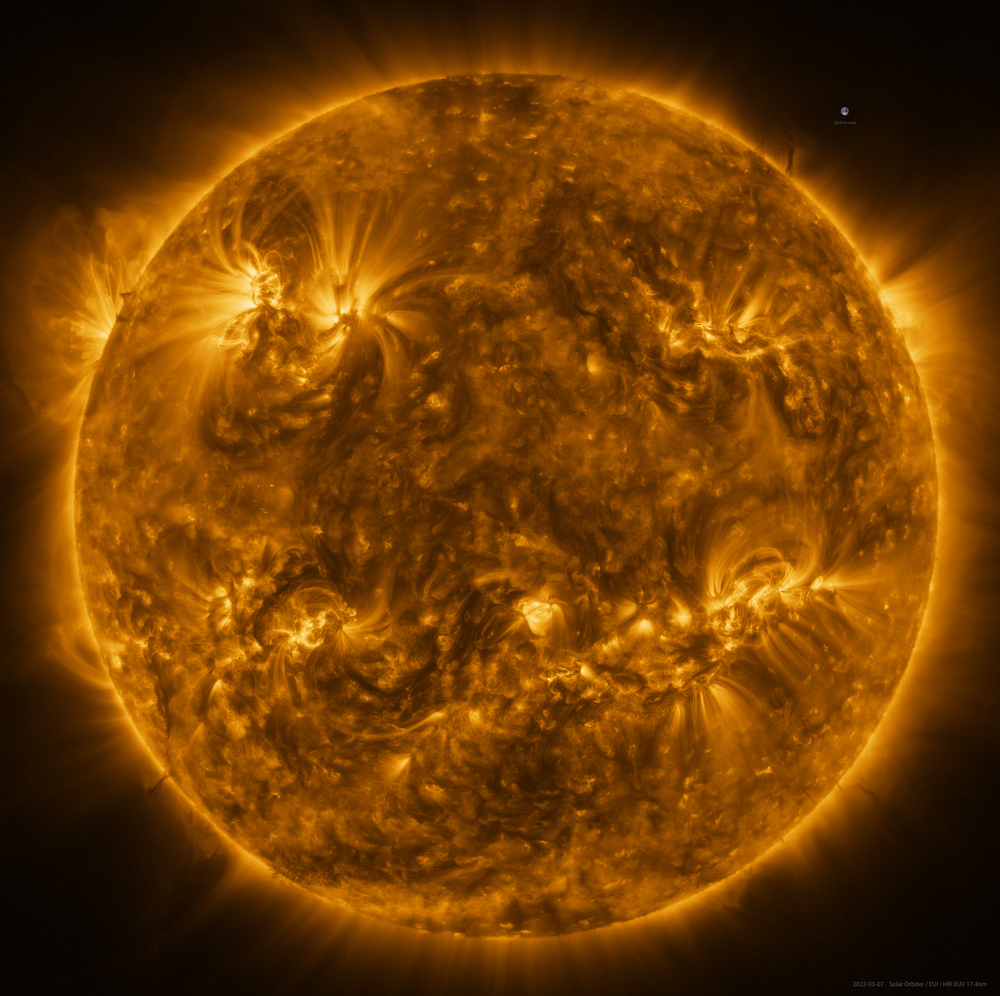
EUI captures images of the Sun in the so-called “extreme” ultraviolet region of the electromagnetic spectrum. The IAS, the instrument’s co-principal investigator, supplied the mirrors and other subsystems for its telescopes. These images reveal the Sun’s upper atmosphere, known as the corona, which has a temperature of about one million degrees Celsius. The EUI’s high-resolution telescope captures images at such a high spatial resolution that, at this close distance to our star, a mosaic of 25 individual images is needed to cover the entire Sun. Taken one after another, these images were captured over a period of more than four hours. In total, the final image contains more than 83 million pixels in a grid of 9,148 × 9,112 pixels. By way of comparison, this image has a resolution ten times higher than what a 4K television screen can display. “The individual images, obtained on March 7 at a distance of 0.5 astronomical units, are already among the highest-resolution images ever obtained of the solar corona. The probe is currently passing at 0.32 astronomical units, and the images obtained show even finer structures! The instrument’s mirrors were jointly developed by the Institute of Space Astrophysics and the Institute of Optics. Their surface never deviates by more than 5 nm from the ideal shape, which is what makes these fantastic images possible,” explains Frédéric Auchère, co-PI of the EUI instrument.
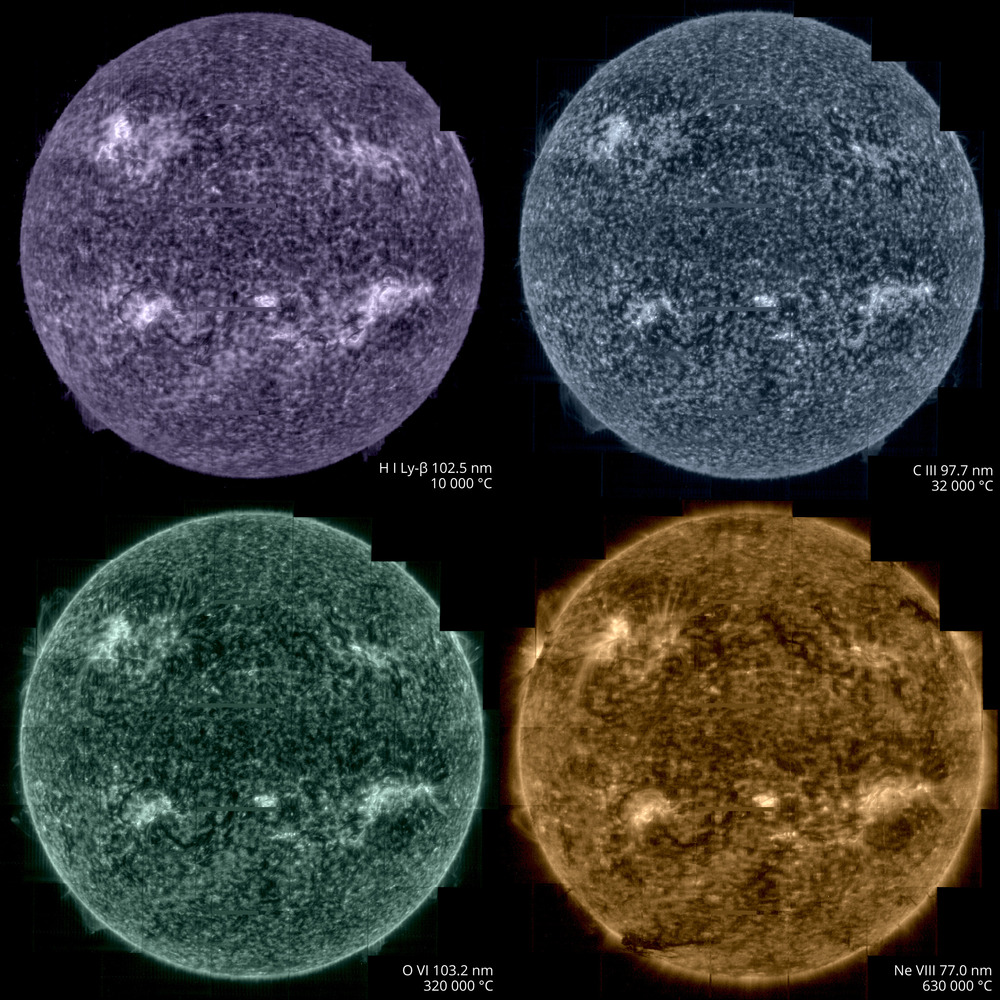
SPICE is designed to track the dynamics of plasma in the layers of the Sun’s atmosphere, from the corona down to a layer known as the chromosphere, which is closer to the surface. To do this, the instrument captures different wavelengths of extreme ultraviolet light emitted by various atoms. The IAS, which supplied the diffraction grating assembly for the SPICE optical system, also leads the instrument’s scientific operations. In the SPICE image sequence, violet corresponds to hydrogen at a temperature of 10,000°C, blue to carbon at 32,000°C, green to oxygen at 320,000°C, and yellow to neon at 630,000°C. The image is composed of 750 images taken during 25 observations, assembled by Gabriel Pelouze (IAS), who says: “It’s meticulous work to piece these small images together. Thanks to this, we obtain maps of specific chemical elements at a given temperature. That’s the major advantage of spectroscopy: we gain access to much more information than we would from simple images.”
This will allow solar physicists to track the powerful eruptions occurring in the corona as they pass through the various layers of the solar atmosphere. It will also allow them to study one of the Sun’s most puzzling phenomena: how the temperature increases as it travels through the atmospheric layers from the surface toward the corona—a mysterious phenomenon that is one of the key scientific objectives of the Solar Orbiter mission.
On March 26, 2022, Solar Orbiter will reach another major milestone in its mission: its first perihelion, a close approach to the Sun. The spacecraft will then be inside Mercury’s orbit, capturing images of the Sun at the highest possible resolution. And this is just the beginning: over the next few years, the mission will return repeatedly, getting closer and closer to the Sun. It will also gradually increase its inclination to observe the Sun’s polar regions, which have not been observed before.