Vibrations
The instruments aboard satellites are subjected to severe vibrations during launches. Vibration testing is used to understand their dynamic behavior, improve and optimize it in accordance with specifications and constraints, and validate their models.
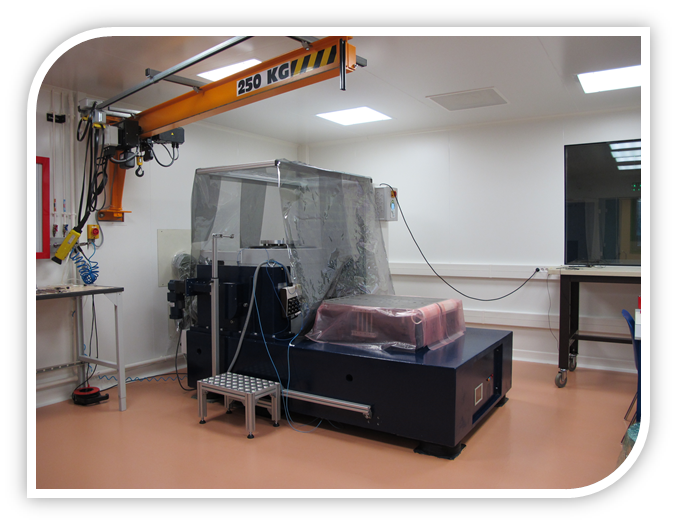
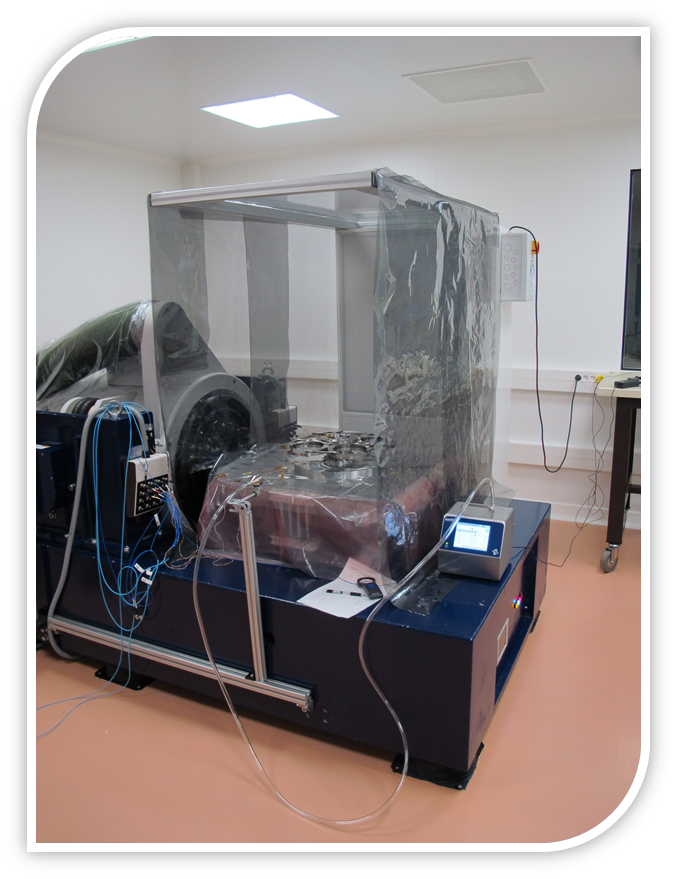
The instrument is placed on a test bench that simulates the actual vibration environment defined in a test profile.
VIBRATING JAR Model: ETS MPA409 M437A GT700
SPESYSTEM SPECIFICATIONSEME:
Sine wave (5 to 2,000 Hz) | 40 kN |
RMS Random Signals (20 to 2,000 Hz) | 40 kN |
Choc (ridge) | 80 kN |
Maximum travel (center-to-center) | 51 mm |
Maximum speed | 2 m/s |
Maximum Acceleration in Peak Sinusoidal (Vertical, No-Load) | 100g |
Interface diameter | 370 mm |
Insert Grid | Ø 150 mm; Ø 300 mm |
Horizontal table | 700 x 700 mm² |
Expansion head | Ø 600 mm |
ENVIRONMENT:
- Charra Hall, classified as an ISO 8 cleanroom
- Insulation of the coil's air-cooling system
- Controlled temperature and humidity
- Daily Particulate Matter Levels
- Positionable ISO 5-class airflow with particle count measurement

SYSTECONTROL SYSTEM:
- Vibpilot software from the company “M+P”
- 32 measurement channels
- Single-axis and three-axis ICP accelerometers
- Test Report and Data Files
