
A prebiotic pathway for ribose formation: the natural formose reaction in the laboratory
The MICMOC experiment, initiated in 2003 at IAS with the objective of coupling astrochemistry and astrobiology, has recently yielded a major and surprising result: the prebiotic formation of the ribose molecule, a key component of RNA, which is widely considered to be the earliest known genetic material in all living organisms.
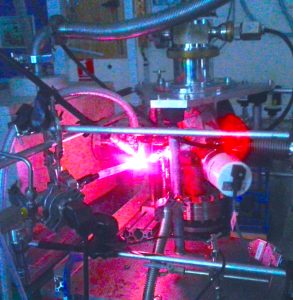
Prebiotic chemistry possesses a distinct characteristic: unlike synthetic chemistry performed by a chemist, it must proceed in an undirected manner through simulations that take into account plausible initial conditions for the formation and evolution of prebiotic molecules. For about a decade, the MICMOC experiment (Figure 1 conducted by the "Astrochemistry and Origins" team at IAS, in close collaboration with analytical chemists from the Nice Institute of Chemistry, has been studying the photochemistry and thermochemistry of laboratory ice analogs representing interstellar and cometary ices, the composition of which is reasonably well constrained by astronomical observations. Numerous prebiotic molecules, such as amino acids, have been detected in the organic residues derived from these ices.
Most recently, the recovery of two molecules—glycolaldehyde (2 carbon atoms), a precursor to sugars, and more importantly glyceraldehyde (3 carbon atoms), the primary sugar of theose family—has provided deeper insight into the prebiotic potential of the simulations conducted at IAS. Indeed, the simultaneous presence in a single simulation of protein precursors (the agents of metabolism) and two sugars involved in the formation of ribose (the precursor of the primordial genetic material) raises compelling questions regarding the impact of these materials on prebiotic chemistry at the surface of a terrestrial planet such as early Earth.
A further, more significant milestone has now been reached, adhering to the same experimental protocol for interstellar ice simulation: the detection of ribose (Figure 2), a molecule utilized in the RNA backbone, along with an entire family of structurally related sugars, accomplished at the Nice Institute of Chemistry using the highly sensitive and selective technique of comprehensive two-dimensional gas chromatography coupled with time-of-flight mass spectrometry. The samples, produced at IAS via the MICMOC experiment (Figure 3) utilizing a laboratory astrophysics approach, were meticulously preserved under an argon atmosphere and shipped to Nice for analysis.
This represents the first genuinely prebiotic synthesis of ribose, given that the molecule was identified through targeted screening rather than synthetic assembly by a chemist. As in Stanley Miller's landmark 1953 experiment, the experimenter merely established a plausible operational protocol, allowing molecular synthesis to proceed along an entirely natural, and thus by definition prebiotic, pathway. However, the true novelty of this finding extends far beyond the production of ribose. Indeed, the diversity of sugars observed in the analysis and their remarkably high absolute abundance suggest the occurrence of an unusual chemical reaction operating in an undirected and therefore natural manner, known as the "formose reaction". Described in 1861 by the Russian chemist Alexander Butlerov, this reaction is well known to prebiotic chemists, who have long sought, without success, such a natural pathway for sugar synthesis. In practice, this reaction requires careful preparation and, in Butlerov's traditional pathway, the use of a strongly concentrated basic catalyst—a reaction condition that cannot be justified on prebiotic grounds. The formose reaction observed during the evolution of these laboratory ices is instead driven by the chain-polymerization of formaldehyde released during the sublimation of ices under progressive sample warming, utilizing glycolaldehyde and glyceraldehyde to generate a cascade of products, including ribose, via an autocatalytic reaction. No basic catalyst is involved in this reaction; it is potentially replaced by the presence of solvated electrons within the irradiated ice that become mobile during ice sublimation. The observed reaction also differs from Butlerov's reaction in that, unlike the latter, it yields substantial amounts of ribose, a molecule typically scarce in the original reaction framework.
Finally, the presence of aldopentoses such as arabinose, threose, and lyxose, alongside glyceraldehyde, clearly highlights the diverse pathways accessible to prebiotic chemistry prior to (or in parallel with) the synthesis of RNA, which is hypothesized to be the precursor of genetic material under the "RNA world" hypothesis formulated 30 years ago by Walter Gilbert. These sugars could have served as the precursors for numerous nucleic acids other than RNA, which remains the sole nucleic acid utilized by contemporary life for reasons yet to be fully elucidated.
The identification of a natural autocatalytic reaction leading to the production of ribose can be regarded as a major breakthrough in prebiotic chemistry, achieved under physicochemical conditions compatible with those known to exist in comets, for instance. It offers a potential answer regarding the exogenous delivery of prebiotic materials to the surface of the primitive Earth. Future research must now focus on elucidating the pathways of chemical evolution in a planetary environment that ultimately led to the RNA found across all extant living systems.
Figure 1: Overview of the MICMOC experiment conducted at IAS. The cryostat (vertical component in the center) is used to deposit a gaseous mixture onto a window cooled with liquid nitrogen, forming an ice layer. A plasma lamp produces high-intensity ultraviolet radiation to activate chemical reactions within these ice layers. Warming the ice at the conclusion of the experiment yields an organic residue that is subsequently extracted, preserved, and analyzed at the Nice Institute of Chemistry.
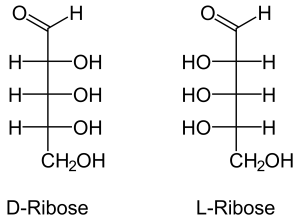
Figure 2: Schematic representation of D-ribose, a chiral molecule existing in two enantiomeric forms, right-handed (D) and left-handed (L).
The current synthesis in MICMOC yields a racemic mixture of both enantiomers (D=L).
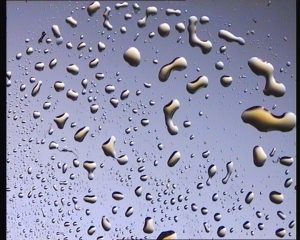
Figure 3: Organic residues produced by the MICMOC experiment, viewed under a light microscope.
The image represents approximately 3×3 mm (© P. Modica).
Contacts
Scientific and Technical Contacts
Louis Le Sergeant d’Hendecourt, 0613162538
Pierre de Marcellus
References
C. Meinert, I. Myrgorodska, P. de Marcellus, T. Buhse, L. Nahon, S. Hoffmann, L. Le Sergeant d’Hendecourt, U.J. Meierhenrich, “Ribose and related sugars from ultraviolet irradiation of interstellar ice analogs”, Science, 352, 208-212 (2016)