
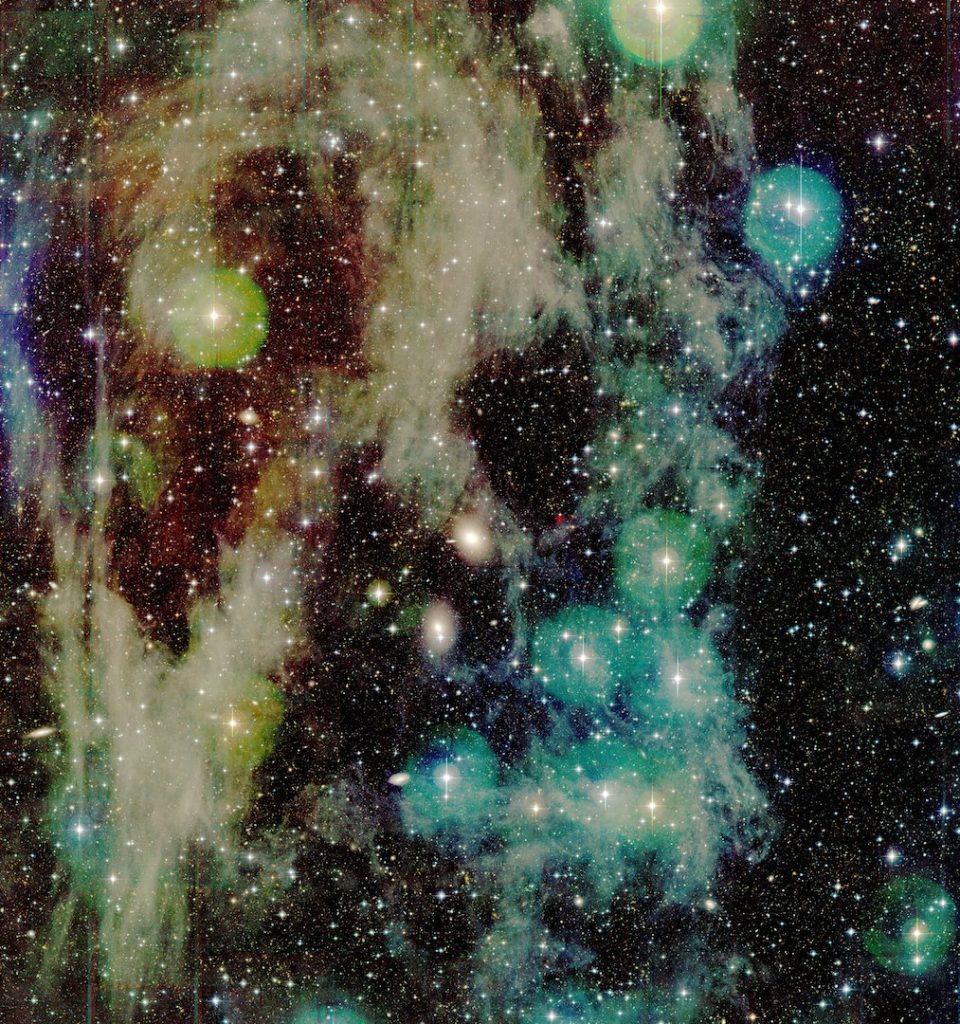
An innovative application of deep optical imaging: small-scale probing of the interstellar medium structure
By combining multi-wavelength observations obtained from space with Planck and WISE and from the ground with the CFHT, a team of researchers has successfully probed the structure of diffuse interstellar matter over several square degrees with unprecedented resolution. Specifically, the study determined the properties of interstellar turbulence over a previously unreached range of spatial scales: from 10 to 0.01 pc.
The main innovation of this work is the use of an optical telescope (the CFHT) to study the structure of matter at very high spatial resolution, which is not possible with conventional infrared observations of the interstellar medium. Direct mapping of dust clouds—the cirrus—located just a few hundred parsecs from the Sun was achieved by detecting light scattered by interstellar grains. Specific deep observation and image processing techniques developed as part of the CFHT Large Program MATLAS revealed this very faint light, which appears as a complex network of filaments of all sizes.
The gain in resolution makes it possible to reach the scales where the dissipation of interstellar turbulence energy takes place. Understanding the exact process by which kinetic energy dissipates is crucial as it lies at the heart of the formation of dense structures in the interstellar medium where stars subsequently form. For example, recent studies based on infrared observations with Herschel of molecular clouds tend to show that there are filaments with a transverse size of 0.1 pc, regardless of their mass. This observational fact has been attributed to the turbulence dissipation scale via ambipolar diffusion (friction between ions and neutrals). The researchers demonstrated that the dissipation scale of the diffuse interstellar medium is smaller than 0.01 pc, imposing strong constraints on the exact mechanism responsible for this dissipation.
The optical emission of the cirrus contaminates many deep optical images initially intended to map the diffuse stellar structures surrounding massive galaxies. This study demonstrates that this component actually contains valuable information on the physical processes at play in the interstellar medium of our Milky Way.
References
Scientific article:
M.-A. Miville-Deschênes, P.-A. Duc, F. Marleau, J.-C. Cuillandre, P. Didelon, S. Gwyn, E. Karabal, Probing interstellar turbulence in cirrus with deep optical imaging: no sign of energy dissipation at 0.01 pc scale, A&A, in press