
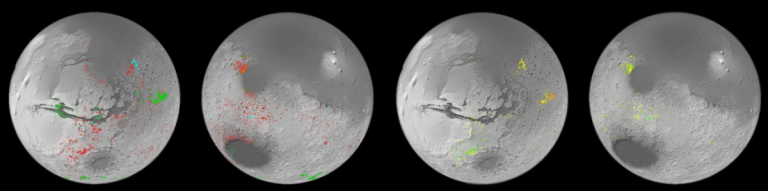
A new map of aqueous alteration on Mars
Research conducted within the Solar System team has provided the first global, high-resolution map of so-called "hydrated" minerals on the Martian surface. These minerals share the characteristic of having formed via chemical interactions between Martian rock and liquid water, and frequently contain water trapped within their crystalline structure. Consequently, they serve as exceptional tracers of Mars' ancient aqueous environments and represent primary targets for astrobiology.
This global mapping effort, which took over 10 years to compile, highlights several hundred thousand sites of aqueous alteration on Mars, compared to approximately one thousand previously known sites. Crucially, it reveals that the oldest Martian surfaces (dating back more than 3.7 Ga) are altered by water almost everywhere, reshaping our understanding of early Mars. Many of the mineralogical sites thus discovered are undergoing further investigation due to their high scientific potential, particularly in the context of in-situ Martian exploration. This led to the selection of Oxia Planum as the landing site for the ESA ExoMars rover. The global mineralogical view provided by this cartography will also help contextualize known or currently explored sites.
On Earth, certain hydrated minerals such as clays (phyllosilicates) or salts (sulfates) are renowned for their potential to sequester and preserve organic matter, notably in sedimentary geological settings. Identifying sites with similar composition and geology on Mars from orbit makes them prime candidates for the exploration of Martian organic matter and its exobiological potential.
Ultimately, this mineral map will help better constrain the volume of Martian water currently trapped within its rocks, addressing a key question in Mars' history: did the planet "drink" the majority of its water into its crust? Another long-term objective is to propose landing sites for future human missions where these mineral deposits will enable in-situ resource utilization via the extraction of volatiles (including water) and use as construction materials.
This mapping work is published in two papers, one focusing on fine-scale distribution and the other on mineral abundances:
A Mars Orbital Catalog of Aqueous Alteration Signatures (MOCAAS) by J. Carter et al is in press in Icarus. 10.1016/j.icarus.2022.115164
The M3 project: 3 – Global abundance distribution of hydrated silicates at Mars by L. Riu et al is published in Icarus, Volume 374, 2022.