A Complex Magmatic History on Mars
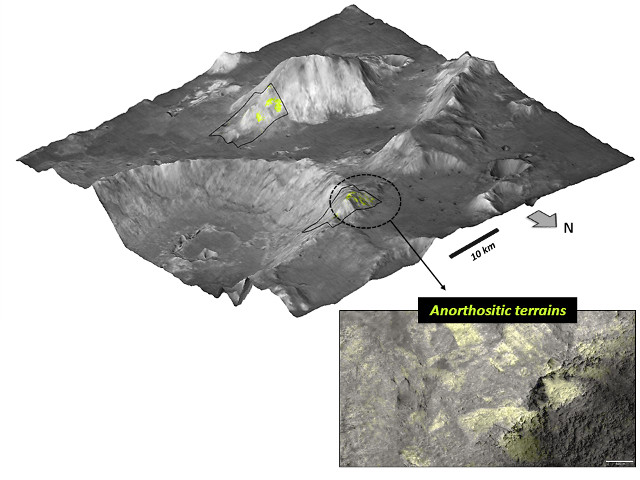
Mars is a volcanic planet whose surface is almost entirely covered by basaltic rocks. Despite numerous space missions, the magmatic evolution of Mars remains poorly constrained due to a lack of samples and instruments capable of determining its internal structure. Its highly uniform composition across large spatial scales was often attributed to a simple magmatic evolution. This assumption has recently been challenged by a study conducted jointly at IAS and ESO, which led to the discovery of a new rock type on Mars.
This rock type is similar to anorthosites, which consist of plagioclase feldspar (90–100%) and a minor amount (0–10%) of mafic components. The presence of these rocks—previously known only in rare locations on Earth and within ancient lunar terrains—demonstrates that Mars experienced a more complex magmatic history than previously thought. Furthermore, their discovery opens up new perspectives for studying the primordial mechanisms of magmatic evolution and crustal formation, which now become accessible on a planet other than Earth.
These discoveries were enabled by NASA's Mars Reconnaissance Orbiter and ESA's Mars Express missions, notably through the CRISM and OMEGA spectrometers.
References
Carter J. and F. Poulet, Ancient plutonic processes on Mars inferred from the detection of possible anorthositic terrains, Nature Geo. This article is also the subject of a "News & Views" commentary in Nature Geoscience.
Link: http://www.abc.net.au/science/articles/2013/11/18/3891945.htm