
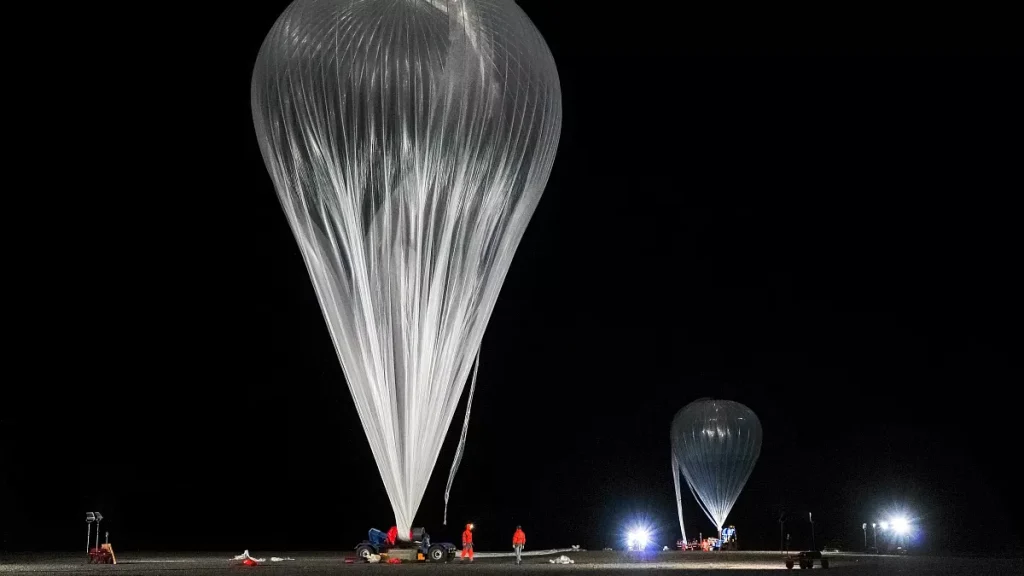
The PILOT instrument took off on the morning of September 24 from Timmins Airport (Ontario, Canada). This third flight of the instrument, carried by a stratospheric balloon, lasted 25 hours, including three hours of ascent, one hour dedicated to instrument calibration, and 20 hours of scientific observations at the ceiling altitude (approximately 38 km during the day and 34 km at night). All flight systems and the scientific instrument performed as expected, and the data obtained are of very high quality.
The instrument ended its flight 900 km northeast of Timmins, north of Montreal. The payload landed just 200 m from a lake (and fortunately not in the lake). It was brought back to Timmins by the French-Canadian recovery team, dried and cleaned, and is currently en route by ship to Toulouse. Aside from minor scratches on some optical surfaces, it appears that the instrument was not damaged.
PILOT consists of a mirror approximately one meter in diameter and an array of several bolometer matrices (similar to those in the Herschel/PACS instrument), divided into two focal planes after the beam is split by a polarizer. The scientific objective is to measure the polarized emission from dust grains in the interstellar medium. For this third flight, replacing the helium-3 adsorption cooler with one developed more than 25 years ago for the PRONAOS experiment made it possible to cool the detectors to lower temperatures than during the two previous flights (between 295 and 300 mK), without requiring in-flight recycling.
This flight made it possible to observe all of the planned astrophysical sources, in particular the Crab Nebula, the Andromeda Galaxy, and several galactic regions and star-forming regions. The entire scientific team is excited to analyze these new data, especially by combining them with the data obtained during the instrument’s first flight, which were not usable on their own.
PILOT is the result of a collaboration between CNES, IRAP, IAS, CEA, Cardiff University, and the University of Rome. IAS serves as the prime contractor for the PILOT photometer. Contact at IAS: Bruno Maffei