
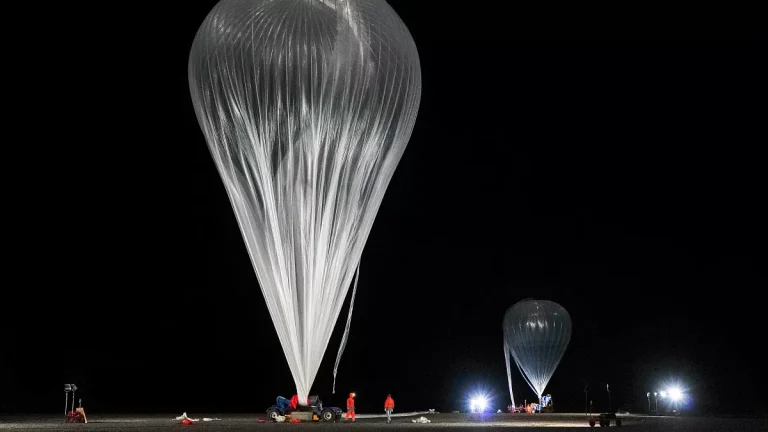
The balloon carrying the PILOT instrument was launched from the Timmins base in Canada at 9:00 p.m. (local time) on Sunday, September 20, 2015. The payload, weighing more than one metric ton—the heaviest carried by CNES in 25 years—was lifted by an 800,000 m³ stratospheric balloon and reached an altitude of 39,500 m after a 3-hour ascent. After a final helium transfer carried out shortly before takeoff, the detectors reached their nominal operating temperature of approximately 320 mK upon reaching the flight ceiling, and scientific observations were then able to begin promptly.
For more than 20 hours, PILOT observed the far-infrared sky using its controlled pointing system, which combines azimuth movements (rotation around the suspension axis beneath the balloon) with elevation movements of the telescope itself. This controlled pointing is then reconstructed with very high precision, both day and night, thanks to a stellar sensor developed specifically for the PILOT project.
PILOT was thus able to measure the intensity and polarization of various regions of the sky observable from the northern hemisphere, including, among others, part of the galactic plane, Taurus, Orion, the Andromeda Galaxy, cold cores where star formation occurs, and regions of very diffuse galactic dust emission. These regions also help us understand the galactic contribution to observations of the polarization of the Cosmic Microwave Background.
At 9:00 p.m. local time on Monday, September 21—24 hours after liftoff—CNES engineers initiated the separation of the payload fairing. After descending under its parachute, the fairing made a hard landing—due to a sudden gust of wind on the ground—in a wooded (and dry!) area. The gondola’s structure fully fulfilled its role by cushioning the impact with the trees, and the instrument’s sensitive components were not damaged. Today, the instrument is on its way back by sea, and further diagnostics and testing of the cryostat and detectors will begin in November, particularly at the IAS, which is responsible for the photometer. These are the first steps toward preparing for PILOT’s second flight, scheduled for April 2017 from Australia.
The balloon, payload, pointing system, cryostat, detectors, and optics all performed as expected. Data processing, which has begun at IRAP and IAS, will enable the production of the most comprehensive and precise maps of galactic dust polarization ever measured. These maps will lead to significant advances in our understanding of the matter cycle and the structure of our galaxy’s magnetic field. The observation of polarized galactic emission at 240 µm (1250 GHz), combined with that measured by the Planck satellite at 850 µm (353 GHz), will also lead to major advances in our understanding of the electromagnetic spectrum of dust. This is a key step toward measuring the B-modes of polarization in the Cosmic Microwave Background, as demonstrated by recent work—partly coordinated at the IAS—on data from the Planck satellite and the BICEP2 ground-based telescope.
PILOT is a project developed by CNES in collaboration with CNRS laboratories (IRAP and IAS), the University of Toulouse 3 Paul Sabatier, the University of Paris-Sud 11, and the CEA, with contributions from La Sapienza University of Rome and Cardiff University, under the scientific direction of Jean-Philippe Bernard of IRAP.
Contacts at IAS: Jonathan Aumont, Jean-Pierre Dubois, François Boulanger