
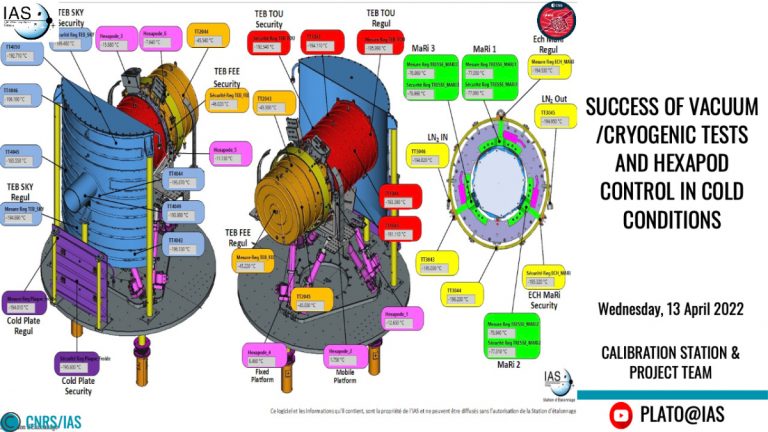
The PLATO project has reached a new milestone in the development at the IAS of the calibration setup for the cameras intended for use on the satellite. Validation tests of the facilities began in early March, using cryogenic vacuum infrastructure designed and deployed in the Saturn thermal chamber at the calibration station. All tests have just been successfully completed.
These tests included the following steps:
1. Verification of the proper functioning of the control system, including cryogenic vacuum alarms.
2. Validation of the distribution and filling of liquid nitrogen for all thermal shields surrounding the camera. These shields ensure that the desired temperature is achieved.
3. Optimization of fluid consumption and control settings to achieve stabilization at the required cryogenic temperature based on scientific requirements during image acquisition.
4. Validation of the thermal component of the camera’s control system (EGSE), specifically ensuring the critical function of maintaining the cameras at a minimum survivable temperature despite the surrounding space cold.
5. Validation of the movements of the hexapod, which will support the camera, under actual operating conditions in cold and vacuum environments. Since the excellent stability and precision required for calibration had already been verified when the chamber was open, the next step is to verify their reproducibility in this new environment.
All of these steps have been fully validated, demonstrating a high level of expertise and quality of preparation over more than two years of development.
The next steps will include, in particular, the validation of the calibration automation scripts for image acquisition and the configuration of the optoelectronic environment. Finally, the compliance of the light beams from the optical bench with specifications must be verified in order to best simulate the signal from the stars that will be observed by each camera during the PLATO mission.