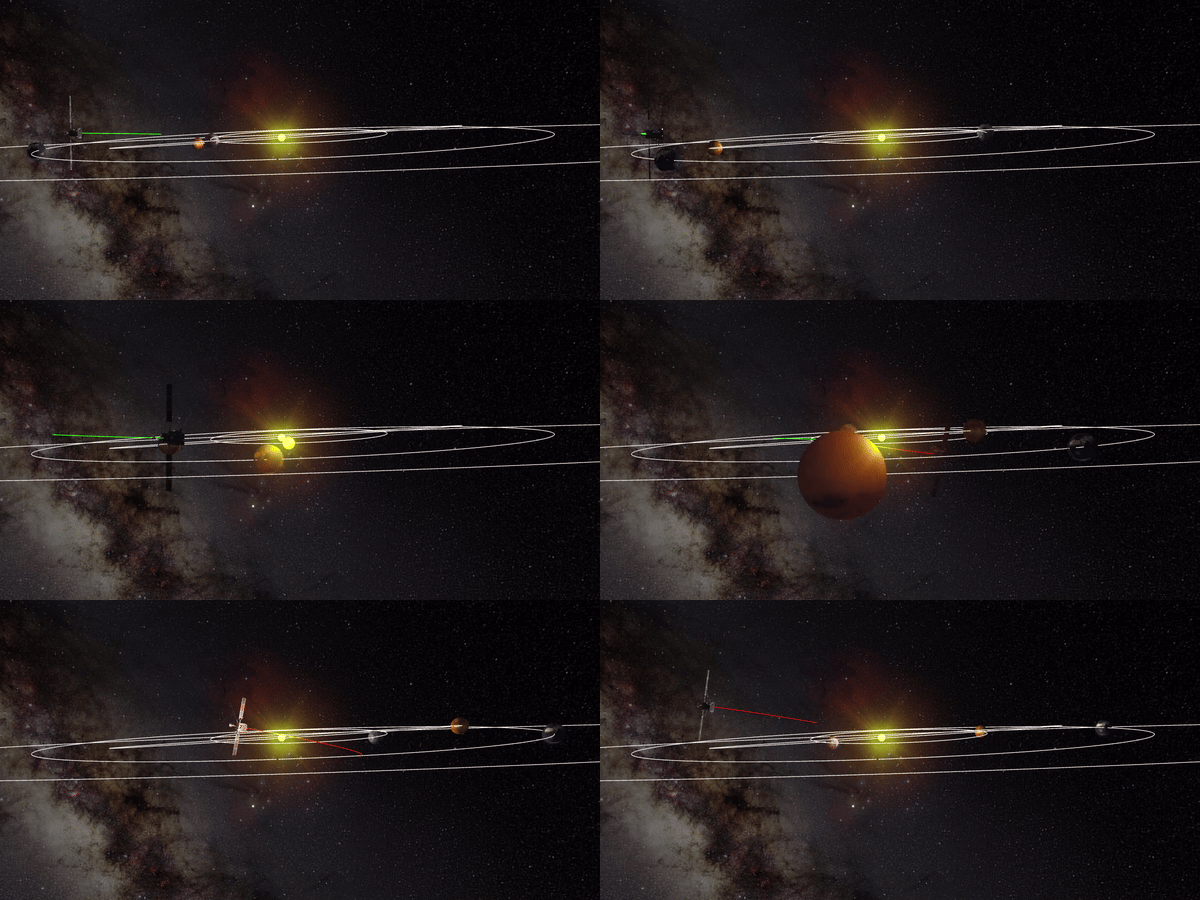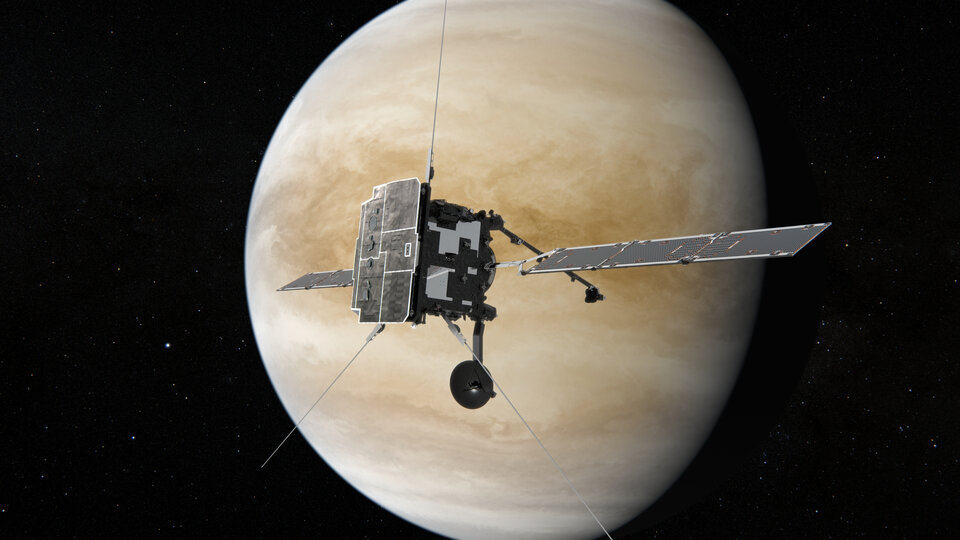
“Getting this close to the planet allows us to use its gravity to significantly alter the satellite’s orbit without using much fuel,” explains Julia Schwartz, a flight dynamics expert at ESA. “The planets in our solar system orbit the Sun in the same plane—the ecliptic plane. Today’s flyby of Venus will use the planet’s gravity to significantly tilt Solar Orbiter’s orbit relative to this plane. This will give Solar Orbiter a much better view of the Sun’s polar regions, which cannot be seen from the plane of the ecliptic.” Future flybys of Venus, such as the one in December 2026, will further tilt the spacecraft’s orbit and enable high-resolution images of the Sun’s entire polar regions.
Flying this close to Venus presents a number of challenges for the team at ESA’s European Space Operations Centre (ESOC) in Germany. Precise calculations and minor trajectory corrections were necessary before and after the flyby to keep the spacecraft on course. Several parts of the spacecraft experienced significant temperature increases, but all components remained well below their design limits.
During the maneuver, Solar Orbiter’s MAG and RPW instruments remained active to record the planet’s magnetic and plasma environment. Initial results show that Solar Orbiter passed through Venus’s ionosphere, which interacts with the solar wind in a unique way.