
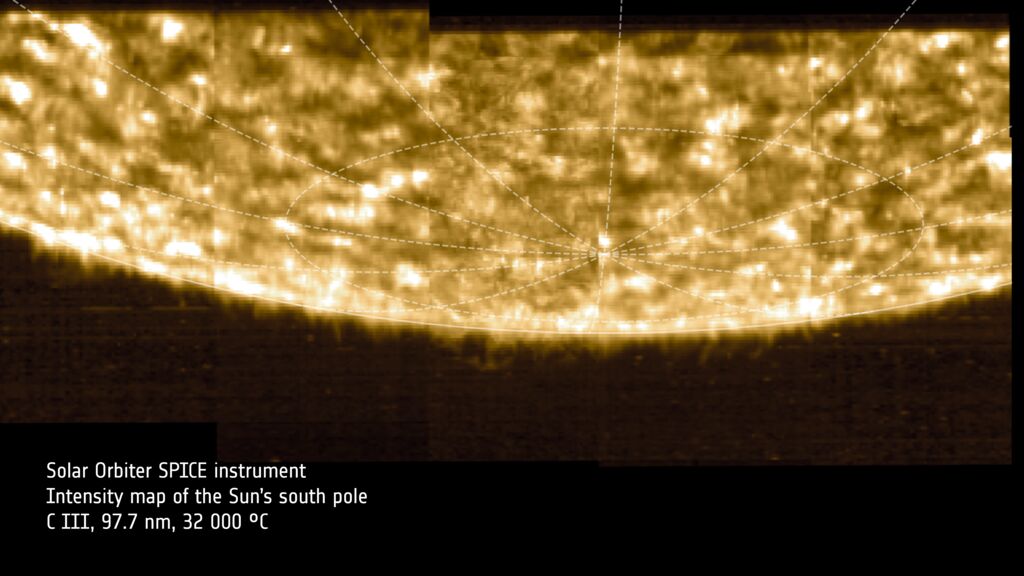
All the images of the Sun you have seen were taken near the Sun’s equator. This is because Earth, the other planets, and all current space probes orbit the Sun in the plane of the ecliptic. By tilting its orbit out of this plane, Solar Orbiter reveals the Sun from a completely new angle. On March 23, 2025, Solar Orbiter observed the Sun for the first time from an angle 17° below the solar equator, providing a direct view of the Sun’s south pole. Over the next few years, the spacecraft will tilt its orbit even further, so the best images are yet to come.
“Today, we are unveiling the first images of the Sun’s pole ever taken by humankind,” said Professor Carole Mundell, ESA’s Director of Science. “The Sun is our closest star; it gives life and can disrupt modern energy systems in space and on the ground. It is therefore imperative that we understand how it works and learn to predict its behavior. These unique new images from our Solar Orbiter mission mark the beginning of a new era for solar science.”
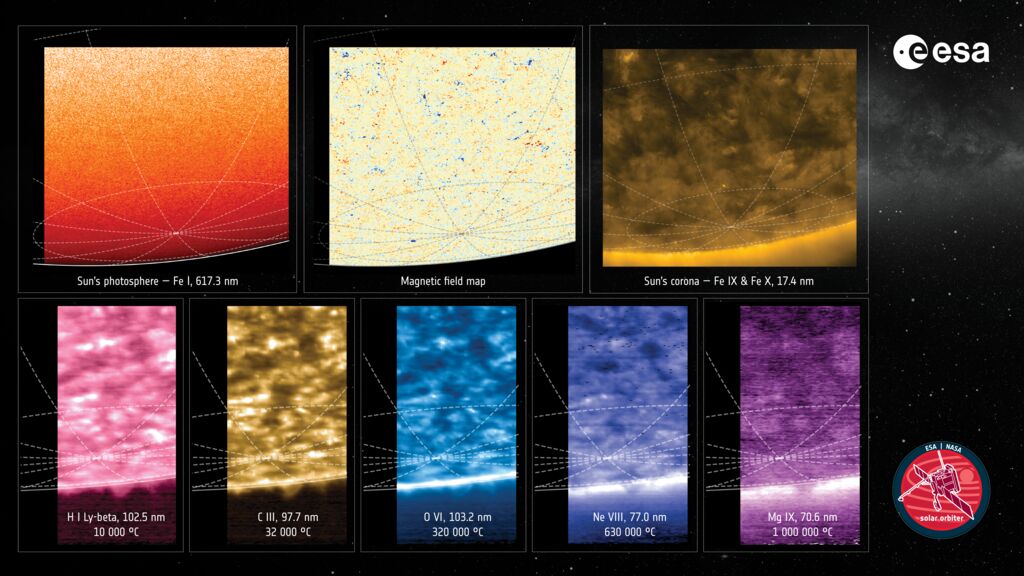
The collage above shows the Sun's south pole as recorded on March 16 and 17, 2025, when Solar Orbiter observed the Sun from an angle of 15° below the solar equator. This was the mission’s first high-angle observation campaign, a few days before it reached its current maximum observation angle of 17°.
The images above were taken by three of Solar Orbiter’s scientific instruments: the Polarimetric and Helioseismic Imager (PHI), the Extreme Ultraviolet Imager (EUI), and the Spectral Imaging Instrument for the Coronal Environment (SPICE).
“We didn’t know exactly what to expect from these first observations—the Sun’s poles are literally terra incognita,” explains Professor Sami Solanki, who leads the PHI instrument team at the Max Planck Institute for Solar System Research (MPS) in Germany.
One of Solar Orbiter’s “firsts” on this occasion comes from the SPICE instrument, for which the IAS serves as the principal investigator. SPICE is a spectro-imager that measures spectra emitted by specific chemical elements—including hydrogen, carbon, oxygen, neon, and magnesium—at known temperatures. Over the past five years, SPICE has used this data to reveal what is happening in the various layers above the Sun’s surface. For the first time, the SPICE team has succeeded in producing velocity maps that reveal how solar material moves within the thin “transition region,” where the Sun’s temperature rapidly rises from 10,000 °C to hundreds of thousands of degrees.
Doppler measurements can reveal how particles are ejected from the Sun in the form of the solar wind. One of Solar Orbiter’s main scientific objectives is to discover how the Sun produces the solar wind. “Doppler measurements of the origin of the solar wind by current and past space missions have been hampered by the low-angle view of the solar poles. Measurements taken from high latitudes—now possible thanks to Solar Orbiter—will revolutionize the field of solar physics, ” says Frédéric Auchère, head of the SPICE team at the IAS.
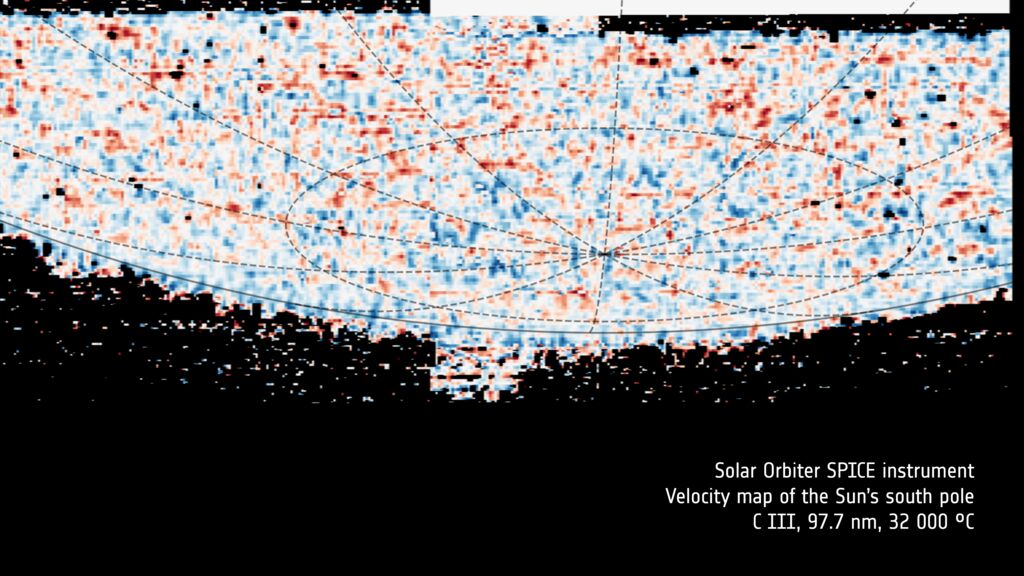
These are only the first observations made by Solar Orbiter from its newly inclined orbit, and much of this initial dataset still needs to be analyzed in greater detail. The complete set of data collected by Solar Orbiter during its first full flyby from one pole of the Sun to the other is expected to arrive on Earth in October 2025. Solar Orbiter’s ten scientific instruments will collect unprecedented data in the years to come.
“This is just the first step: in the coming years, the spacecraft will move further away from the plane of the ecliptic to obtain even better views of the Sun’s polar regions. This data will transform our understanding of the Sun’s magnetic field, the solar wind, and solar activity,” notes Daniel Müller, chief scientist for the Solar Orbiter project at ESA.