
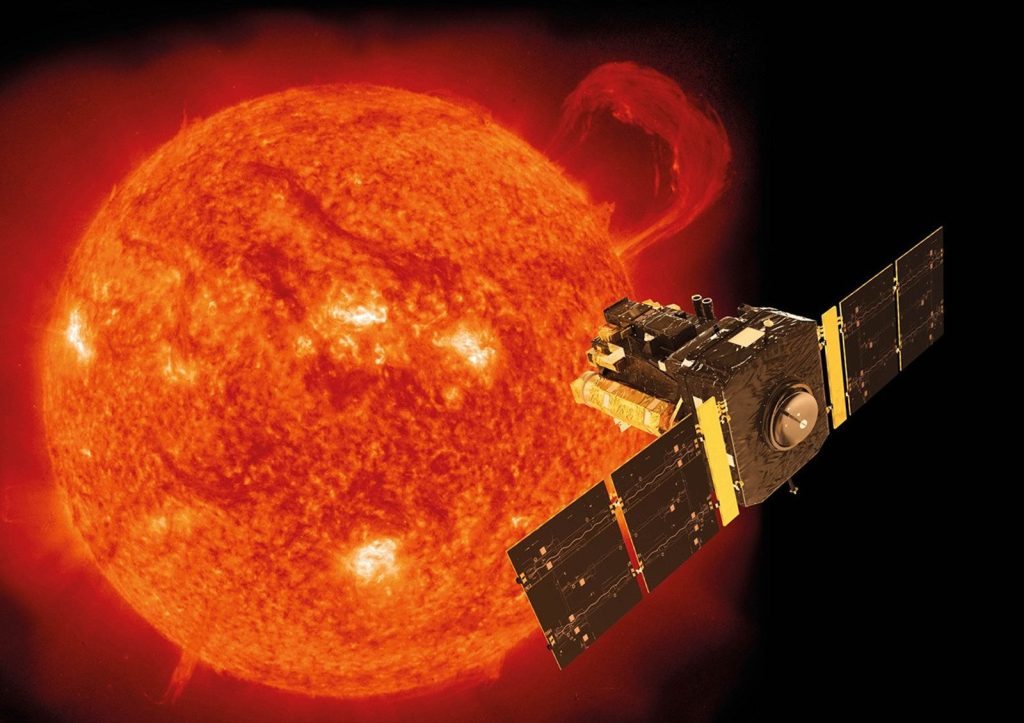
SoHO
The SoHO mission (Solar and Heliospheric Observatory – ESA/NASA) was designed to study the internal structure of the Sun, the heating of its atmosphere, and the origins and acceleration of the solar wind. It was launched in late 1995 from Cape Canaveral and remains operational.
The role of IAS
Team members participate as Co-Is in four of the twelve instruments on board the SOHO platform, which observes the Sun from every angle: GOLF (Global Oscillation at Low Frequency), EIT (Extreme ultra-violet Imaging Telescope), SUMER (Solar Ultra-violet Measurements of Emitted Radiation), and VIRGO (Variability of solar IRradiance and Gravity Oscillations). One team member serves as PI for the GOLF instrument.
The team led the design and development of these instruments and contributed to others on the mission, resulting in numerous team members acting as Co-Investigators (Co-I) for these instruments alongside active participation in their operations. MEDOC provides access to all data produced by the twelve SoHO instruments.
Data access: https://idoc.osups.universite-paris-saclay.fr/medoc/
Status
Operational
Partners (academic / industrial)
Funding agencies
Key dates (est.)
Key milestones
Launch: 1995
Contacts
Scientific and Technical Contacts
- Karine Bocchialini, Solar and Stellar Physics Team (SUMER instrument)
- Frédéric Auchère, Director of IAS, Solar and Stellar Physics Team (EIT instrument)
- Patrick Boumier, Solar and Stellar Physics Team (GOLF instrument)
- Thierry Appourchaux, Solar and Stellar Physics Team (VIRGO instrument)