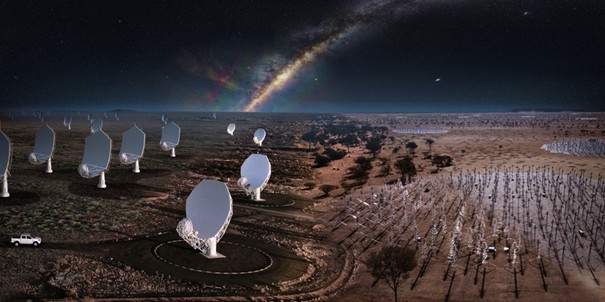
Credit: SKAO

SKA

The Square Kilometre Array (SKA) is the world’s largest radio telescope, designed to explore the universe at low frequencies using the Australian array (SKA-Low, 50–350 MHz) and at medium frequencies using the South African array (SKA-Mid, 350 MHz–15.4 GHz). It aims to study the formation of the first stars and galaxies, dark matter, dark energy, gravitational waves, the Sun, exoplanets, and interstellar matter, among other topics. Sixteen countries are official members of this intergovernmental organization, including France, which joined in June 2026. Construction of the SKA-Low (SKA-Mid) network began in 2023, and the telescope entered the commissioning phase in 2025. The scientific verification phase begins in 2027 (2029 for SKA-Mid, the South African telescope), with the first scientific observations scheduled for 2030 for the Australian SKA-Low telescope and 2032 for the South African telescope.

The Role of the IAS

The project is based on the establishment of a network of SKA regional centers (SKA Regional Centers Network, SRCNet) that will distribute the telescope’s value-added data (Advanced Data Products, ADP) to astronomers around the world. A node of this network is planned for France (frSRC) through the networking of several regional mesocenters, including the Paris-Saclay mesocenter. Through its researchers and engineers, the IAS is involved in the establishment and maintenance of this node.

 In development

Intergovernmental organization 

Commissioning in 2027 for at least 10 years

Designed in 1986

Development: 1986–2026

Published online: 2027

First observations: 2029

Contacts

Advisors (scientific and technical)

Work Team

  • Marian Douspis, Astronomer, Cosmology Team
  • Pietro Albanese Guidi, Ph.D. Candidate, Cosmology Group
  • Lilian Crascall-Kennedy, Ph.D. Candidate, Cosmology Team
Scroll up