
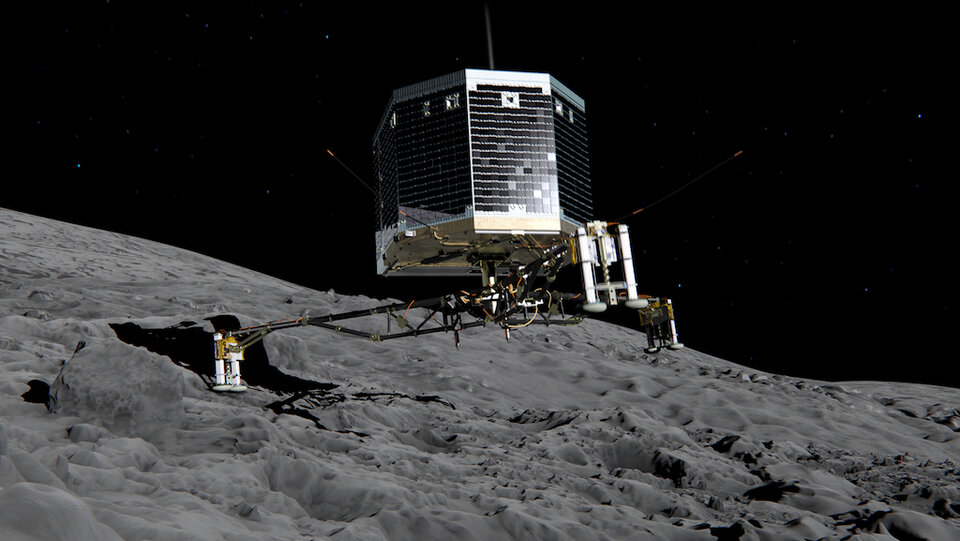
The target for the Rosetta lander has been chosen: the site offers very high scientific potential while ensuring the best possible landing conditions for Philae and the opportunity to optimize its power resources. Landing is scheduled for November 11, 2014.
The site was selected on September 15 by a European team of engineers and scientists, with the participation of Jean-Pierre Bibring from IAS, co-scientific lead of Philae and principal investigator of the CIVA instrument.
At this site, Philae will perform the first in situ analysis of a comet and provide unprecedented information on the comet's composition, structure, and evolution. Specifically, the chosen site offers the opportunity to analyze pristine materials, characterize the properties of the nucleus, and study the processes driving cometary activity. Regarding safety conditions, the selected site is relatively free of rocks. It optimizes battery usage with a descent time from Rosetta reduced to seven hours and sufficient solar panel illumination.