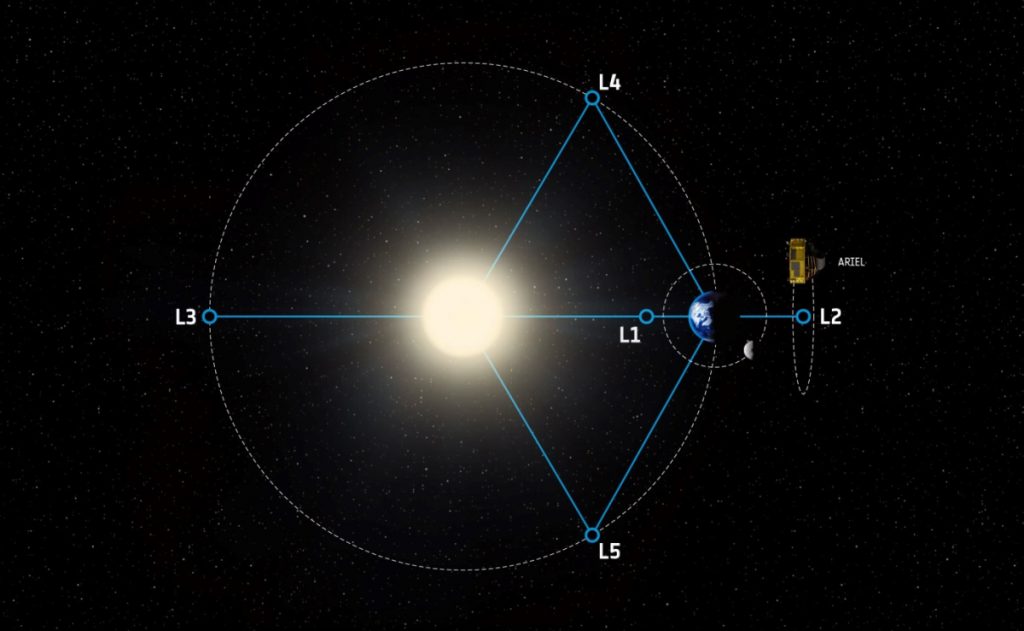
The selection process took place in several stages:
- Call for mission proposals issued by ESA in August 2014;
- Preselection in June 2015 of 3 missions out of the 27 proposed for detailed concept studies;
- Evaluation of the study results by a committee of experts and recommendation of a mission in November 2017;
- Formal vote by the ESA Programs Committee and public announcement on March 20, 2018.
Pierre Drossart notes: “The ARIEL mission study was conducted based on the EChO project, which was a candidate for ESA’s M3 Mission in 2014. Advances in exoplanet research now clearly position spectroscopy as a major challenge for the coming decade in the study of their atmospheres.”
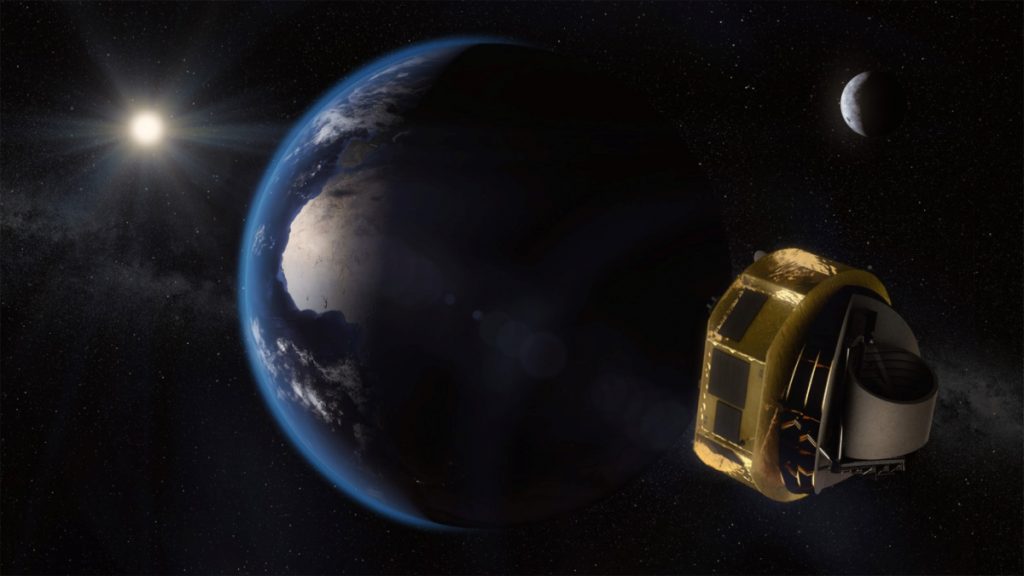
The ARIEL mission was proposed by a consortium of more than 60 institutes in 15 European countries(*). Scientific and technical coordination is provided by the United Kingdom. A contribution from the United States is currently under consideration. ARIEL will consist of a telescope approximately one meter in diameter to collect visible and infrared light from stars around which an exoplanet orbits. A spectrometer will disperse this light into a “rainbow,” and when the exoplanet transits in front of its star, the resulting spectrum will show absorption bands of the star’s light caused by molecules in the exoplanet’s atmosphere.
Marc Ollivier emphasizes: “The observation is particularly challenging, because the information about the planet must be separated from the light of the star itself, which is 1,000 to 100,000 times brighter than the planet. The ultimate performance is achieved thanks to the instrument’s intrinsic photometric stability and a very rigorous understanding of how it works.”
ARIEL builds on research conducted over the past 10 years. In 2007, water vapor, followed by carbon dioxide and carbon monoxide, were detected in the atmosphere of the hot Jupiter HD189733b using the Spitzer and Hubble space telescopes. The initial results highlighted the difficulty of the measurements and the immense diversity of exoplanet atmospheres. To obtain such challenging measurements across a large number of planets, dedicated and optimized instruments are necessary. A group of scientists therefore began studies as early as 2008. Starting in 2015, drawing on the expertise they had accumulated, teams from five French laboratories (IAP, DAp/AIM, IAS, LESIA, LAB) played a very significant role in the ARIEL studies. Their contributions to the development of the scientific proposal, the mission scenario, and the feasibility studies for the infrared spectrometer—the satellite’s core component—were decisive. This led the French teams to take responsibility for the design and delivery of the infrared spectrometer. The spectrometer will be built, under the supervision of CNES, by CEA-Irfu with significant contributions from IAS and LESIA.
“ARIEL is the logical next step in the exoplanet observation programs we will be conducting with the JWST. ARIEL’s statistical approach is crucial; it is very encouraging that Europe can play a leading role in this new chapter in the history of exoplanet research,” concludes Pierre-Olivier Lagage.
(*) : United Kingdom, France, Italy, Poland, Spain, the Netherlands, Belgium, Austria, Denmark, Ireland, Hungary, Sweden, the Czech Republic, Germany, Portugal