
Rosetta detects macromolecular carbonaceous material in dust particles from Comet Churyumov-Gerasimenko
With just a few weeks remaining in the Rosetta mission and after analyzing several months’ worth of data collected by COSIMA—a mass spectrometer aboard the Rosetta spacecraft—the team of scientists working on this instrument has provided evidence of the presence of a macromolecular organic component in cometary dust grains.
The COSIMA instrument is under German leadership (MPS Göttingen) with significant French instrumental and scientific contributions. COSIMA is a sort of mini-physicochemical laboratory designed to collect cometary dust particles near the nucleus of Comet Churyumov-Gerasimenko, detect them, and photograph them using the COSISCOPE microscope, developed at the IAS (co-PI-level responsibility), and analyze them using secondary ion mass spectrometry coupled with time-of-flight analysis (ToF-SIMS).
In the study recently published in *Nature*, the team of scientists from the COSIMA experiment—including two co-investigators from the IAS—focused on identifying the carbonaceous material that makes up the dust of Comet Churyumov-Gerasimenko. The authors based their analysis on a comparison of the spectra of cometary grains measured by COSIMA with spectra obtained in the laboratory from reference organic compounds. This led to the conclusion that the detected cometary carbonaceous material has a macromolecular structure.
This result was eagerly awaited by the scientific community. Indeed, this macromolecular carbonaceous material could explain, at least in part, the dark color of the comet’s surface, as observed in particular by the panoramic cameras on the Philae lander (CIVA-P), which is under the responsibility of the IAS. According to analyses conducted by COSIMA, this carbonaceous material detected in the cometary dust is similar to the so-called “insoluble” macromolecular organic matter extracted from certain extraterrestrial materials analyzed in the laboratory (carbonaceous meteorites and micrometeorites, and interplanetary dust). It is also consistent with certain experimental simulations of the evolution of ices under irradiation, conducted notably by the IAS “Astrochemistry and Origins” team, which result in the formation of complex organic matter that is more or less cross-linked—that is, containing macromolecules of varying sizes and quantities, depending on the experimental conditions applied. These observational constraints, combined with simulations and laboratory analyses, will help refine scenarios for the formation and evolution of organic matter in the primordial solar nebula.
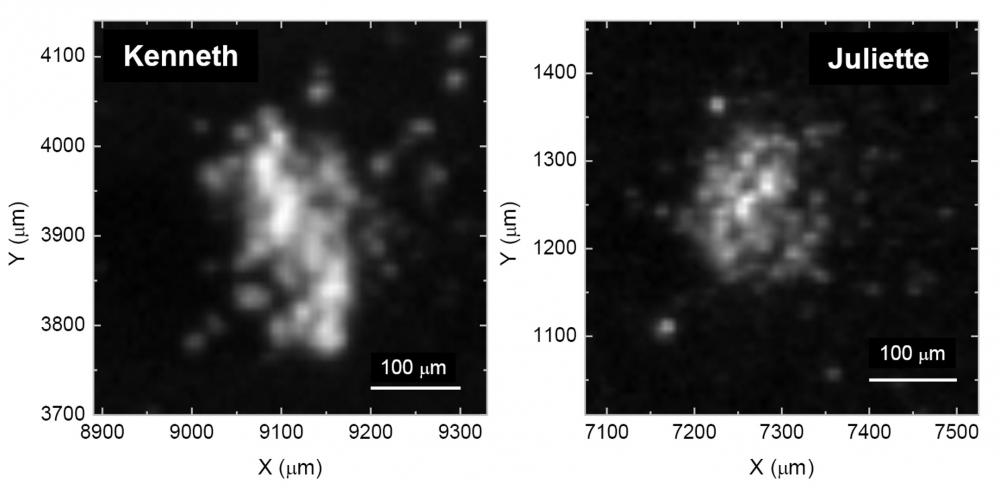
Images of two cometary particles, named Kenneth and Juliette, collected by COSIMA, photographed by COSISCOPE, and then analyzed by mass spectrometry, in which organic macromolecules were detected.
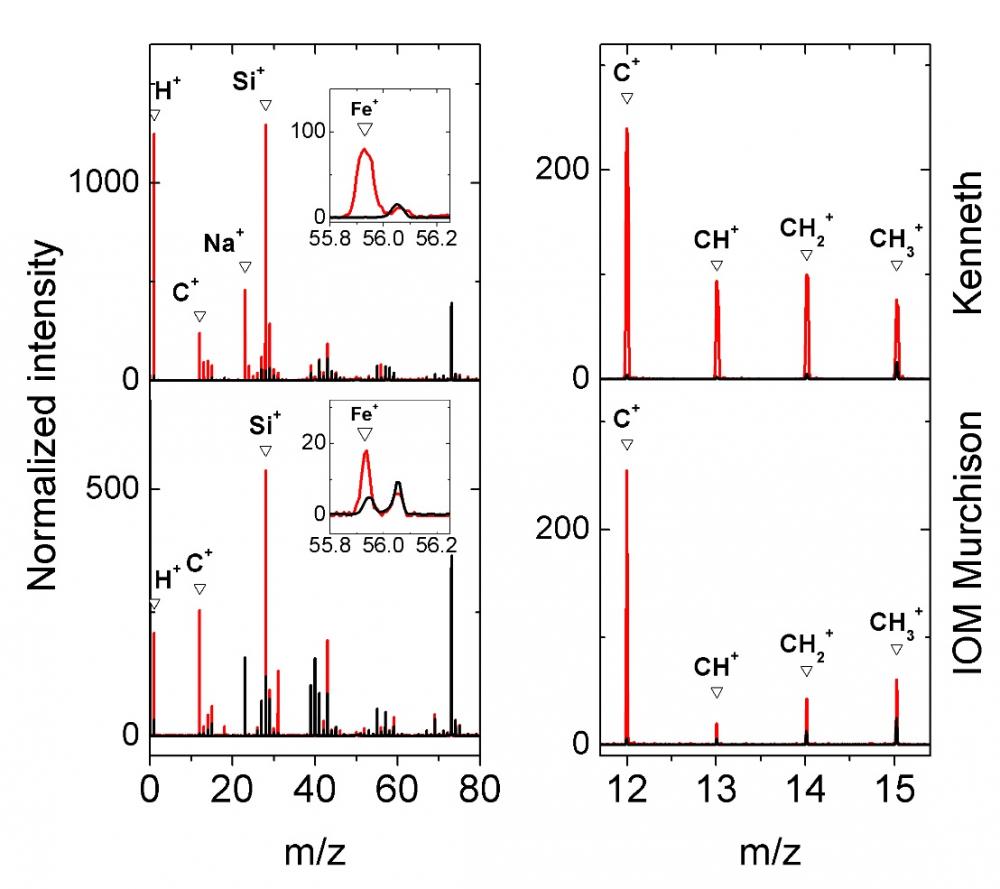
Comparison between a mass spectrum of the cometary particle Kenneth, measured by the COSIMA instrument on the Rosetta spacecraft, and macromolecules (IOM, Insoluble Organic Matter) extracted from the Murchison meteorite. The red spectra were measured on the samples, and the black spectra nearby were measured for instrumental reference. The meteoritic IOM is the only set of molecules in the instrument’s reference spectrum library that shows similarity to the cometary samples. A comparison of the intensities of the peaks attributed to CH+, CH2+, and CH3+ with the intensity of the peak attributed to C+ in both samples suggests that the cometary material is richer in hydrogen and therefore better preserved than any meteorite material known to date.
Contacts
- Donia Baklouti, Associate Professor, Astrochemistry & Origins Team
- Yves Langevin, Solar System and Planetary Systems Physics Team
References
- CNRS/INSU Press Release: http://www.insu.cnrs.fr/node/5982
- Scientific article:
Fray, N., Bardyn, A., Cottin, H., Altwegg, K., Baklouti, D., Briois, C., Colangeli, L., Engrand, C., Fischer, H., Glasmachers, A., Grün, E., Haerendel, G., Henkel, H., Höfner, H., Hornung, K., Jessberger, E.K., Koch, A., Krüger, H., Langevin, Y., Lehto, H., Lehto, K., Roy, L.L., Merouane, S., Modica, P., Orthous-Daunay, F.-R., Paquette, J., Raulin, F., Rynö, J., Schulz, R., Silén, J., Siljeström, S., Steiger, W., Stenzel, O., Stephan, T., Thirkell, L., Thomas, R., Torkar, K., Varmuza, K., Wanczek, K.-P., Zaprudin, B., Kissel, J., and Hilchenbach, M. High-molecular-weight organic matter in the particles of comet 67P/Churyumov-Gerasimenko. Nature, in press (https://dx.doi.org/10.1038/nature19320)