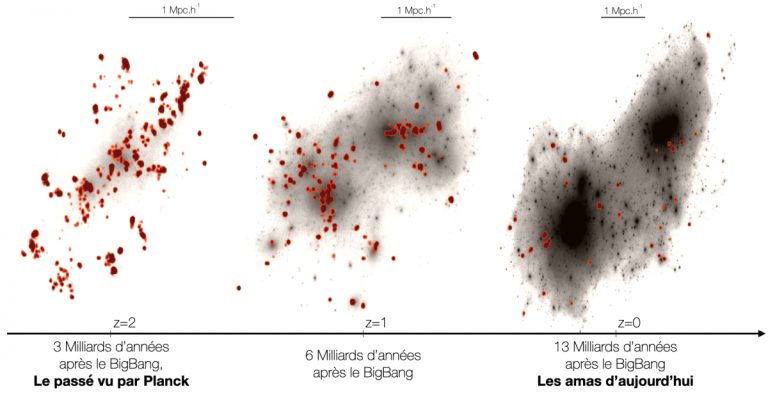
Star-forming regions (in red) disappear over time, while the dark matter cluster grows (in black). In the distant past explored by the Planck mission, proto-galaxy clusters were forming many stars, whereas today these massive structures have become quiescent and form only a few stars./© Gouin et al., 2022, IAS, with IllustrisTNG simulations

Back to the Future of Galaxy Clusters

For the first time, the distant galaxy clusters discovered by the Planck satellite can be explained by simulations that also predict their future evolution. More than a decade after their detection, this new in-depth study of numerical simulations shows that about 70 percent of these distant objects are expected to have evolved into massive galaxy clusters by now.

Contacts

Advisors (scientific and technical)

Scroll up