
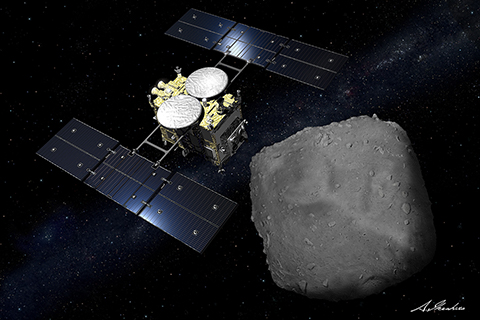
After collecting samples from two sites, the Japan Aerospace Exploration Agency (JAXA) Hayabusa2 spacecraft departed the asteroid Ryugu on November 19, 2019, bound for Earth. The capsule containing the samples is scheduled to land this Saturday, December 5, 2020, at approximately 6:40 PM (Paris time) in the Woomera desert of Australia. Once recovered, it is expected to be rapidly transported to ISAS, JAXA's space laboratory in the suburbs of Tokyo, where the samples will be extracted and stored in ultra-clean enclosures for characterization.
The Hayabusa2 mission launched on December 3, 2014, toward Ryugu, a likely very primitive object: its extremely low albedo may indicate the presence of carbonaceous compounds from the proto-solar disk, similar to the nucleus of comet Churyumov-Gerasimenko, upon which Philae landed. As a pioneering sample-return mission in this regard, Hayabusa2 represents a complement with major scientific potential.
For the first time, sample characterization will be performed using an instrument that identifies sample composition (minerals, hydrated phases, carbonaceous compounds) grain by grain in a purely non-destructive manner: via infrared hyperspectral imaging. Specifically, a dedicated MicrOmega instrument, developed at IAS under the responsibility of Vincent Hamm, has been installed in the curation facility where the samples will be analyzed and cataloged before potentially being distributed for subsequent analysis in other international laboratories.
The discovery potential offered by the analysis of these samples is immense regarding the formation of the Solar System, and particularly the role that primordial carbonaceous constituents may have played in the evolution toward life on Earth. Through MicrOmega, IAS—and the broader French scientific community—is deeply involved in this unique endeavor.
Two critical mission milestones remain to be accomplished: on Saturday morning, around 6:30 AM (Paris time), at a distance of 220,000 km from Earth, the sample capsule will be ejected from the main module, which will then be deflected to avoid Earth and continue its journey toward a new near-Earth asteroid. The atmospheric entry of the capsule will take place on Saturday, December 5, 2020, according to the following (margin-predicted) timeline:
6:28 PM entry into the outer atmosphere, at an altitude of 200 km.
6:30-6:31 PM end of the visible fireball trail.
6:31-6:33 PM parachute deployment, transmitter powered on.
6:47-6:57 PM landing.
You will be able to both watch all the steps broadcast live and interact with IAS managers of Hayabusa2 activities, and in particular the analyses that will be carried out using the MicrOmega instrument: Cédric Pilorget, Rosario Brunetto, and Jean-Pierre Bibring.