
RESEARCH QUESTIONS
What is the astrophysics of interstellar matter?
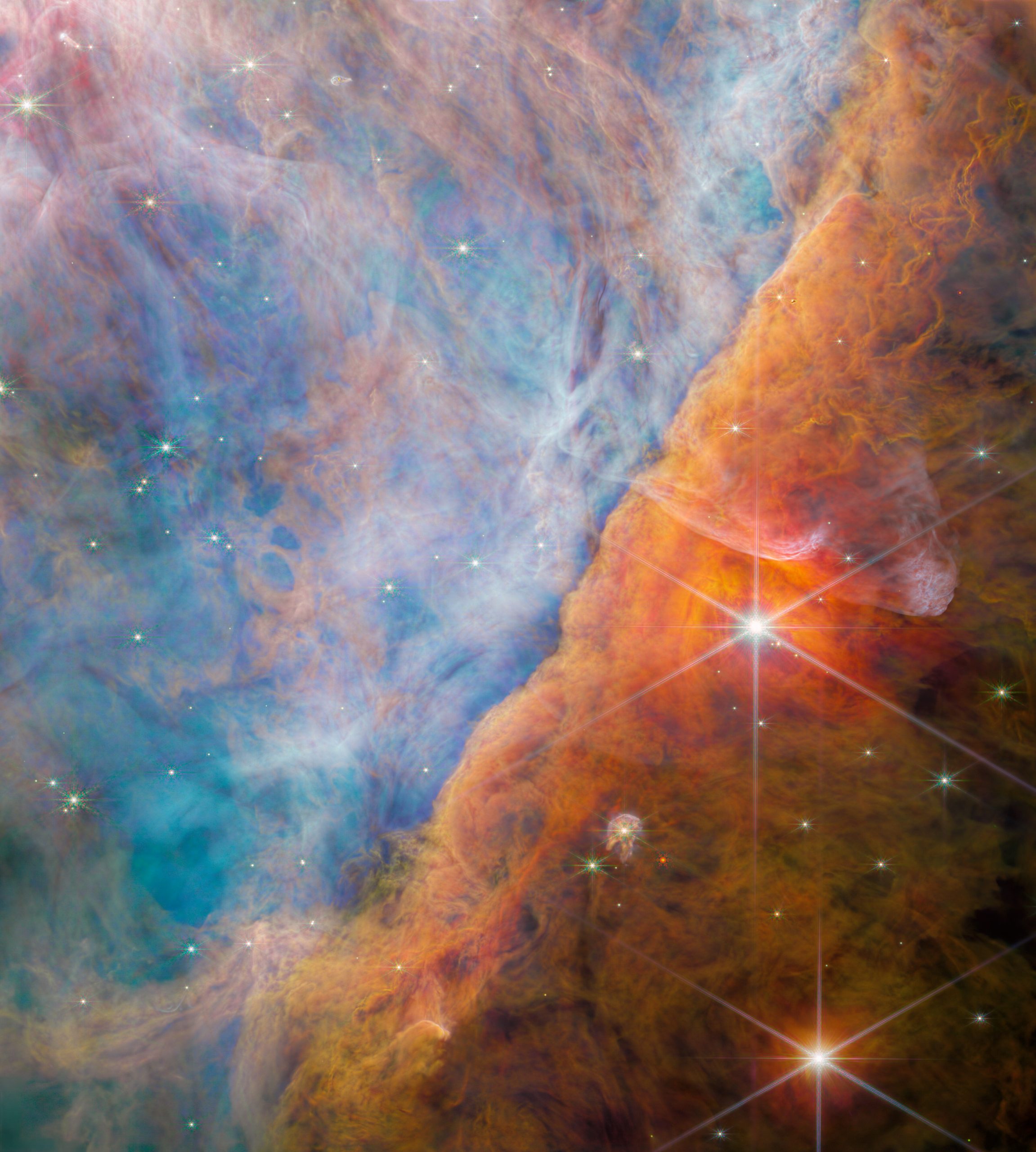
Her goal is “to understand the physical and chemical evolution of interstellar and circumstellar matter, because it is from this matter that stars and planets form,” explainsEmilie Habart, head of the Interstellar Matter Astrophysics team.
Scientific Operations of the JWST
The James Webb Space Telescope (JWST), launched in late 2021 with an estimated lifespan of at least 26 years, has revolutionized our understanding of the universe. Thanks to its state-of-the-art instruments, it allows us to observe interstellar matter with a unmatched precision :
- Major discovery: A wide variety of chemical compositions in protoplanetary disks, revealing previously unknown details about the processes of planet formation.
- Impact: The JWST has transformed our understanding of star and planet formation by providing infrared observations with unprecedented resolution and sensitivity.
Analytical Methods
To study interstellar matter, researchers use a multi-wavelength approach, tailored to the physical properties of this material:
- Observation using appropriate telescopes :
- Warm or cold environments: Use of infrared, radio, and near-visible instruments to detect the characteristic emissions of these environments.
- Hot Matter: Near-infrared observations to analyze higher-energy regions.
- Study of stellar radiation: Stellar light radiates into interstellar matter. Analyzing this light helps us understand its impact on the chemistry, structure, and evolution of matter.
Space Missions
- IRAS (Infrared Astronomical Satellite): The first mission to map the sky in infrared, revealing cold sources and dust clouds.
- ISO (Infrared Space Observatory): Expanding infrared observations with higher spectral resolution.
- Spitzer: Observations of protoplanetary disks and star-forming regions.
- Herschel: Study of molecular clouds and star-formation processes in the far-infrared.
- Planck: Measurement of the cosmic microwave background.
Ground-based instruments
Observations from Earth also play a role supplementary :
- Giant telescopes: They offer better angular resolution and the versatility needed to study ancient or distant objects with optimal capabilities.
- Researchers' contributions: Optical testing, data processing, and the development of new analytical methods.
- Supplementary Program: ALMA (Atacama Large Millimeter Array): Enables the observation of protoplanetary disks and molecular clouds with high spatial and spectral resolution.
Major Areas of Research
- Particle Growth and Gas-Dust Coupling
- Feedback from Star Formation
- Chemistry and Dynamics of Disks