
RESEARCH QUESTIONS
What is the physics of the solar system and planetary systems?
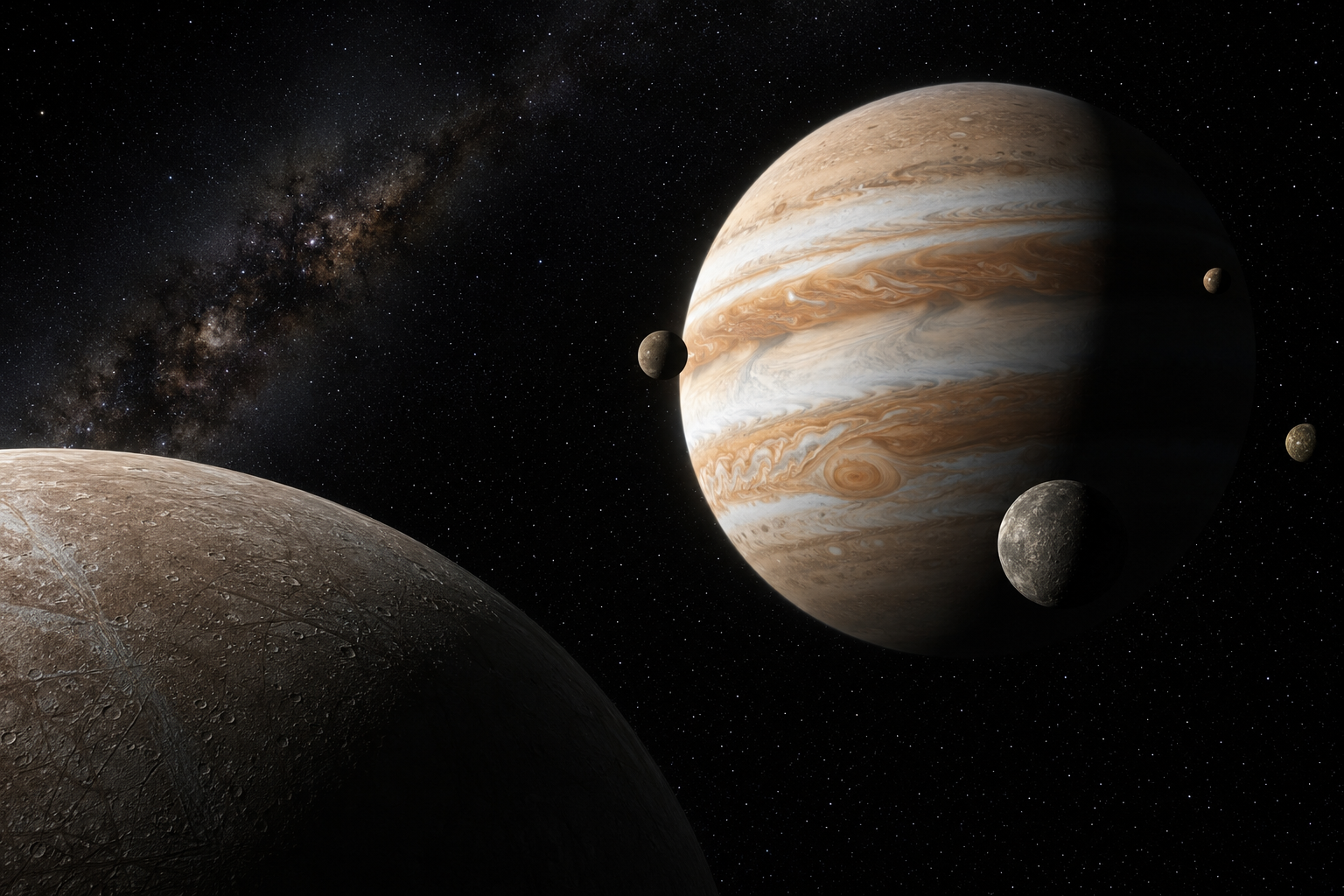
Planetology is a scientific discipline dedicated to the study of planets, moons, small bodies (asteroids, comets), and exoplanets (planets orbiting stars other than the Sun). Its goal is to understand the formation, evolution, and physical, chemical, and climatic characteristics of these objects, as well as their potential to harbor life.
As Mathieu Vincendon, head of the Solar System and Planetary Systems Physics team, explains, this discipline makes it possible to “characterize the properties of the surfaces, atmospheres, and environments of planets and small bodies in the solar system, as well as exoplanets, in order to understand their formation, evolution, and potential to harbor life.”
Central Theme: Global Change
- Origins of the Diversity of Solid Objects
- Physicochemical and Climatic Changes
- Unique Features of the Earth's Orbit
- Measuring the Composition of Outer Envelopes
- Study of solid planets, moons, small bodies, and exoplanets
- Development and Operation of Space Instruments
Preferred Targets
1. The Icy Moons of Jupiter and Saturn
Particular attention is given to icy moons, such as Europa (Jupiter), Ganymede, Callisto, and Enceladus and Titan (Saturn). These celestial bodies harbor underground oceans and extreme environments:
- Subsurface oceans: Take Enceladus, for example, where geysers erupt to the surface, revealing the presence of liquid water, salts, organic matter, and CO₂.
- Internal Circulation: A Study of Convection Cells in These Oceans.
- Extreme environment: Exposed to intense radiation, these moons could be home to complex reactions conducive to the formation of prebiotic molecules.
2. March: The Quest for Water and Life
Mars is a major target for several reasons:
- Liquid water: Past or present presence in certain regions. Example: Mars Express mission (2004): Initial measurements to locate water-rich sites on Mars.
- European mission in the works: First European rover equipped with a 2-meter drill (its functionality remains uncertain).
- Key question: If life does not exist on Mars, what factor is preventing it from emerging?
Analytical Methods
To study these objects, researchers use advanced techniques:
- Infrared Spectral Imaging :
- Infrared spectroscopy: Analysis of sunlight reflected by the planets.
- Imagers : Measurement of how light behaves as a function of wavelength for each pixel.
A concrete example involving Mars:
- In visible light: basaltic lava and oxidized dust.
- Infrared: Different colors depending on the type of rock, allowing their composition to be identified.
Flagship Projects
European Rover on Mars
- Launch: 2028.
- Landing: 2030.
The rover collects samples on a conveyor belt that transports them to Micromega.
Infrared images capture details down to the scale of dust and sand particles, with the option to use a drill to analyze depths.
JUICE Mission (JUpiter ICy moons Explorer)
- Launch: Early 2023 (scheduled to arrive in 2031).
Its goal is to explore Jupiter's icy moons (Europa, Ganymede, Callisto).
To do this, she will use MAJIS (an IAS instrument): Infrared spectroscopy at -180°C to analyze the composition of the surfaces.
The high-resolution images will make it possible to identify areas where the ice is malleable (indications of organic matter or salts).
Extreme radiation conditions must be taken into account, as they create a hostile environment for astronauts and could trigger prebiotic molecules.
ARIEL Mission (Atmospheric Remote-sensing Infrared Exoplanet Large-survey)
The goal is to perform spectroscopic observations of exoplanet atmospheres from Earth's orbit.
- Partnership: Collaboration with AIM/CEA.
ARIEL's mission is to study the chemical composition of atmospheres to identify potential biosignatures.
BepiColombo Mission
It is an 8-year journey to Mercury.
- Key finding: Presence of ice at Mercury's poles (areas in permanent shadow).
- Hypothesis: Water may have been brought by comets and asteroids, which date back to the early days of the solar system.
- Setup: Dual satellite (Japanese and European).
- Reentry on September 3, 2026, following a flight using a protective system.
- Problem: Solar panels damaged during the trip.
- Final push: Successful despite the challenges.
Through ambitious space missions and cutting-edge instruments, planetary science allows us to push the boundaries of our understanding of the universe and, by extension, the factors involved in the emergence of life. Every project, every observation, and every analysis aims to bring us closer to the answer to a fundamental question: Are we alone in the universe?