
RESEARCH QUESTIONS
What topics are studied in solar and stellar physics?
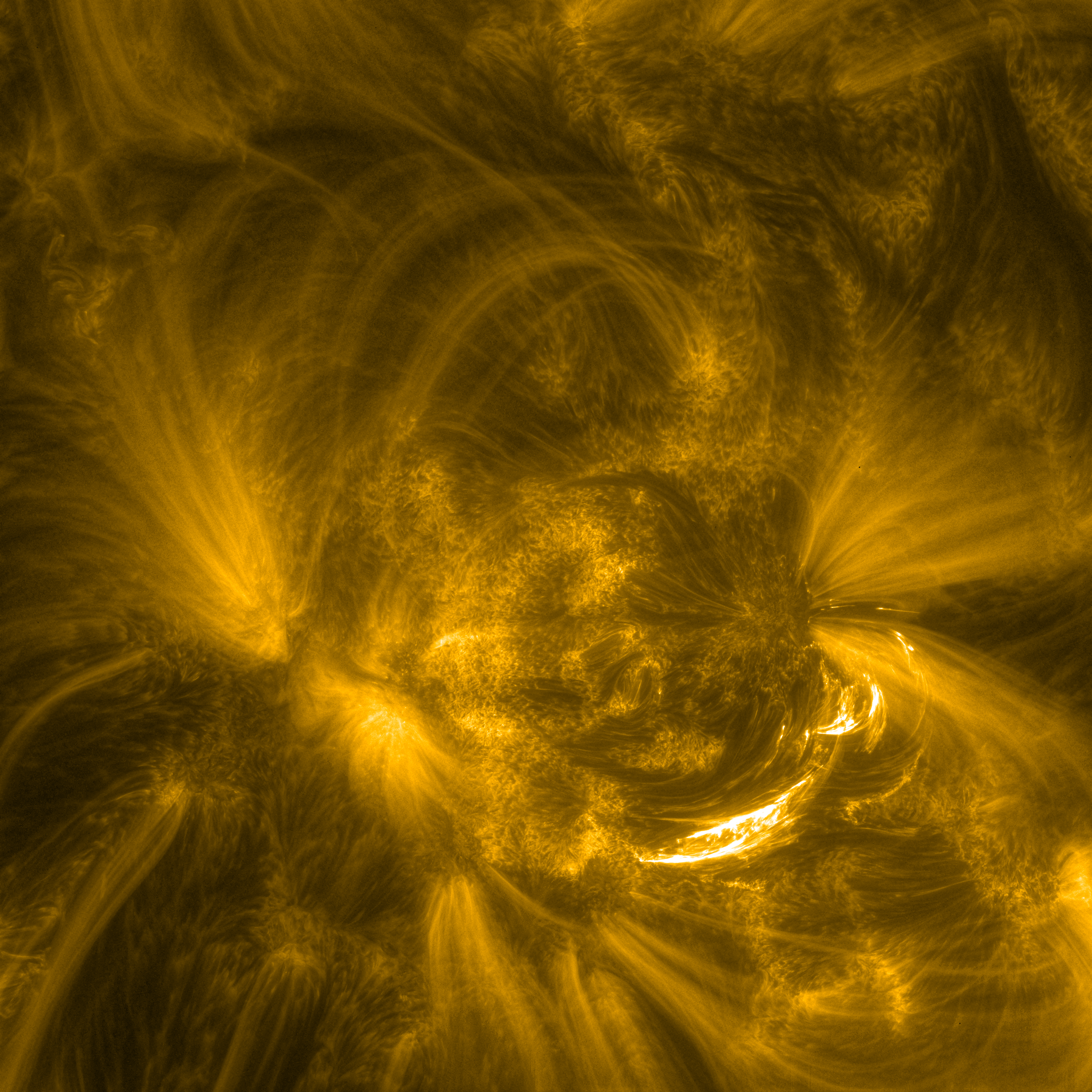
As ÉricBuchlin, head of the Solar and Stellar Physics team, explains, his goal is to “understand the physical phenomena of the Sun and stars—from their internal structure to their outer atmospheres—by studying their dynamics, their heating, and their interactions with interplanetary space.”
This field seeks to analyze the following mechanisms:
- Internal Structure and Evolution of the Sun and Stars
- Stellar Activity and Magnetism in Relation to Structure and Evolution
- Crown Diagnostics
- Dynamics of the Solar Atmosphere
- Solar flares
The Sun: Structure and Phenomena
A unique thermal structure
The Sun has a complex structure in which temperatures vary in surprising ways:
- Photosphere: The surface visible to the naked eye, with a temperature of approximately 5,500 °C.
- External atmosphere: Contrary to what one might expect, the temperature increases with altitude.
- Solar corona: The outermost layer, reaching 1 million °C.
- Nucleus: The site of nuclear reactions and the source of solar energy.
- Convection zone: A plasma movement that concentrates the magnetic field. Sunspots—cooler, darker regions—originate here.
Dynamic and powerful phenomena
The Sun is the scene of energetic phenomena that are in constant interaction with its environment:
- Pressure imbalance: Between the solar atmosphere and the interstellar medium.
- Solar wind: A continuous stream of charged particles emitted into space.
- Solar flares: Billions of metric tons of matter (plasma) are ejected into space.
- Interaction with the Interplanetary Medium: Variations in the Solar Magnetic Field.
- Accelerated particles (such as cosmic rays).
Space Weather: Impacts on Earth
Solar phenomena have direct consequences for our planet:
- UV rays: Absorbed by the upper atmosphere, they cause atoms to become ionized, creating ions and free electrons.
- Ionosphere: A conductive medium through which electric currents can flow, disrupted by the Earth's magnetic field.
- Magnetosphere: A protective shield against the solar wind. UV rays ionize the atmosphere, forming a conductive plasma. This plasma, under the influence of Earth’s magnetic field, creates the magnetosphere, which protects us from solar particles.
- Polar auroras: Result from magnetic reconnection between the solar wind and Earth's magnetic field.
- Telecommunications Disruptions: Fluctuations in solar activity can affect power grids, aviation, and communication systems.
- Plasma: Ionized matter subjected to a magnetic field, which is ubiquitous in the space environment.
Flagship Projects
1. Solar Orbiter (ESA/NASA)
- Objective: To study the solar atmosphere, magnetic fields, and solar poles—regions that are still poorly understood.
- Trajectory :
- Initially in orbit around Venus.
- Change in trajectory to exit the plane of the ecliptic → first direct observation of the Sun's poles.
- Use of Instruments :
- Measurement of solar magnetic fields.
- Analysis of the solar wind and solar flares.
- Observation of high-energy particles emitted by the Sun.
2. PLATO (Planetary Transits and Oscillations of Stars)
- Launch: Coming soon (ESA mission).
- Objective :
- Observe the light curves of many stars for asteroseismology (the study of stellar vibrations).
- Detection of exoplanets using the transit method.
3. Kepler
- Data Analysis :
- Separation of signals (planets, stellar oscillations, eruptions) for a detailed study.
- Study of sunspots (contrast, size, number) and comparison with the Sun.
- Light curves: Used to study stellar oscillations and gain a better understanding of the internal dynamics of stars.
4. SOHO (Solar and Heliospheric Observatory)
- Launch: 1995 (joint ESA/NASA mission).
- Objective: To study the Sun from its core to its outer atmosphere, as well as the solar wind.
GOLF Instrument: Measurement of solar vibrations to model the Sun's internal structure and dynamics.
5. Model Reconstruction:
- Development of 3D models of the Sun's interior to understand its composition, movements, and evolution.
Methodologies and Challenges
To study the Sun and the stars, scientists use:
- Space telescopes (such as those on Solar Orbiter or Solar-C) to avoid interference from Earth's atmosphere.
- Asteroseismology: The study of stellar vibrations, which reveals the internal structure of stars (transit, oscillation analysis, local seismology).
- Numerical modeling: Simulation of magnetic processes and solar flares to predict their behavior.
- Multiwavelength Data Analysis: Combining X-ray, ultraviolet, visible, and radio observations for a comprehensive view.