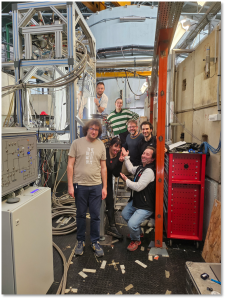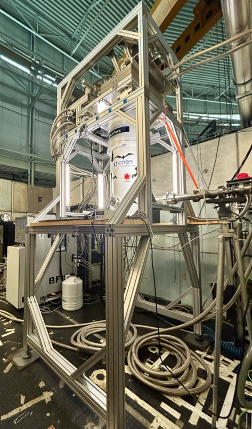
Thanks to its program—launched several years ago—to study the effects of cosmic rays on ultra-high-sensitivity cryogenic detectors, the IAS has developed the DRACuLA (Detector irRAdiation Cryogenic faciLity for Astrophysics) system, which enables measurements of how these types of detectors respond to the impact of particles such as protons or alpha particles.
LiteBIRD is a future space mission project led by JAXA, whose goal is to measure the B-modes of the polarization of the cosmic microwave background (CMB). One of its instruments, the MHFT (Medium and High Frequency Telescope), is currently in the Phase A study phase at CNES, conducted by a European consortium.
During this second test campaign at ALTO, prototype detectors for the HFT instrument—developed by NIST in the U.S.—were integrated into the DRACuLA system to be cooled to a temperature of 0.1 K. The system was then coupled to the TANDEM particle accelerator to irradiate these detectors with a proton beam. These are the first measurements of this type on these detectors.
DRACuLA demonstrated excellent thermal stability (poster and paper to be presented at the SPIE conference in June 2024 in Yokohama – A. Besnard, V. Sauvage, S. Stever, B. Maffei). The detector measurements are currently being analyzed and will be the subject of a future publication. The tests and measurements were carried out through a collaboration between the IAS, Okayama University, and the University of Pisa.