
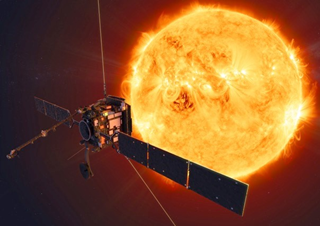
The instrument was powered on on February 24 by the SPICE team at RAL Space (UK). Over a four-week period, all mechanisms were tested, high voltage was applied to the detectors, and finally, the detector door and two outer doors were opened. The opening of these doors flooded the SPICE telescope with sunlight for the very first time, enabling the acquisition of the first spectra of our star on April 21.
Complete spectra across both of SPICE's wavelength bands were acquired using all four slits and various exposure times to verify the full range of the spectrometer's capabilities.
The observed spectral lines are emitted in the extreme ultraviolet by ions of various elements (hydrogen, carbon, oxygen, neon, sulfur, magnesium, and iron), providing critical data on the temperatures, densities, velocities, and plasma composition of the Sun's lower atmosphere.
According to Dr. Fludra from RAL Space and Principal Investigator for the instrument consortium, "SPICE is operating as expected—a resounding success for the entire international team led by RAL Space."
SPICE is one of 10 instruments aboard ESA's Solar Orbiter mission, which will help us understand how solar activity varies across its cycles and the resulting impacts on the solar wind—the stream of charged particles ejected from the Sun propagating throughout the solar system. The IAS team provided the SPICE diffraction grating and is responsible for instrument operations.